Travel is once again a terrorism-fueled nightmare for Idris Elba’s corporate hostage negotiator in Hijack, whose second season puts its protagonist Sam Nelson through a terrifying transit wringer.
George Kay and Jim Field Smith’s Apple TV+ series (January 14) does its best to mix up its straightforward formula by changing up its vehicular venue and doling out a few carefully calibrated twists. And in Elba, it boasts one of television’s most magnetic stars, capable of making even the stalest scenarios seem reasonably fresh. Nonetheless, there’s only so much the headliner can do to enliven a story that builds on its predecessor in predictable ways, and whose thrills, as before, are mitigated by an eight-episode, six-and-a-half-hour length that routinely dampens the action’s power.
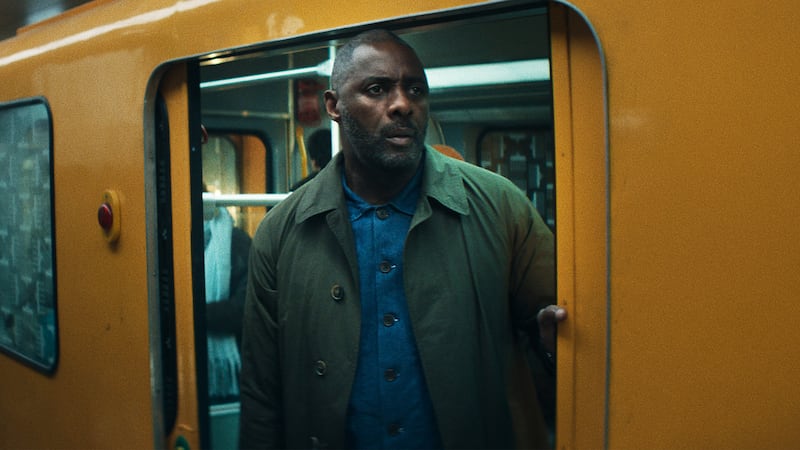
Having foiled Stuart’s (Neil Maskell) plot to commandeer a flight from Dubai to London, Sam arrives in Berlin to meet with Olivia (Clare-Hope Ashitey) at the British embassy, where he wants to discuss CCTV photos he’s received that suggest that Stuart’s boss John Bailey-Brown (Ian Burfield) is in the city. Sam wants to take down the criminal he blames for the airline hijacking and, also, for the murder of his son Kai—an incident that, bafflingly, has taken place off-screen in between the show’s two seasons. Olivia, however, is stood up by Sam, who instead boards a Berlin U-Bahn subway during the morning commute.
Sam’s anxiety is an immediate giveaway that all is not well, as is his brusqueness with Mei (Jasmine Bayes), a colleague who met him at a prior event and knows about his celebrated heroism. Weirder still, he immediately fingers an Arab backpacker as a possible threat, compelling two police officers to confront, and disembark with, the man.
[Warning: Minor spoilers ahead.]
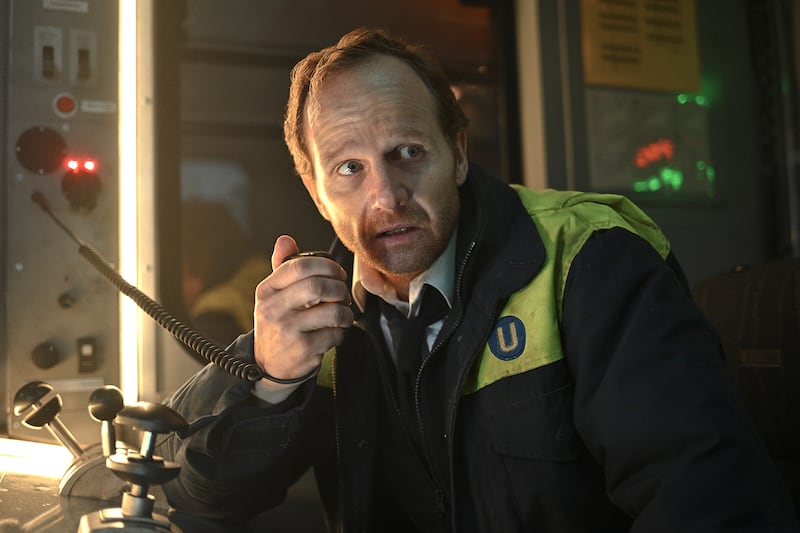
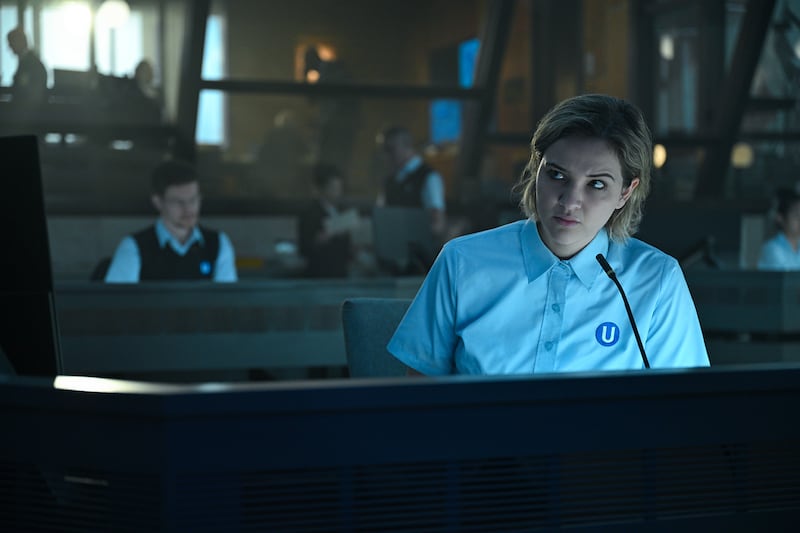
There’s something strange about this ride, and it’s not just Sam; the train’s driver, Otto (Christian Näthe), is a nervous wreck, to the point that he temporarily stops at a station to use the bathroom. Meanwhile, a class of adolescent students (accompanied by two teachers) joins a gaggle of commuters on the subway, and in the transit system’s control room, newbie Clara (Lisa Vicari) is put in charge of overseeing the line.
Hijack introduces a wealth of supporting characters who will inevitably factor into its ensuing drama, including a sketchy individual posing as a construction worker who sneaks into the underground tunnel as the police raid his apartment and discover materials for detonators. Yet before any of these players can reveal their true roles, Sam turns everything upside-down by doing the unthinkable: Using keys that he mysteriously possesses, he breaks into the driver’s cabin and informs Otto that he’s hijacking the train.
This is a bombshell that most will see coming or, at the very least, find less than stunning, since Hijack has no choice but to diverge in some fundamental way from Season 1. Still, if it won’t cause many jaws to hit the floor, it does raise intriguing questions that showrunners Kay and Smith cagily tease during the early going. The most pressing of those concerns Sam’s motivation for risking the lives of hundreds of innocent people. And he eventually provides an answer when he demands that John Bailey-Brown be found and brought to him.
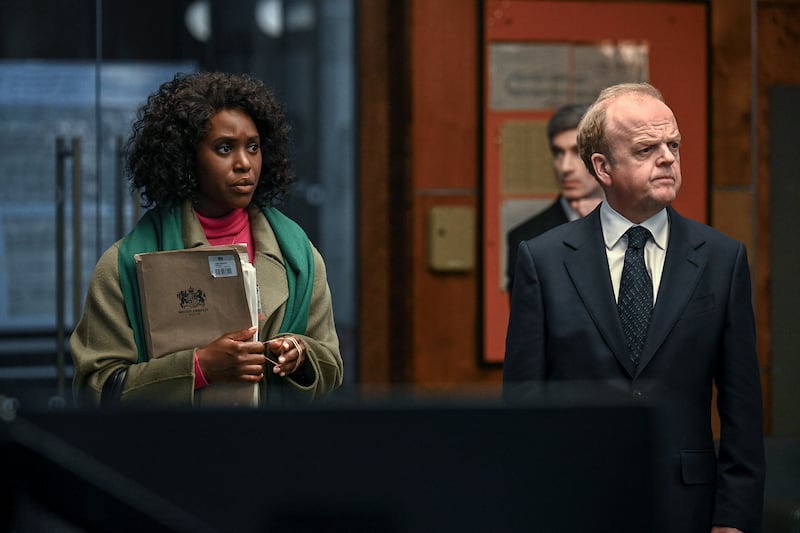
This is a big ask for police officer Winter (Christiane Paul), who’s put in charge of this calamity. And she gets little help from her second-in-command—who’s primarily around to stereotypically push her to take decisive violent measures against Sam—or from Peter Faber (Toby Jones), an enigmatic MI5 operative who appears out of nowhere to help manage this massive headache.
As is soon clear, Otto was aware of this hijacking ahead of time, and despite Sam’s gruff back-and-forths with Winter and company, he’s carrying out this crime under duress. This too is far from astonishing, given that from the get-go, Hijack intermittently cuts to Sam’s beloved ex-wife Marsha (Christine Adams) at a remote cabin in the woods, where she’s staying to cope with her grief on this, the anniversary of Kai’s death.
Between the two friendly randos who deliver her flowers, and the man watching her abode from a parked-at-a-distance SUV, there’s overwhelming reason to think that Marsha is in more danger than she realizes. In short order, Sam confesses to Otto and another passenger (who’s accidentally stumbled into the middle of this mess) that he’s not perpetrating this hijacking because he wants revenge against John Bailey-Brown for Kai’s slaying (which is what the authorities believe). Rather, he’s being blackmailed by evildoers who are going to execute Marsha if he doesn’t do as they request.
With these (and subsequent) developments, Hijack strives to pull the wool over viewers’ eyes. Its plotting, however, is hackneyed in conception and clumsy in execution, with every surprise easily foreseeable. Compounding matters, Sam’s inherent goodness negates the possibility of him turning homicidal, just as the distended runtime means that the majority of the proceedings’ incidents and insinuations—be it the notion that a dodgy passenger is a killer, or that heavily armed tactical units are going to storm the train and take out Sam—are destined to be fake-outs that conclude without genuine fireworks.
At no juncture does it feel like Sam is in real danger, or that any of the impediments in his path will stop him from reaching the end. Considering that virtually all of the other characters are uninteresting and inconsequential, the show simply putters along.
While Hijack’s feints are pretty feeble, Elba is as commanding as ever as the stalwart Sam, whose efforts to keep everyone alive require both pretending to be a baddie and taking daring risks that put him squarely in the police’s and villains’ crosshairs. Yet for all his quick-on-his-feet strategizing, he rarely uses the negotiating skills that are his calling card, and Kay and Smith give him almost no chances to demonstrate his badass action bona fides.
Sam is merely a bland do-gooder in a situation that’s both absurdly reminiscent of, and less compelling than, his previous outing, leaving Elba with the unenviable task of steering a thriller series that proves content to stay on the all-too-familiar tracks.