Grief is a force of both destruction and creation in Honey Bunch. Although it’s not as powerful as love—one of many surprising twists doled out by this unpredictable, unnerving, and altogether entrancing thriller.
For their sophomore feature following 2020’s Violation, directors Madeleine Sims-Fewer and Dusty Mancinelli channel ‘70s-era horror for a decidedly bizarre tale of a woman taken by her husband to a remote rural facility to recuperate from a brain injury that had previously left her in a coma.
A strange, hypnotic trip with style to burn and a habit of upending expectations, it’s an audacious indie—in theaters February 13 and co-starring The White Lotus’ Jason Isaacs in a disquietingly dynamic turn—that plumbs the depths of passion, loyalty, and sacrifice with beguiling earnestness and intensity.
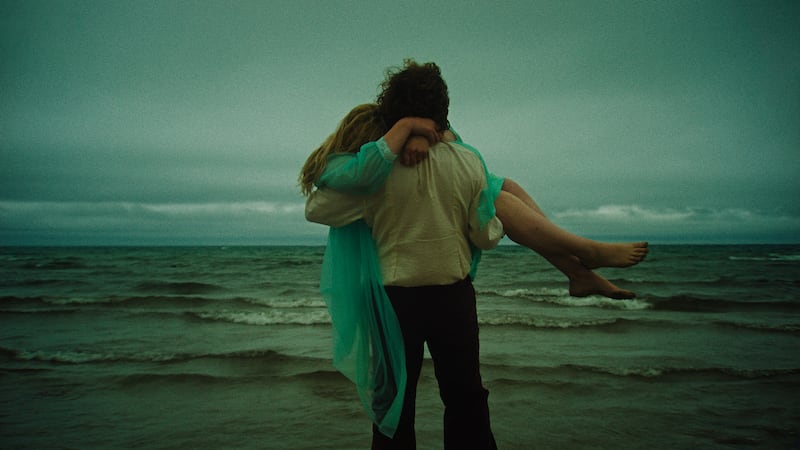
Under a gray sky, bookish Homer (Ben Petrie) stands on the beach behind his wheelchair-bound wife Diana (Grace Glowicki), whose sloped mouth and immobile condition imply that she’s suffered a debilitating accident. Gently, Homer carries Diana into the water—both fully clothed—and, as thunder cracks overhead, he tells her he loves her.
Before we see how this incident ends, Honey Bunch segues to an old station wagon—a first tip-off that this is the 1970s—driving on a road sandwiched by forest. At the wheel is Homer, and by his side is Diana, whose countenance doesn’t seem distorted like in the prior scene, and who wakes from a nap feeling “real foggy.”
Homer is taking Diana to an out-of-the-way trauma facility operated by Dr. Trephine (Patricia Tulasne), where she’ll receive groundbreaking treatment for her (ill-defined) ailments. Pulling up to the rustic house that will serve as her new home, Diana is apprehensive, though her fears are temporarily quelled by Homer quoting The Odyssey.
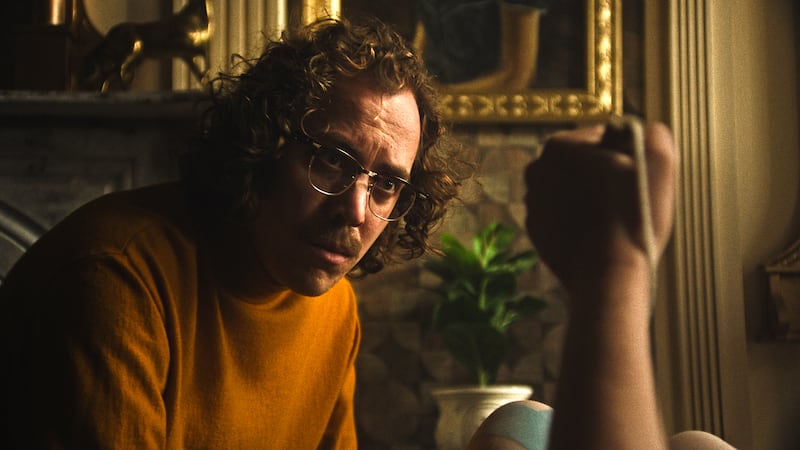
The mood conjured by Sims-Fewer and Mancinelli suggests that the young woman is destined for her own personal epic journey of self-discovery involving battles against nefarious forces, with the directors using an array of zooms into and out of close-ups—often reflecting Diana’s visual and auditory perspective—to generate gnawing unease.
Things quickly get uncanny for Diana, who’s subjected to “sensory stimulation theory” in which, with her bare feet surrounded by sugar glass, she’s bombarded with strobe lights.
The ethereal and unearthly sounds (and moans) of Andrea Boccadoro’s score (and a handful of period tunes) combine with cinematographer Adam Crosby’s alternately shadowy and sun-dappled visuals to cast Honey Bunch as an unreal fable—albeit about what, initially, it’s not apparent.
What is clear is that Diana’s mind is not wholly reliable, and her comment about how Farah reminds her of Rebecca’s Mrs. Danvers speaks, cannily, to the film’s fascination with unreliable memories.
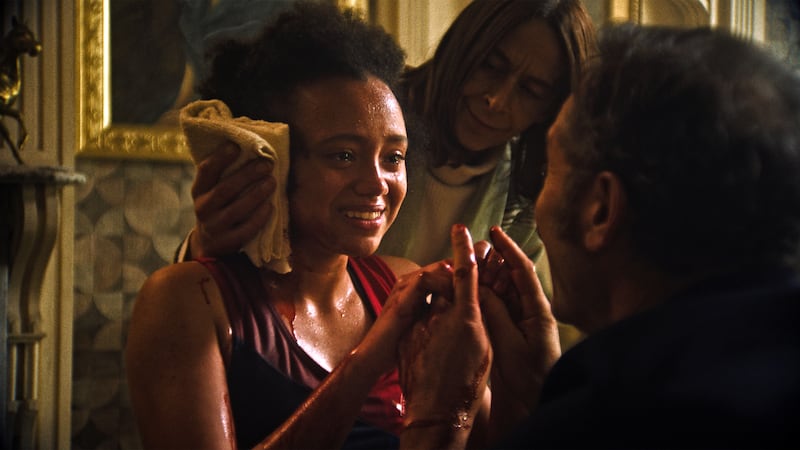
In this hallucinatory mix, Honey Bunch welcomes two new arrivals: Joseph (Isaacs) and his daughter Josephina (India Brown). This girl is also on the mend from an undisclosed infirmity, and Joseph’s love for his daughter (expressed by Isaacs with affecting fervor) is as profound and seemingly selfless as Homer’s is for Diana. And, additionally, as Dr. Trephine’s was for her late wife Joan, whose smiling portraits adorn the walls of every room.
Adoration is ubiquitous, to the point that everything feels oppressively claustrophobic and more than a touch unhinged.
Honey Bunch’s opening passages are laced with suggestive comments, but Sims-Fewer and Mancinelli don’t overdo it with the caginess, peppering their action with a number of frightening sights to go along with more languorous sequences, including Diana following a creepy stranger into the woods and locating Joan’s grave.
Better still, they don’t wait too long to reveal the first of their film’s bombshells; instead, they use it as a springboard for a descent into multiplicative madness, with doubling and tripling of images, themes, and motifs contributing to the stifling atmosphere.
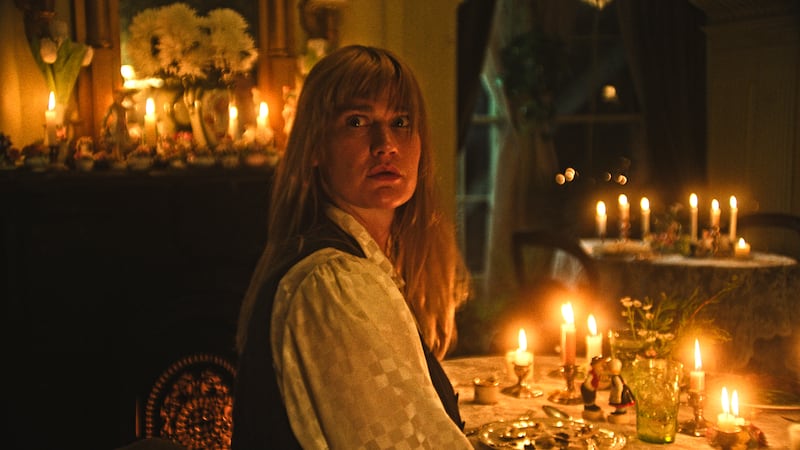
There’s a bit of Dario Argento and Lucio Fulci in Honey Bunch’s hothouse dreaminess, even as Sims-Fewer and Mancinelli largely sidestep violence, gore, and flamboyant supernatural mayhem to focus on Diana’s confusion and anxiety. The film’s big reveal recasts the material as a portrait of deranged, obsessive love.
Yet the directors have another trick up their sleeve that’s wholly related to Homer’s early denigration of the concept of “soulmates” and his belief that when a person finally sees every version of their partner and chooses to keep coming back for more, “that’s romance, baby.”
Devotion is the glue that holds people together in Honey Bunch, and despite the reality of her outrageous situation, Diana’s struggle is ultimately about understanding and coming to grips with that fact.
Amidst all the hidden documents, playfully combative flashbacks, and fiery outbursts, Sims-Fewer and Mancinelli’s latest roots itself in the eternal desire to hold onto that which one most cherishes—no matter the (financial, moral, spiritual) cost—and the simultaneous beauty and horror of that impulse.
There’s a fine line between kindness and cruelty, adulation and loathing, in this phantasmagoric affair, and it walks it deftly right up to a finale that, even at the end, keeps one guessing.