
Trauma is a ghost that haunts a young girl in Josephine, the sophomore feature of writer/director Beth de Araújo (Soft & Quiet), which captures a bracing sense of her protagonist’s headspace as she navigates a crisis she can’t possibly be expected to handle.
Both literally and figuratively assuming the perspective of 8-year-old Josephine (Mason Reeves), who strives to comprehend and come to terms with a crime she unwittingly witnesses, this intensely empathetic film—co-starring Channing Tatum and Gemma Chan—has a tendency to tip into strident affectation. But thanks to newcomer Reeves, it still lands more than its fair share of punches.
Josephine’s opening shot is from the POV of its title character as she battles her fears and runs beneath a garage door—at the urging of her competitive soccer-loving father Damien (Tatum)—before it closes. If this minor task is daunting, her subsequent ordeal is far scarier.
During an early-morning jog through a park, she sprints ahead of her dad and, alone, hears a woman screaming from a nearby public bathroom. As she watches from behind a tree, the individual (Syra McCarthy) emerges, as does the man who’s accosting her. Smashing her head against the ground, undressing her, and strangling her to keep her docile, this fiend proceeds to rape his semi-conscious victim. When he spies Josephine, he comes for her as well, only to run away upon Damien’s arrival.
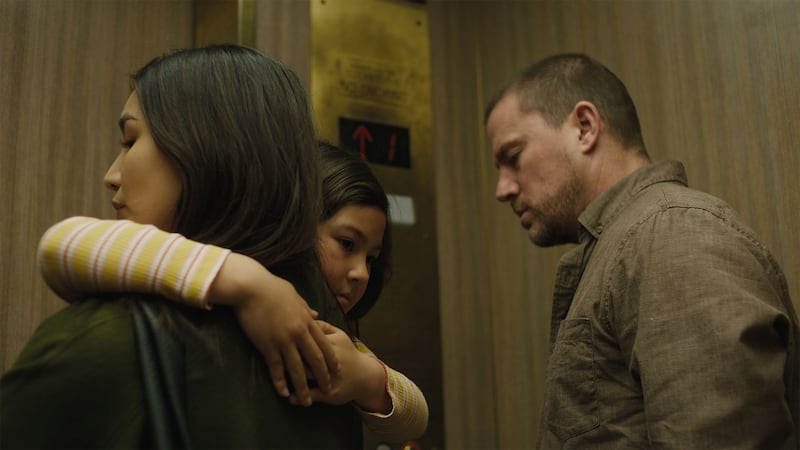
Josephine knows that what she’s seen is horrible. And yet, as a naïve second grader, she can barely process this assault. The immediate fallout from this ordeal isn’t any more comforting, with Damien and the police chasing after and catching the perp, Greg (Philip Ettinger), who stares down Damien with a fury that feels like a threat.
Sticking closely to her grade-school star, de Araújo evokes Josphine’s view of adults as overwhelmingly big and cold, be it a police officer who brusquely watches over her as Damien searches for the assailant, or the shellshocked victim who sits beside her in the backseat of a police cruiser, trembling and incapable of looking up. To the child, the world is intimidating and difficult to understand, and despite overhearing Damien and her mom Claire (Chan) say the word “rape,” and secretly looking it up on a phone, she remains deeply confused by this turn of events.
Collaborating with cinematographer Greta Zozula, de Araújo erases the space between her viewers and subject, and that proximity is a primary source of Josephine’s power. At school, Josephine begins to act out, and in response, Claire tries to take her to a psychologist. Alas, the girl, upset about missing soccer practice, flees the vehicle and races across San Francisco. Damien, whose closeness to his daughter is rooted in their love of sports, instead convinces Josephine to join a martial arts program, believing that teaching her self-defense is the surest way to make her tough enough to survive.
Between her mom’s strained attempts to foster a close, open-dialogue relationship, and her dad’s insensitive advocacy of strength and responsibility, Josephine is poorly served by her guardians. De Araújo’s script doesn’t conceive of its grown-ups as bad parents, but it does depict them as head-smackingly bad at parenting, confronting Josephine’s serious and escalating issues with one dumb statement, decision, and reaction after another.
That adults are frequently blind to their kids’ inner turmoil is inarguable, and Tatum and Chan do the best they can with what they’re given. Yet Damien and Claire are so incompetent that they seem to need basic child-rearing classes.
Because they keep failing her, Josephine quickly spirals into violence, taking her dad’s protect-yourself lessons too far during recess, and angrily accosting him when, after eavesdropping, she discovers him on top of her mom—a mistake that requires a sex-education talk that goes about as well as their other clumsy tactics.
All the while, Josephine is shadowed by the imaginary specter of Greg. Whether lurking motionless (and despondent) in the background of her day-to-day, or actively engaging her in her bedroom, he proves an unnerving manifestation of her terror, and his presence spurs her on to ever-more-hazardous courses of action.
Meeks’ stern, focused countenance suggests a maturity beyond her years. So do eyes that appear to be taking in (and trying to grasp) the marital and familial chaos swirling around her, not to mention legal proceedings that compel her to give statements to the authorities and to testify in court (which are sources of contention between her parents).
At the same time, the adolescent actress, in her screen debut, beautifully expresses her protagonist’s apprehension, bewilderment, and horror, and her turn is assured even in the face of narrative incidents that, however nerve-wracking, are frustrating byproducts of Damien and Claire’s refusal to respond with common sense to the obvious symptoms of her distress.

That Josephine is inspired by de Araújo’s own childhood experiences may imply that Damien and Claire’s ineptness is true to life. Yet that doesn’t make it dramatically convincing or tolerable, and the filmmaker’s decision to drench countless sequences in Miles Ross’s cascading and moaning score is less entrancing than repellent.
Couple that with intermittent use of look-at-me slow motion, and de Araújo’s aesthetics sometimes work at cross purposes with her intentions, offsetting the effectiveness of dreamy cutaways to snapshots of the heavily wooded park, which speak to Josephine’s inability to figuratively escape that fateful morning.
Fortunately, Josephine pushes through these showy gestures in later passages in which the title character is forced to figure out, on her own, a means of dealing with Damien’s hardness and hostility, Claire’s remoteness and cluelessness, and the scars left by Greg’s monstrousness.
In a climactic courtroom scene, Meeks’ kid learns that age isn’t a shield against the literal and figurative violence that women are asked to endure (including from other women), and her courage in the face of this ugliness is a testament to the resilience of youth.
On a beach with Damien, meanwhile, Josephine may bridge gaps and heal wounds by performing her father’s favorite facing-opposite-directions leg exercise, but as de Araújo subtly, poignantly illustrates in her film’s closing moments, this stirring girl now has her own back.