
If Ice Cube’s War of the Worlds taught us anything, it’s that watching people watch screens is an intolerable bore. Timur Bekmambetov’s Mercy, unfortunately, didn’t get the memo, spending 100 minutes depicting Chris Pratt strapped to a chair in a 2029 courtroom where an AI serves as judge, jury, and executioner.
An inert hybrid of Cube’s awful 2025 H.G. Wells adaptation and the “screenlife” trilogy of Unfriended, Searching, and Missing—all of which were produced by Bekmambetov—this high-tech thriller (Jan. 23, in theaters) asks as little of its audience as its stars, laying out clues to its mystery with a half-heartedness that breeds a deadly combination of frustration and enervation.
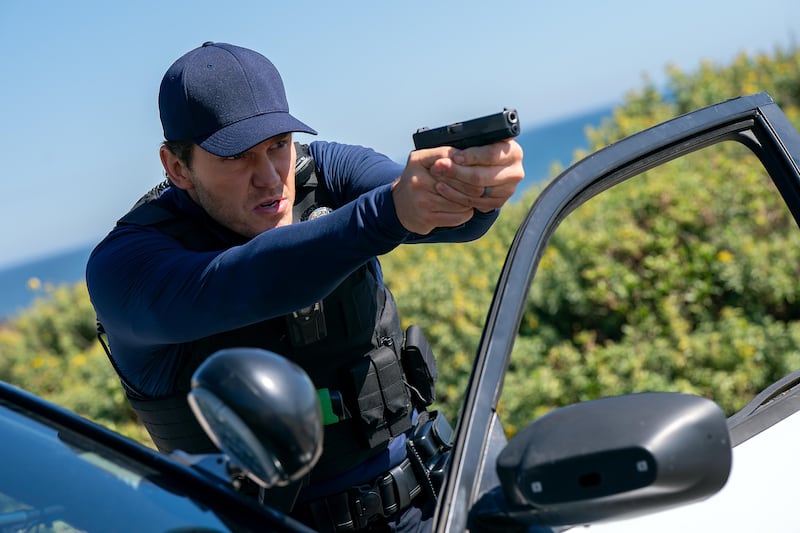
Designed in every way to make one bleary-eyed, it’s the new year’s dreariest, goofiest, and all-around dumbest film.
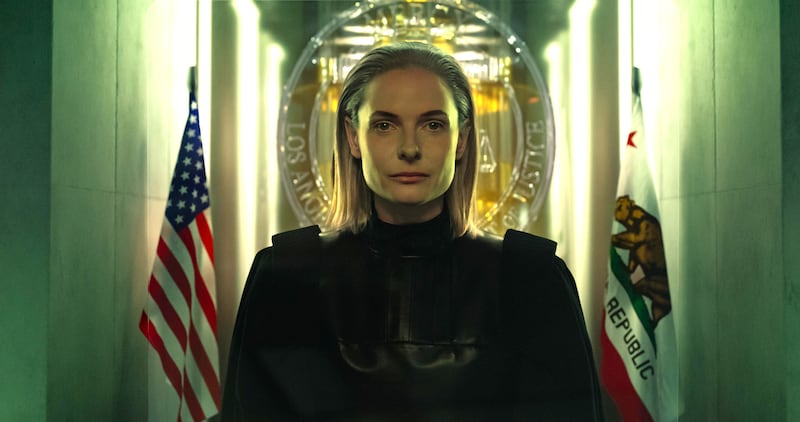
Detective Chris Raven (Pratt) awakens in a seat before a giant screen whose AI avatar Judge Maddox (Rebecca Ferguson) informs him that he’s been charged with the murder of his wife Nicole (Annabelle Wallis). This is Los Angeles’ cutting-edge Mercy court, where artificial intelligence uses all available digital evidence—including from the “public cloud” to which registered cell phones and devices connect—to determine innocence or guilt, with the latter verdict leading to immediate death courtesy of the accused’s chair’s sonic pulses.
As a rapid-fire intro elucidates, society has chosen to combat skyrocketing crime by turning to computers renowned for their peerless efficiency and perfection. Chris, however, isn’t of the opinion that Mercy is flawless, loudly and defiantly proclaiming that he didn’t kill Nicole.
Chris is a classic “wrong man,” and in Mercy he’s given 90 minutes by Maddox—complete with a ticking countdown clock, for maximum stress-inducement—to prove that he’s blameless.
Doggedly following the formula, Marco van Belle’s script makes it an initially arduous undertaking, presenting details that suggest Chris committed the crime and simply doesn’t remember it. Or, perhaps, is cannily lying to save his hide!
Using an array of video footage from bodycams, surveillance cameras, social media, news broadcasts, and other sources, Maddox explains the case against the decorated cop. Nicole was found fatally stabbed in her kitchen shortly after Chris’ early morning visit to the house, during which things got heated; he then went to a bar and got hammered, leading to a fight with cops; Nicole’s blood was found on his clothes; and there’s no sign of anyone else entering or exiting the house at the time of the slaying.
Chris’s alcoholism (and recovery) is an additional problem for the defendant, although Mercy doesn’t grapple with them skillfully. There’s at least one giant plot hole related to these facts that goes unresolved to the end.
Because of this mountain of damning material, Maddox contends that there’s a 97.5 percent chance that Chris offed his spouse, and she grants him an hour-and-a-half to lower that percentage below the 92 percent guilty threshold. What this means in practice, alas, is that Chris frantically questions his buddies and scrutinizes on-screen material in the hope of spying something out of place. The film encourages viewers to do likewise, but the game it’s playing is rigged, with bombshells emerging out of nowhere and Chris diligently concocting an alternate story that points the finger at a third party.
Ferguson is only seen from the neck up and carries herself with the calm, composed arrogance of a program that’s convinced it’s irreproachable and will locate the truth by following the rules and the copious evidence at hand. Yet uninterested in just having Maddox be a cold, emotionless robo-judge, Mercy repeatedly has her exhibit flashes of humanity.
Flip-flopping between harshly assessing Chris’ borderline-non-existent chances of clearing his name and not-so-subtly helping him with his exoneration efforts, Ferguson’s AI is unconvincing and, to a large extent, ridiculous—never more so than when a revelation so impresses her, she almost raises her eyebrows as if to silently say, “Oh really? Well played!”
Ferguson is too good to be relegated to a 21st-century Max Headroom, whereas Pratt is comfortable being an unjustly indicted, maddeningly bland guy in Mercy. Chris, it turns out, was the poster child for Mercy, having arrested the first man to be tried and executed by the system, and he thus finds it ironic that he’s now in its proverbial hot seat.
Regardless of the proof trotted out by Maddox, however, he’s plainly not homicidal. Consequently, director Bekmambetov’s drama—in which Chris calls his distraught daughter Britt (Kylie Rogers), pal Rob (Chris Sullivan), and cop friend Jaq (Kali Reis) as part of his defense—is severely hampered by a shortage of surprises. It’s simply a matter of time before Chris figures out what’s actually occurred, and given his deadline for doing so, his early sleuthing is bound to come up short, thereby transforming the film’s first half into sluggish setup and padding.

Mercy is an inherently static affair that, save for reaction shots of Pratt looking harried, angry, and laser-focused, takes place entirely on Maddox’s screen, and all the whooshing about between digital windows, folders, documents, photographs, and videos is a lame replacement for genuine physical and spatial movement.
On a couple of occasions, Maddox magically envelops Chris in immersive 360-degree holographic projections, situating him inside the action, but the effect is gimmicky and corny. Worse, despite existing on, and being about, screens, the film has nothing to say about this dynamic (and the act of movie-watching). Rather, its sole concern is the reliability (or lack thereof) of machines, especially when it comes matters of life and death.
This is a debate that can only go one way, and Mercy doesn’t pretend otherwise, foreshadowing its finale with a scene in which Maddox goes on the fritz after hearing about Chris’s “gut instincts,” which don’t compute in her ultra-rational mind.
There are just a few potential suspects, and it’s not difficult to deduce which are real and which are red herrings. A late twist affords merely one more opportunity to sigh and roll one’s eyes at the neat-and-tidy nature of this enterprise. Devoid of loose ends, it’s a puzzle that fits together so seamlessly that it feels like it was written by the very technology it views with intense skepticism.