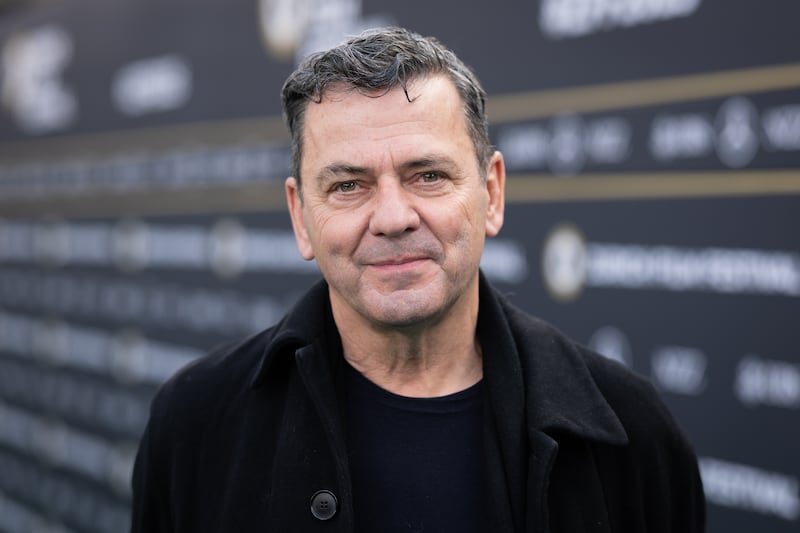
For the past 25 years, in heralded films like Barbara, Phoenix, and Transit, acclaimed German director Christian Petzold has charted the boundary between the living and the dead, the real and the unreal. The auteur continues devising new ways to traverse that liminal space with Miroirs No. 3—an early contender for the best film of the year.
Another of Petzold’s masterful tales about ghosts, transitions, and the links between then and now, the drama—which premiered at the Cannes Film Festival, and arrives in U.S. theaters on March 20—is a haunting story about Laura (Paula Beer), who in the wake of a car accident that kills her boyfriend comes to reside with a stranger, Betty (Barbara Auer).
This is an odd pairing, and made odder by the fact that the longer the two cohabitate, the more it becomes clear that Betty believes her guest is, for all intents and purposes, her dead daughter.
Betty’s conviction isn’t shared by her husband (Matthias Brandt) and son (Enno Trebs), who operate a local garage, and she never shares it outright with Laura. Instead, she cautiously grows closer to the young woman as she recuperates. Laura, for her part, finds herself drawn to Betty and her rural home, and Miroirs No. 3 proceeds at a dreamy pace in which the characters’ closeness is countered by visual compositions that highlight their separation.
Petzold’s tale is about people who are caught between two realities and unsure how to unite them, and it’s highlighted by a superb lead performance Beer, who in her fourth consecutive collaboration with the director—this on the heels of Petzold making six films with former favorite leading lady Nina Hoss—is an enthrallingly enigmatic specter coasting through a life that may not be her own.
Named for Ravel’s sorrowfully lyrical classical music suite, Miroirs No. 3 is an enchanting saga about identity, family, and the lingering presence of the departed, and for Petzold, it’s the latest in a long line of triumphs.
There are few contemporary filmmakers working on his level, and thus it was an honor to sit down with him ahead of the film’s release to talk about ghosts, the lure of Hollywood, and what makes his and Beer’s partnership so special.
Miroirs No. 3 is, to a certain extent, another of your ghost stories. What is it about ghosts—and doppelgängers—that so fascinates you?
That’s a good question, because I never start to write a script with this intent or target. I think there are some movies in my life that open doors for me. The first movie, when I was eight or nine years old, was Nosferatu by [F.W.] Murnau. I was really shocked by this movie.
There’s one scene in which the guy who’s visiting Nosferatu in his castle, it’s evening, and he’s standing there in front of the bridge, and the stagecoach is coming. He gets in the stagecoach, the stagecoach is very fast going directly to the castle, and he goes over the bridge into something unheimlich (i.e., uncanny), and the ghosts are coming right at him. For me, it’s a typical German thing to think that there must be a bridge, and behind the bridge, something is happening. This, for me, has something to do with cinema. You go to the cinema, you’re sitting there, your body is here, but your mind is going away, and you are passing over a bridge.
Therefore, I think I’m a little bit infected by ghosts and mirrors. And the other thing was, I heard this song, “Miroirs No. 3,” while we were making Afire. On the 15th day of shooting, I felt that all the actors were getting into a melancholic mood. I said, I have a new script in my mind. “Tell us,” Paula Beer said. At this time, I heard this Ravel piano piece, and so I said the film is about a young girl who has a crisis and she’s coming to people who are traumatized, and they give her a wrong identity, but this wrong identity is something that cures her. This was the idea, and they were interested. But I had to improve it—I had nothing! [laughs]
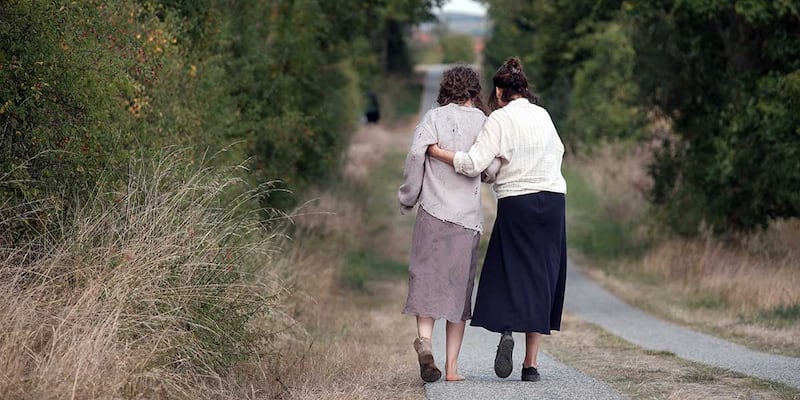
How does the idea of mirrors factor into the film?
I knew that, because I mentioned Ravel and “Miroirs No. 3,” the mirror has something to do with the thing I told them. That you are standing in front of the mirror. There are so many movies where actors stand in front of a mirror and say, “Who am I?” and smash the mirror and all these things [laughs]. I said, I want to make a movie without any mirrors. But the whole situation is the mirror. She knows that she’s standing in front of a mirror, and behind the mirror there is a dead daughter staring at her. It also has something to do with Jean Cocteau; the mirror is the entrance into the world of the dead.
I told so many things to the actors, they were a little confused. But I know all these themes and subjects are in many of my movies, because I had a retrospective in Paris, and I said, oh my God, so many! Yella has a second life and Vertigo themes everywhere [laughs]. I always have the feeling I’ve made something special and new, but it all depends on the same bridge I crossed.
Where does a story start? Is it with a character? The plot? A theme? Or an emotion?
In most cases, it’s a very small situation. In Miroirs, I’m now older than 60, so there aren’t many parties anymore. But one-and-a-half years ago, I was invited to a party, and the German parties are always like, there’s a living room with a DJ and the old people are in the kitchen. So I was in the kitchen near the refrigerator, where the cold beer and white wine was, and I heard a conversation. The first sentence of the conversation was, “What are you doing?” I realized, it’s always like that—when you meet someone, your identity is your work. I thought, it must be fantastic to meet someone who doesn’t ask you that.
At the same time, during COVID, there were no clubs, no theatres, and even today, many have traumatic depressions. I thought, one of these girls, a young female student, she can’t smell anymore, she can’t taste anymore, she doesn’t see anyone anymore—this is depression. And she’s born in a car accident. Someone comes over and they never ask her, where are you from? Who’s your father? What is your profession? They just provide elementary things—here is a bed, here is a coffee, here are clothes, you can learn to paint a fence, here are herbs you can taste. It’s a reeducation with someone who lost someone else. This young girl, Laura, she knows there is another name, but it’s okay because she now has a new life. Wrong identity, but better than nothing.
Despite its similarities to your past work, the film is different in that it concerns family. What made you want to focus on that subject?
When [filmmaker] Harun Farocki and I worked together, until his death, we had some subjects written down. One was how groups (like, for example, unions), or couples, or families live. We had a professor at this time who said, you have to make movies that, in 25 or 30 years, will immediately let people feel and know how you, in this time, kissed, looked at each other, and so on. I thought I had this problem, because it’s very hard to make a movie about families because you have so many points of view.
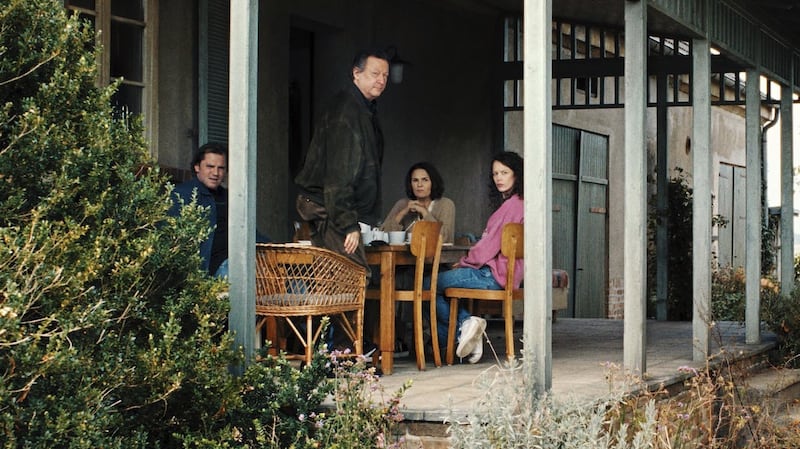
I learned many, many things about cinema from watching courtroom movies, because you have a judge, you have the audience, you have the lawyers, and you have to make a decision about your camera position. What is the axis? What is this movie about, and from which position am I telling this story? It’s a little bit like in a family. You have a father, son, daughters, and they’re sitting around the dinner table, which is something that goes back to Jesus. Leonardo Da Vinci’s “The Last Supper,” it’s very cheap, because they’re all sitting in a half pipe rather than facing each other. In very bad movies, you’re filming a family like Leonardo Da Vinci [laughs].
Family is between people, so you have to think about what is happening between; what is under the surface. Because it was so complicated, I had a fear about making a family movie. So many of my movies are about couples, but when I made Afire, I had situations at the table outside, and it was a little bit like a family. That told me, I can do this. I was really relieved.
In the wake of Undine (water) and Afire (fire), Miroirs No. 3 begs to be read as the conclusion to an “elements” trilogy. Is that how you imagined it? And if so, what element is this film?
Harun always said when we finished a movie, it was fitting to go on holiday, and this is a bad feeling, because you have to think about the next movie. Each movie opens the door to another one, and you have to pass through the door. But when we made Undine, I didn’t have the idea. Still, with a journalist, I told them this is the beginning of a trilogy, to put pressure on myself. That pressure then gave me an idea: fire, the forest fires, the climate catastrophe. So that was Afire.
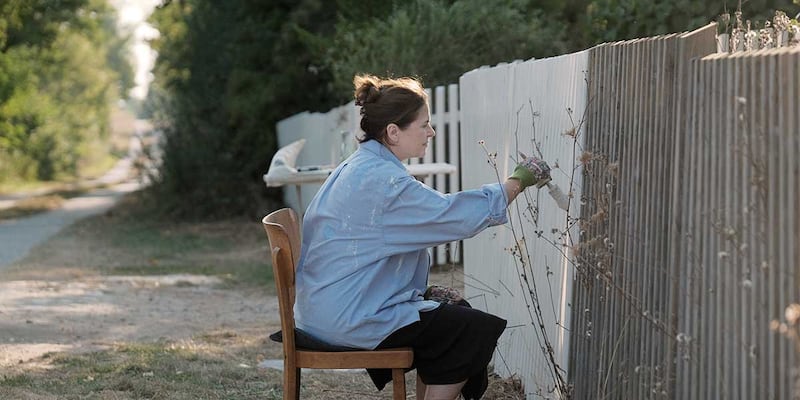
For this movie, I haven’t got an element. But on the 10th day of shooting, when we started shooting outside on the porch and near the fence, there was a strong wind the whole time. Barbara Auer said, hey, this is the third element: wind. For her, it was a joke, but it gave me an idea. At the beginning of the shoot, I thought, this is a Western movie, because Western movies are very simple and clear, but very complex at the same moment. When Barbara said this about the wind, I thought about the wind in Westerns, which have two reasons.
First, the wind blows through ruins—abandoned ranches, stagecoaches with dead bodies—and this is the wind of death. But on the other side, you have movies where the wind refreshes the world. People open the window and the dust goes out and there’s new life. This movie is about a house, like in Westerns, and it’s a ruin where things—and people—don’t work anymore. And on the other side is this young woman bringing the wind inside to refresh something. So in that way, it’s the third part.
How did Ravel inspire the film?
In the past, I was a DJ, and I knew everything about pop music. Nowadays, I just listen to classical music. I loved this piano work, and I thought about it because it’s a little like the cinema. You have a theme, and then something completely out of the structure appears and is working, and then you come back to the theme, but it’s changed a little bit. That reminded me of [Michelangelo] Antonioni’s L’Avventura, when Monica Vitti searches for a woman who’s vanished. She arrives in a village, there are some guys on the street sitting in the sun and their motorbikes are there, and two years later, Vitti is in the same village with the guy, and the same guys and motorbikes are there, but something has changed a little bit.
I spoke to the actors, who are really intelligent—sometimes it’s good to have intelligent actors, sometimes it’s a pain in the ass [laughs]—and they understood it completely. The scenes are like a mirror; we doubled the scenes so she does things two times. But the difference between the two scenes is the story. I didn’t want to have a score in the movie because the whole movie is music.
This is your fourth straight movie with Paula Beer, and before that, you made six movies with Nina Hoss. What is it about Paula that appeals to you? And what is it that you like about these long collaborations? Is it the challenge of working with the same person, but doing something different each time?
Yes, I think this is the thing with Nina. We collaborated for 10 years with six movies, and sometimes the collaboration has to renew itself. We are waiting for this. I’m sure that in three years, I will make a movie with Paula and Nina, but they don’t know this...
They will now!
Nina comes from the stage, and she’s very intellectual, she knows everything. I saw Frantz by [French film director] François Ozon, and he showed me rushes of Paula, and she’s like a dancer. She was never on stage; she comes from another background. I thought, she could be another kind of someone I want to follow. Now I think, perhaps, I can put them together, but I must think about it.
We’ve been talking about the way in which stories come from other stories. Now that you’ve finished Miroirs No. 3, do you have other projects already lined up?
Yes, we start shooting soon, but it’s not for cinema; it’s a television crime story. I love it, and it’s also 90 minutes—it’s the same type of work, but I don’t have to go to festivals [laughs]. After that, the next two movies are for the cinema, but the scripts are not ready. One treatment is 40 pages, and the other is 10 pages, and the second one is with Nina and Paula together.
It’s about Chekhov’s The Cherry Orchard, about this theater which is out of money, and it’s sold to a guy who wants to make a musical theater, a Starlight Express-like thing, and throw all these actors out, and they fight against this. So it’s there.