
(Warning: Spoilers ahead.)
Rhea Seehorn doesn’t know what is going to happen with the atom bomb that Carol brings home in the last scene of the Pluribus first season finale. It sure is an explosive breakup gift.
Still, the star of 2025’s most thought-provoking new TV show has plenty to say about the catalyst behind Carol hightailing it back to Albuquerque from a romantic winter wonderland with Zosia (Karolina Wydra) to save the world with the uninfected Manousos (Carlos-Manuel Vesga).
In the Apple TV sci-fi series from creator Vince Gilligan, less than 100 days have passed since an extraterrestrial signal connected the world’s population via “psychic glue.” However, the hive mind is making significant leaps in its attempts to turn 13 uninfected humans. In fact, this number is down to an even dozen, as one person voluntarily joins the global majority in the finale.
While the Others need explicit consent to remove stem cells from the remaining individuals to tailor a special version of the virus to join the hive, Carol did not account for the eggs she previously froze when she was considering having children with Helen (Miriam Shor). Surely they wouldn’t use this option. Right?
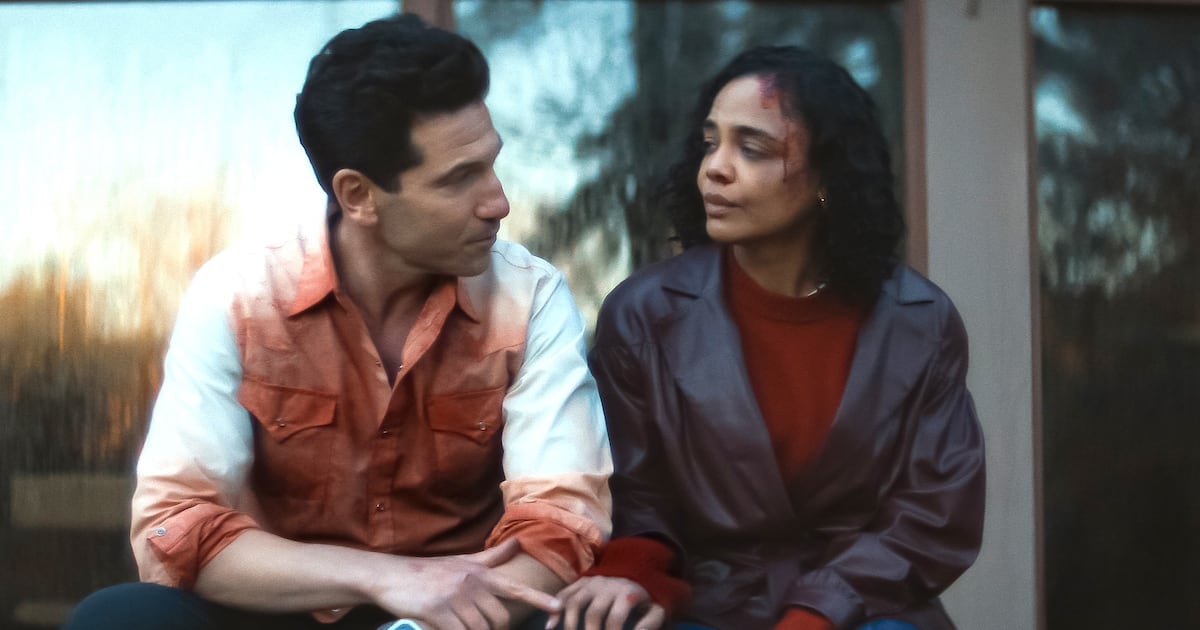
After initially pushing back against the Others, Carol has come around to co-existing. Okay, it is much more than stopping to say hello. Zosia has gone from a designated companion role to lover. That is, until she discovers that her eggs do not fall under the same agreement as the stem cells in her body. In fact, the hive is already working to source the materials needed to make Carol one of them.
“I was like, ‘Holy smokes! The betrayal, the horrible, rude awakening of, I am an idiot for thinking even for five seconds that any of this was sincere,” Seehorn tells The Daily Beast’s Obsessed. “While her [Wydra] character is still trying to argue it’s totally sincere, how much we love you; we just still have this imperative. We’re still going to do what we’re going to do.”
In the jam-packed finale, Carol initially chooses to go after the girl rather than put the world back to the way it was. After crossing the line and becoming intimate with Zosia in the penultimate episode, Carol leaves her home when the Others have another mass exodus from Albuquerque.
Much like Carol, Manousos is seen as too much of a threat when his experiments to find a cure result in the violent shaking Carol is all too familiar with. Instead of living in a city with a population of two, Carol goes on a globe-hopping series of dates with Zosia. It looks like paradise, but as with everything else in Pluribus, there are limits.
To an extent, Carol is being willfully ignorant of Zosia’s pre-Joing past. Take the careful way Carol dances around the pronouns of Zosia’s previous significant relationship.

“I think Carol specifically doesn’t ask. There is still a part of Carol that is not deep in the delusions that doesn’t want to know that answer,” says Seehorn. Instead, she sits by the pool reading while Zosia swims, takes long walks together on a gorgeous, picture-perfect beach, and snuggles up in a snowy setting.
Despite the unique circumstances, Carol also resorts to playing the ex-game, even if it is only vague questions about Zosia’s love life.
“You could call it pathetic, you could call it petty, and sometimes you just call it very, very human, that she can’t stop picking at it,” says Seehorn. “But she knows enough to not ask the gender, because it would open up this box of saying, ‘Maybe what you have with me is not sincere or real.”
Before this dance around the truth, Carol’s envy rears its head as she feels hurt when Zosia says she loves Manousos equally to how she loves Carol. “We had some fun conversations on set of like, ‘What is it that makes if people truly loved you in every way that you’d want to be loved 100 percent, they just simply loved others the exact same amount. Why does that make the love for you less? Why do we want to be loved uniquely?”
Pluribus scratches at illimitable identity and existential itches. One recurring theme is the intrinsic link between art and the human experience. I tell Seehorn that Better Call Saul—her first collaboration with Gilligan—helped me through a period of ill health. Seehorn’s character Kim Wexler is as essential to me as the Golden Girls are to Carol. “It was one of many things that came up with the show, as I’m hearing is happening to a lot of people. It brings up a lot of feelings, a lot of thoughts, a lot of questions,” she says.
Carol’s jealousy and pettiness are as much a part of being human as the art we find solace in. From her sitcom comfort watch to replacing the Georgia O’Keeffe print with the real thing, these bonds are evident. The latter is also a reminder of Helen.
“I constantly want Helen—until Carol, very, very broken and severely living in a delusion—played by the brilliant Miriam Shor, to be present. Because it hasn’t been that long since she died,” she says. Leaving Albuquerque with Zosia puts blinders on to every bad thing that has happened since the Joining and even before.
When Manousos sweeps Carol’s home to ensure they are not being surveilled, he discovers a device in the liquor cabinet. But the Others didn’t put it there; Helen did. The tracker recorded whenever the door was opened, which Carol learns was during the time they were freezing her eggs.
As with other aspects of Pluribus, this storyline, from Helen’s secret surveillance to what the Others are now doing, can’t help but draw real-world thematic connections. In this case, bodily autonomy and reproductive rights, even if this isn’t Gilligan’s creative intent.
“I like hearing your takeaway about bodily autonomy. The show, in general, Vince doesn’t write to a theme, to a topic, to preach a certain thing,” says Seehorn. “He’s writing about human nature, but he lives in the world that we live in, so it’s touching all these chords in people.”
It is not the subtext of the scene, nor is Seehorn playing it that way. Still, there are other layers regarding the betrayal: “The bodily autonomy part, I think for me, was more ‘These eggs represented a future I was hoping to have with my wife, that it’s your [the Others] fault she’s dead.’ I now know that my wife was worried that I wasn’t even going to be able to have healthy eggs because I was drinking too much, which was also horrific.”
Carol’s traumatic adolescent experience at a conversion camp came up earlier in the season, highlighting why she has a strong reaction to the Others’ indoctrination.
“Religious zealotry was another thing that came up when I was thinking about the scene of people who sincerely love you but honestly think that you’d be happier if you would just follow the belief system that they have,” says Seehorn. “For Carol, it couldn’t be worse to be confronted with this particular type of betrayal.”
How did Seehorn react to the finale twists and turns? Rather than get advance notice of storylines, Seehorn and Wydra found out the egg reveal at the same time: “You’ll have to ask Karolina, but I remember she and I spoke as soon as we got that script, and she was like, ‘I did what?!’ [I was like] ‘Yes, you did, you did it!”
As with the build-up to Carol and Zosia’s first kiss, this pivotal interaction took time to find the scene’s tone.
“We did it many, many, many, many times, because there are such small nuances of when Carol is catching on and when she starts to unravel a thread,” she says. Similarly, they explored how “obsequious” Zosia could be. “If you get too neutral with it, it can also look sinister. She has to care about my feelings,” says Seehorn.
Seehorn says they did some takes where Carol “fell apart, almost pleading with her.” Carol isn’t just losing the love she perceives; she is terrified that the clock is ticking on how long she has before the hive successfully extracts stem cells. Ultimately, the final cut of the scene directed by Gordon Smith fits with Carol’s trajectory: “I noticed that they went with a take from a series of takes where Carol is shutting down in that moment, ‘I will not be vulnerable with you anymore,’ even with how much she’s rumbling inside.”
No matter how much Zosia has been saying “I,” she is still a “we;” the hive comes first. Ditto for Carol protecting her free will. In the final scene, Carol returns home to Albuquerque to collaborate with Manousos to put the world back to the way it was. While Carol was vacationing, Manousos had made progress working on the theory that the cure is linked to the body’s electric circuit.
How the atom bomb that Carol returns with factors in is up in the air (“I can tell you that I don’t know,” says Seehorn). As is, how Carol will interact with Zosia going forward. She certainly won’t share her heart again anytime soon, but she still has a trusted companion.

“Both Carol and Kim [Wexler], while they are pretty polar opposite as characters, they often have the audience as their greatest confidant,” Seehorn says. “The audience knows what I am suppressing, not letting the person in the scene with me see, which is a really fun relationship to have with the viewer.”
Not every answer is forthcoming in the Pluribus finale, but the bond between Carol and us remains unbroken.