Grammy-winning singer-songwriter Chappell Roan has walked back a post calling late actress Brigitte Bardot her “inspiration.”
The outspoken Gen Z pop star, 27, rose to fame with hits “Hot to Go,” “Good Luck, Babe!,” and “Pink Pony Club,” and one song which she said was inspired by Bardot.
Roan won Best New Artist at the 2025 Grammys, delivering an impassioned speech about healthcare reform, livable wages for working musicians, and visibility for trans people.
But now she has been tripped up by reacting to Bardot’s death on Sunday by praising her for being an inspiration—despite the French actress’s long history of far-right views.
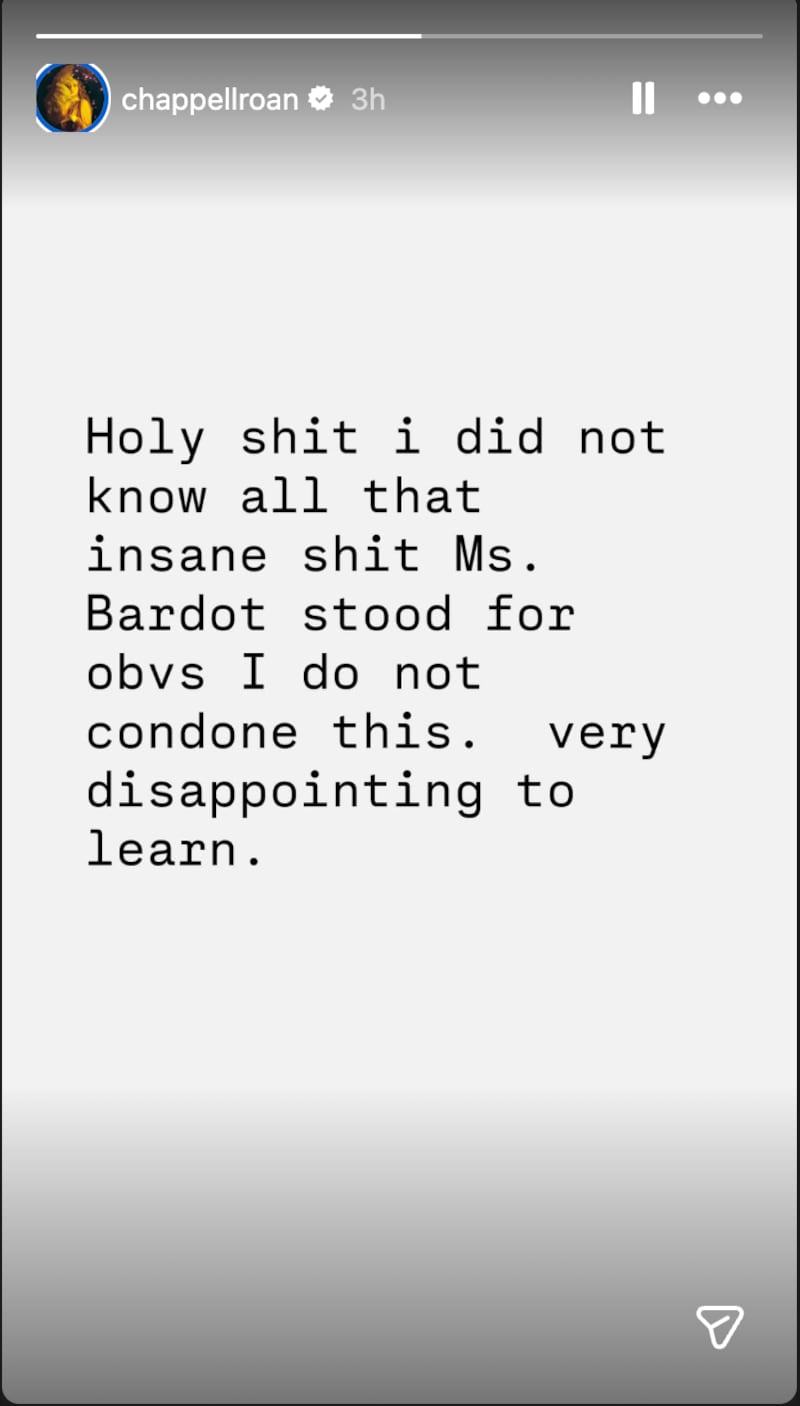
That prompted Roan to apologize on Monday, with a follow-up post on her social media. “Holy s--t, I did not know all that insane s--t Ms. Bardot stood for.” She added, “I do not condone this. Very disappointing to learn.”

Bardot’s organization announced that she had died at the age of 91, without specifying how or when. Roan, whose popular song “Red Wine Supernova” names Bardot, wrote on Instagram over the weekend, “Rest in peace Ms. Bardot. She was my inspiration for ‘Red Wine Supernova.’”

But Roan and her producers appeared not to have realized that after retiring from acting, Bardot had been convicted and fined five times for “inciting racial hatred.” She repeatedly declared that Muslims were “invading,” “overpopulating,” and “destroying” France, in comments which were widely reported on in both French and English.
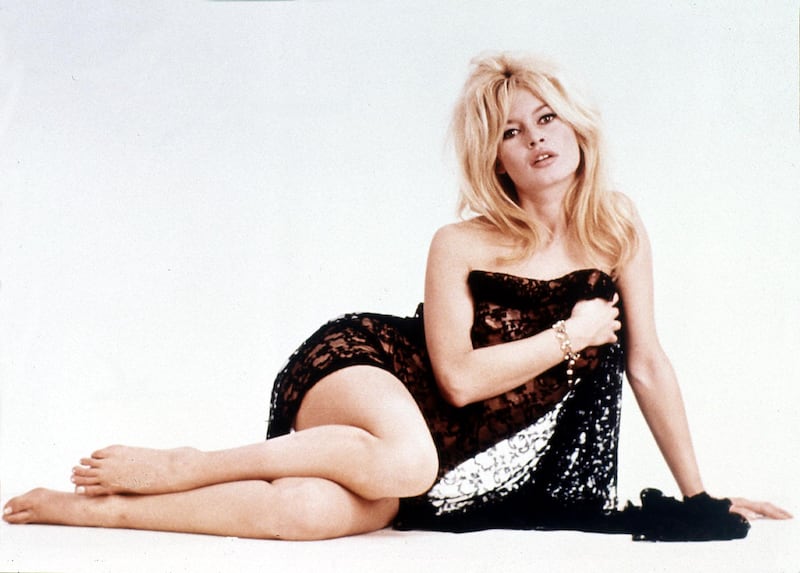
Her final marriage was to Bernard d’Ormale, a former adviser to the extreme right politician Jean-Marie Le Pen, whose long leadership of the French National Front was accompanied by downplaying the Holocaust and, eventually, being fined for what he said.
Bardot linked her far-right views to her activism for animals, something which she had quit acting to pursue. But by 2003, she was writing a book, Un cri dans le silence (A Scream in the Silence), which directed abuse at gay men, women in politics, interracial marriages and Islam while praising those who had—in her telling—given their lives in previous generations to repel invaders.
In 2019, she referred to the indigenous people of the French Pacific island of Réunion as “savages,” earning her a fine two years later in a French court of close to $20,000. She had also derided the French version of MeToo, accusing actresses who alleged misconduct by men of being “hypocritical, ridiculous, uninteresting.”
While Bardot’s incendiary commentary may have been a blind spot for Roan, it was not for French newspaper Le Monde, which remembered Bardot’s “advocacy for animals went hand in hand with her Islamophobia.”
The publication also noted that “Bardot remained, for three decades, an exception in French culture—the only celebrity to openly defend the far right.”