
Welcome to UNMISSABLE, the Daily Beast’s Obsessed’s guide to the one thing you need to watch today. Whether it’s the most gripping streaming show, the most hilarious comedy, the movie which you’ll never forget, or the deliciously catty reality TV meltdown, we bring you the real must-see of the day—every day.
Had they asked anyone, the answer would have been, “That’s ridiculous!” A group of middle-aged women, devoid of musical experience, forming a punk band? Preposterous.
So?
Past the stage where other people’s opinions influence them, it’s time for these women to do more of what they want—if they only knew what that was.
The heroines of Riot Women have fulfilled the usual obligations of marriage, child-rearing, and jobs. But now marriages have ended, children have grown (some are launched, others may never be), and they’re not ready to be in God’s waiting room just yet.
Premiering on BritBox Jan. 14, the series has already been renewed for a second season, given its successful run in the U.K. Had this been made as a sitcom, it would have been cutesy; in other hands, it might have been mawkish. Instead, it’s a raw, funny, sometimes devastating drama, with lightness threaded throughout.

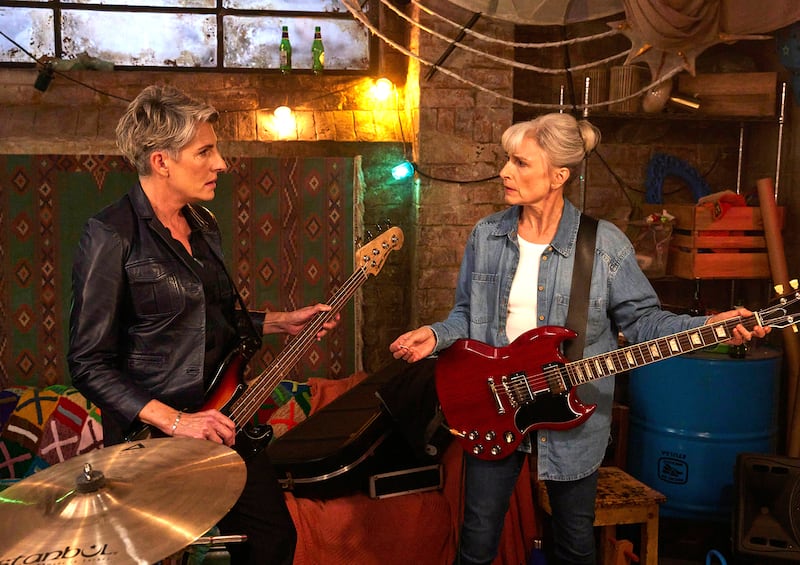
Jess (Lorraine Ashbourne, Bridgerton) wants to enter a local talent show in her West Yorkshire village. A pub owner, she’s tough and deals with the ongoing nonsense of her adult daughter, who acts like a petulant teen. Privately, Jess taught herself how to play the drums, as did creator, writer, and director Sally Wainwright.
“I learned to play the drums as research to see how realistic it would be that five women could enter a talent contest as a joke,” Wainwright (Happy Valley, Gentleman Jack) says before dinner at a midtown Manhattan hotel.
Once she mastered playing chopsticks, Wainwright bought drumsticks and a practice pad and found online classes.
“And then it did occur to me that I could actually afford to buy a proper drum set,” says the BAFTA winner and creator of Last Tango in Halifax, which was inspired by her mother’s experiences. “Well, now I’m 60, so I did. I went out, and I started getting lessons.”
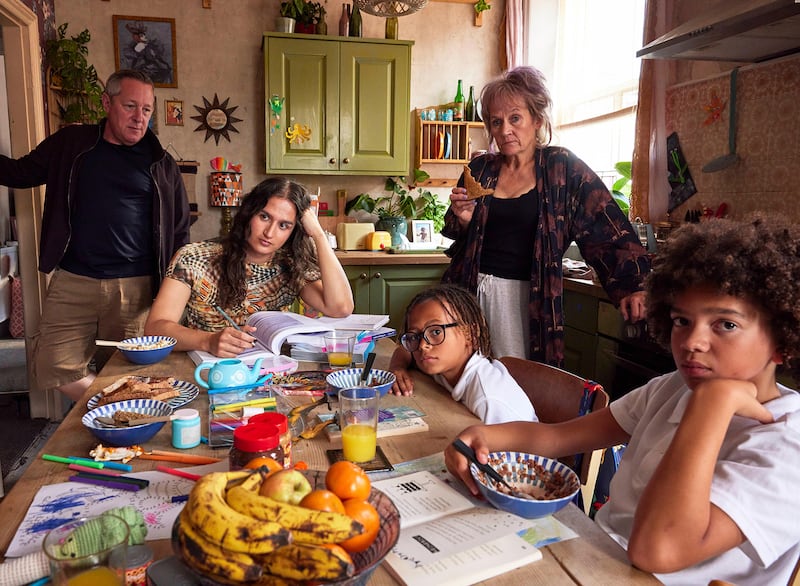
That was three years ago. Since, Wainwright created the series, a deft look at women eased out of familiar lives and game for a diversion that promises fun and flashy eye makeup.
“I love writing about women because I don’t think men are emotionally articulate,” Wainwright says.
The initial inspiration for the series, however, began percolating with her a decade ago.
“My mum’s developed dementia,” Wainwright recalls. “I’ve got two teenage boys, and there were all the messy ups and downs of teenage boys, which my husband and I were struggling with. It was affecting our own relationship.”
Combine that with always wanting to write about a rock group, then dealing with the psychological and physical effects of menopause, and Wainwright poured it all into Riot Women.
Although she shares a love of percussion with Jess, Wainwright says she’s closest to Beth, the group’s keyboardist.
Just looking into Beth’s open, eager face, you know she was an obedient, studious girl who developed into a rules-following woman. By the time we meet Beth (Joanna Scanlon, Slow Horses), however, she’s done. Truly.
Her husband left. Her grown son is entitled, married, and squeezes her in, if convenient. Beth is about to kill herself. But, as a responsible person, when the phone rings, she removes the noose from her neck to answer it.

The chair of her school’s English department, Beth is fed up with the students, co-workers, and her condescending boss (a theme among the women here). Life feels devoid of purpose. She’s so infuriated that it’s a wonder she did not try to kill anyone other than herself.
But that call from Jess changed all.
Like the character she plays, Scanlon had played the piano as a child. She relearned for this, although she admits, “I was pretty much starting from scratch.”
“The good thing that I had done was I sang in a choir, so I did learn how to read music,” she says. “That was a help.”
The actress worked with Wainwright on HBO’s Gentleman Jack and wanted to repeat the experience.
“A lot of people have said this is a story about becoming invisible,” Scanlon says. “And then I think, well, hang on a minute. What has made us so-called invisible? And I think what that boils down to isn’t invisibility, it’s not being looked at, it’s being an uninteresting thing to look at. And I actually think that’s a horrible way to think of ourselves.”
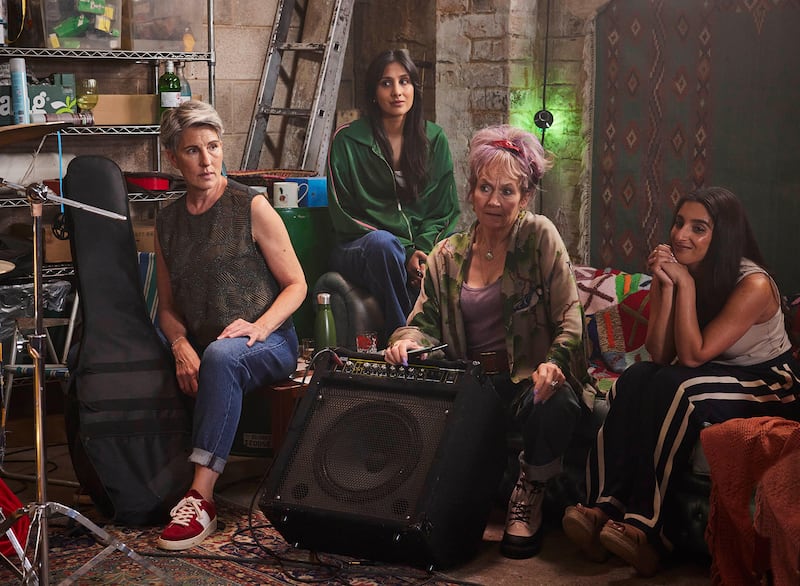
Creating a punk band may sound far-fetched, but given the age of most of these characters, punk was the soundtrack to their youth. They reveled in the UK’s first wave of the genre.
“I didn’t need any introduction, and I was exactly the right age,” says Scanlon, who calls The Sex Pistols “utterly transformative.”
Riot Women’s songs are tremendous fun. Their anthem about menopause has a chorus: “Am I invisible? Am I untouchable? Am I unlovable?”
The only cast member in this with serious music chops is Rosalie Craig (Moonflower Murders), a musical theater actress and the youngest in the series.
We meet her as Kitty during a rampage. She’s trashing a store, washing down pills with vodka pulled off the shelves. Screaming, fighting, flinging stock, the scene grows tense when Kitty grabs a knife. By now, the police have arrived.
The cops arrest Kitty, who suffered a significant slash to her face during the melee. One of the arresting officers is Holly (Tamsin Greig, Sexy Beast), who’s already in the band with her sister, a midwife, Yvonne (Amelia Bullmore, Gentleman Jack).
Beth and Jess were schoolmates. The sisters and everyone know Jess because of her pub. Kitty is the newcomer. Walking past a bar, Beth hears Kitty’s rage, misery, and perseverance in a guttural, powerful voice. She’s belting from the depths of her soul to a near-empty bar.
It’s a very different range than the one Craig normally uses on stage.
“There’d be days and story beats that would hit, like, one week, one day I’d be like having a breakdown, and the next I’d be, you know, performing in a massive festival,” Craig says of the six-month shoot. “As you can tell, it was a brilliant opportunity to really play a character in terms of someone who isn’t like myself.”
That’s pretty evident in her clothes as she chats from Manchester, where she was filming another project. Left to her own devices, Craig wears a demure blouse with a pussycat bow. In the series, she struts about in a leopard-print coat, gold lamé pants, and an indomitable attitude. Really, what else do you need?
This flame-haired menace just needs to sing. Beth takes her in; Kitty is broke, homeless, and has a sketchy past, having done two stints in prison. Her family runs a notorious gang. Every part of her life has been tough, and Kitty does not make it easier. She has a temper and a foul mouth, and she isn’t afraid to use either.
As we get to know her, her even darker past emerges. Growing up without her mother, who left under suspicious circumstances, and a father and brothers running criminal enterprises, made her pretty feral. She carries the trauma of gang rape, too, abuse that happened over months. Kitty was 12.
Beth and Kitty probably would never have crossed paths otherwise, yet a beautiful friendship is born.
“Kitty becomes the person that Beth can nurture, and Kitty’s the person who needs to be adopted, basically,” Wainwright says. “And then, not only does that kind of come about, they find this fabulous ability to write songs together.”
“They give each other a different perspective on themselves,” Craig says. ”Beth sees Kitty in a certain way that allows her to actually think that there’s a purpose for her, or she actually has a talent, or there’s a reason for being in the world. And I think Kitty frees Beth as well, and she gives her a new lust for life. It’s a beautiful friendship.”
“Sally and I talked for a long time about the fact that she’s so tired of seeing female friendships on screen where it’s just bitchy or simplified,” Craig adds.
Wainwright acknowledges she expected men not to care about the show, and yet their response has been overwhelmingly positive.
The overriding message is that menopause isn’t the end of us. Bodies shift, missions change, but, naturally, we forge on. Incidentally, when the band does perform, you will find yourself at least couch dancing.
“The message that I hear in it is, participation is everything,” Scanlon says. “Life is not about receiving and consuming. It’s about giving and participating.”
“We’ve got a lot to say at this time of our lives and progressing through life, and I think that we don’t want to be diminished,” Craig says. “We’re not invisible. We’ve got a lot of rage, and we need to talk about it. We’re often told that we’re irrelevant, or that it’s time to close the door, and you’ve had a good run. So, you know, just pack your bag very quietly and just stay over there. And I think, as a collective, I feel like we’re not doing that anymore.”
Given the cliffhanger, the next season could find Riot Women exploding on the scene as a fun, new band or seeking revenge on those who brutalized Kitty.
“It’s kind of rich with possibilities,” Wainwright says. “I love getting a second series of anything, because it always feels like you’re confident with who your characters are. Your actors are confident with what they’re doing. I think getting second shows is the most joyous thing, because there are some choices about where we could go.”