

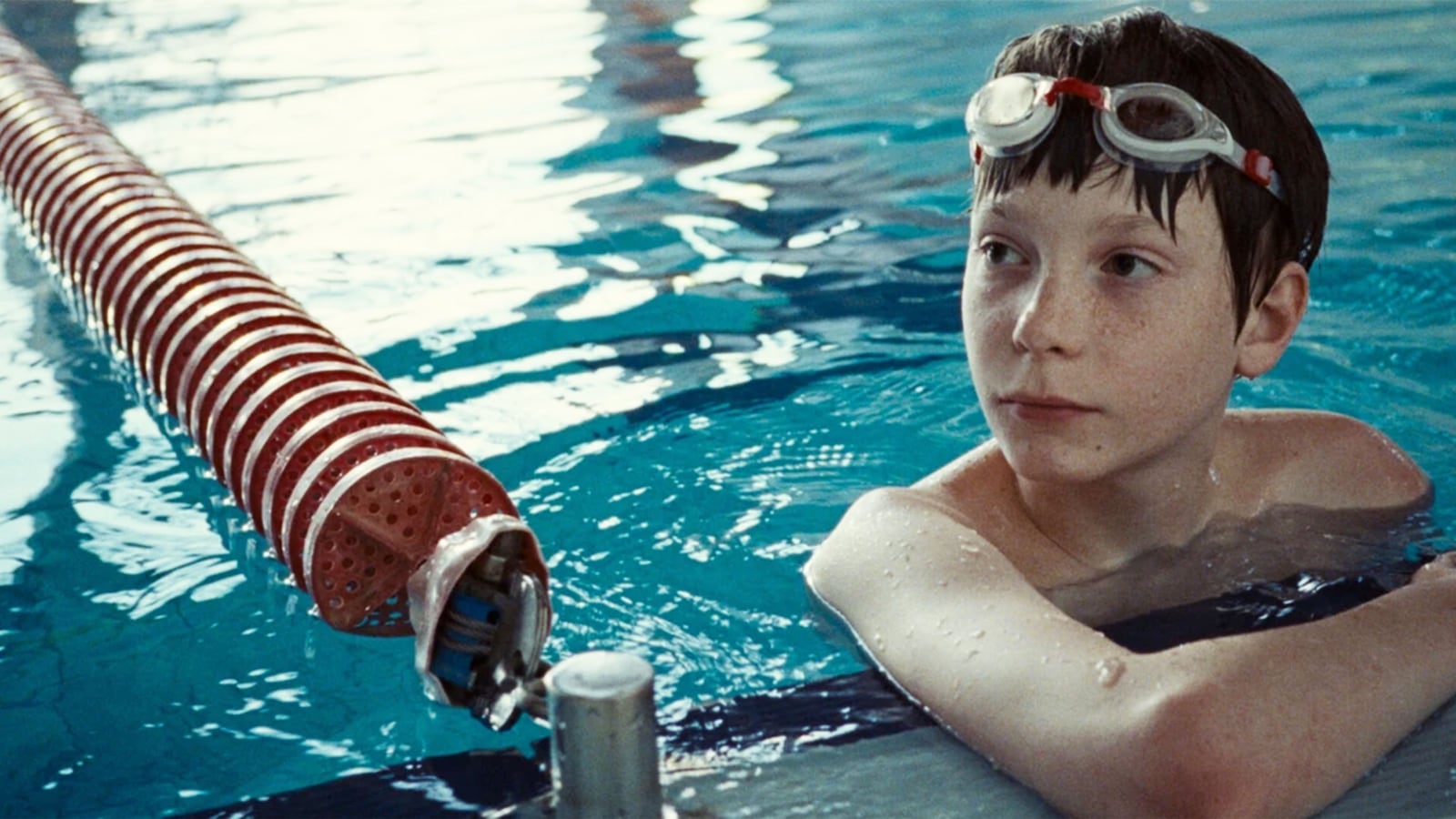
Tweendom is a battlefield of brutal social pressures, and in The Plague, the desire to fit in—and the lengths kids will go to avoid ostracization and rejection—is all-consuming and invariably disastrous.
Capturing its protagonist’s harried mindset with a fairy tale ominousness that frequently flirts with horror-movie malevolence, this psychological thriller co-starring Train Dreams’ Joel Edgerton proves an auspicious feature debut for writer/director Charlie Polinger, whose formal poise and imagination enhance his saga about bullying and the destruction it wreaks. Taut and entrancing, it’s a stark reminder that adolescence sucks.
Opening text cards elucidate that The Plague (December 24, in theaters) is set during the second session of the Tom Lerner Water Polo Camp in the summer of 2003—a time and place whose specificity is emblematic of this incisive character study.
Twelve-year-old Ben (Everett Blunck) has just moved to the area from Boston with his mother, whom he reveals in a candid moment left his dad after meeting another man at a business function. This transition has left him feeling disconnected and adrift, and those feelings are amplified by his arrival at camp, where he immediately identifies Jake (Kayo Martin) and his buddies as the kings of the proverbial hill.
Ben’s decision to join them at their cafeteria lunch table indicates that the newcomer isn’t shy. Nonetheless, his sense of self is put to the test when Jake embarrasses him by forcing him to say the word “stop,” which Ben pronounces as “sop”—thus landing him the nickname “Soppy.”

A tall, gangly kid, Ben radiates a natural mix of confidence and trepidation, and he’s taken aback when Jake and his loyal cohorts leap out of their cafeteria seats and flee to another table to avoid Eli (Kenny Rasmussen). Later conversations clue Ben into the fact that Eli is thought to be afflicted with “the plague,” an ill-defined malady that’s saddled him with skin rashes, bruises, and abrasions that he partially covers up with a long-sleeve swimming shirt.
According to Jake, the leader of this ugly clique, Eli caught the plague from a first-session camper and is now destined to suffer decreased motor functions, although it’s apparent that the boy is merely a (potentially autistic) outcast being persecuted for his strangeness. Still, Ben can tell which way the wind is blowing, and despite being entertained by a shocking Eli magic trick, he sticks with the pack and shuns the boy, desperate to solidify his standing in this hierarchical arena.
Blunck’s expressive face suggests that Ben is both a compassionate pre-teen and a pragmatic newbie determined to avoid becoming an Eli-grade pariah at (almost) any cost, and The Plague fixates on his countenance as it charts his initial camp ups and downs.

Whether in the cafeteria, the locker room, or the dormitory, the boys’ chatter is often about sex, and Ben joins in, telling an X-rated story to his bunkmates in the dark (as they masturbate) as a means of proving that he’s one of them. Even in these moments, the actor’s strong performance makes clear that Ben is playing a part due to his recognition that Jake is a perpetual danger, powerful enough to cast him out—and ruin his summer—over even the slightest faux pas.

The Plague is, narratively speaking, a straightforward affair about oppressive and coercive tween social dynamics, but in Polinger’s skillful hands, it resounds with alarming menace and malice. An early water polo match shot in slow motion and set to a chorus of rhythmic male chanting has a primal, tribal energy that establishes the material’s hostile-masculine atmosphere.
Similar subsequent sequences—also often filmed at reduced speeds, and accompanied by heavy breathing, high-pitched singing, clanging percussion, and wall-of-sound wailing—underscore the film’s urgency. The director’s aesthetics position the proceedings as an outgrowth of ancient macho forces at play: anger, competitiveness, fear, and survival-of-the-fittest ruthlessness.
Polinger fashions The Plague as a nightmarish blend of Lord of the Flies, Carrie, and Beau Travail, and its tension mounts in tandem with its humiliations, such as Eli, at a pool populated by male and female campers, being shamed for having an impromptu erection. Ben’s pity is of a conflicted sort, especially once his act of kindness toward the outsider results in both the thing he dreads most and, worse, the strange appearance of acne and rashes on his own chin and torso.
His reactions to his circumstances are equally messy, driven as they are by anxieties about being seen as weak, repulsive, and inferior—and which cause him to perpetrate cruelty in a (futile) attempt to save face and restore his reputation.
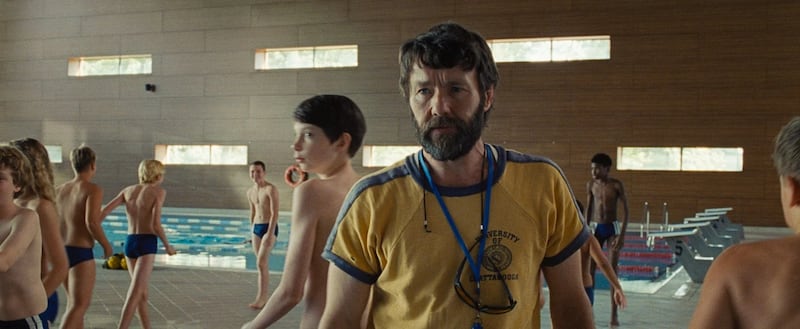
While Blunck colors Ben’s sympathy with self-preservation calculation, Martin oozes bratty, conniving callousness as Jake, whose punk attitude earns him the respect of his peers and the condemnation of Edgerton’s counselor Daddy Wags. Jake is an all-too-familiar schoolyard tyrant, his every glance and smile laced with sinister intentions, and The Plague recognizes that Ben has no easy method of opposing him.
Following a late-night prank, Ben flees the camp and, from a diner, calls his mom, only to earn himself a meal with Daddy Wags, who tries to make the boy understand that this phase shall pass, that reinvention is possible, and that being yourself is best. This is, on the face of it, sound reasoning. Yet Pollinger’s tale grasps that it’s not practical advice for someone immersed in an environment where popularity is king and exclusion is death.

Torn between his warring instincts, Ben acts out in a manner that leads to calamity and, ultimately, tears him apart, and The Plague concludes with a dance sequence that harrowingly, heartbreakingly conveys the turmoil raging within him. For Ben, camp is a fight, and he’s in it alone, and Polinger gets at his rage, terror, and sadness without resorting to feel-good resolutions.
On the contrary, he casts summer camp as simply one of many combat zones which all adolescents must traverse on their way to figuring out who they are and what they want to be. That anyone makes it out in one piece is, as demonstrated by this keen and distressing film, akin to a miracle.