

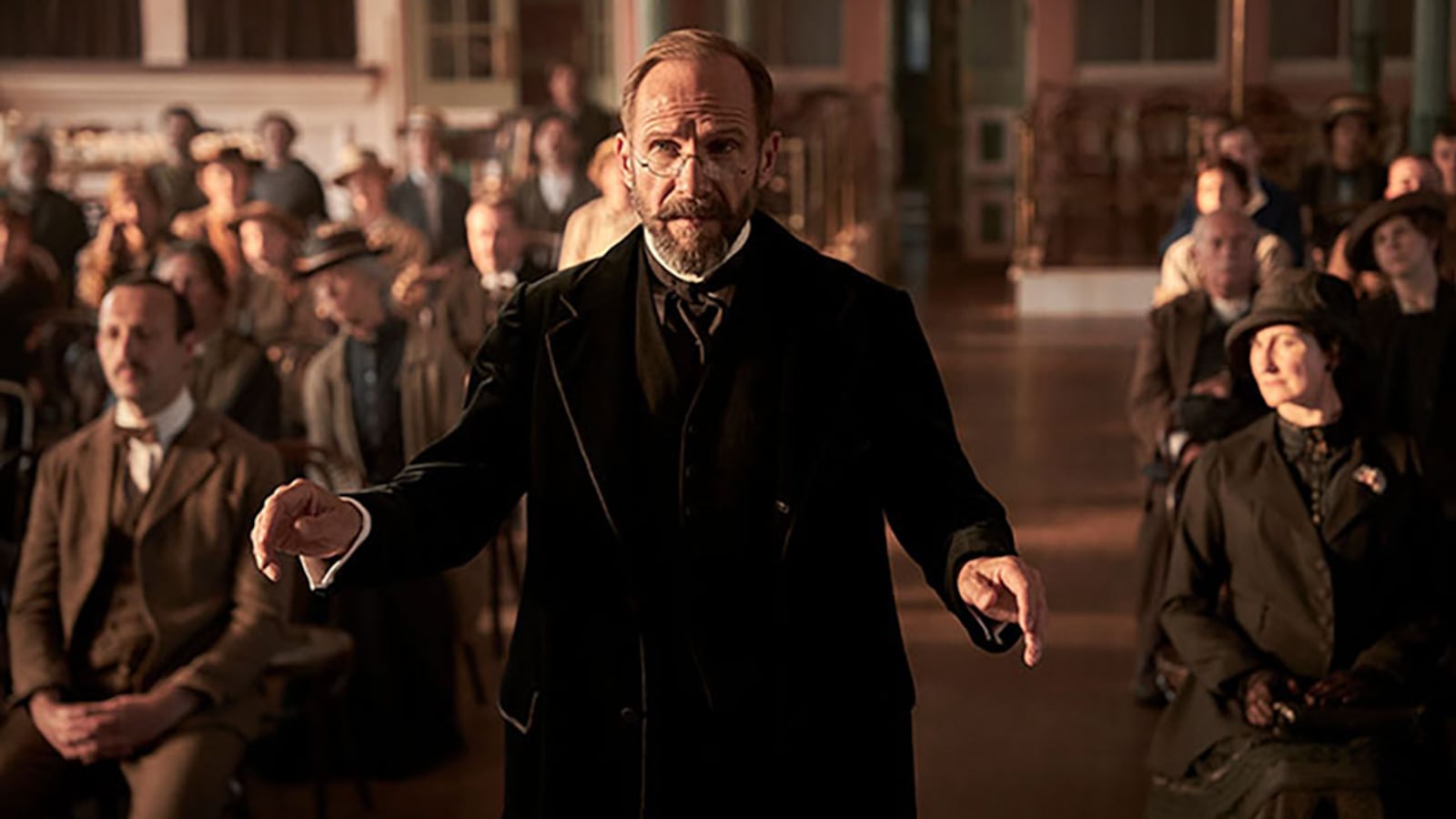
Ralph Fiennes’ artistry is second to none. Over the course of three-plus decades, he’s proven his versatility in everything from modern dramas (Conclave, The Menu) and adaptations of classics (The Return, Coriolanus) to period pieces (Schindler’s List, Quiz Show) and genre efforts (Harry Potter, 28 Years Later).
There’s no excuse, then, to barely utilize him, as is the case with The Choral (December 25, in theaters), a somber and inert film about war, music, loss, sacrifice, and perseverance, which makes its headliner merely one of many bland players in a drama so thin, you can practically see through it. A typical provincial British tale about everyday Englishmen and women banding together to accomplish a controversial task against long odds, it’s akin to a warm glass of milk.
For his first feature in 10 years, director Nicholas Hytner (The Madness of King George, The History Boys, The Lady in the Van) collaborates once again with playwright Alan Bennett. This time, it’s on an original work that infuses The Choral with zero tension and even less energy, although that’s not immediately apparent as he sets his scene in the fictional town of Ramsden, Yorkshire in 1916.
There, Lofty (Oliver Briscombe) earns his keep delivering to wives and mothers the heartbreaking telegram notices informing them of their loved ones’ deaths in the Great War. Lofty is accompanied on this daily task by his best friend, Ellis (Taylor Uttley), and upon seeing a flyer, the two decide to audition for the local choral group, whose membership has dwindled as so many young men head overseas to fight.
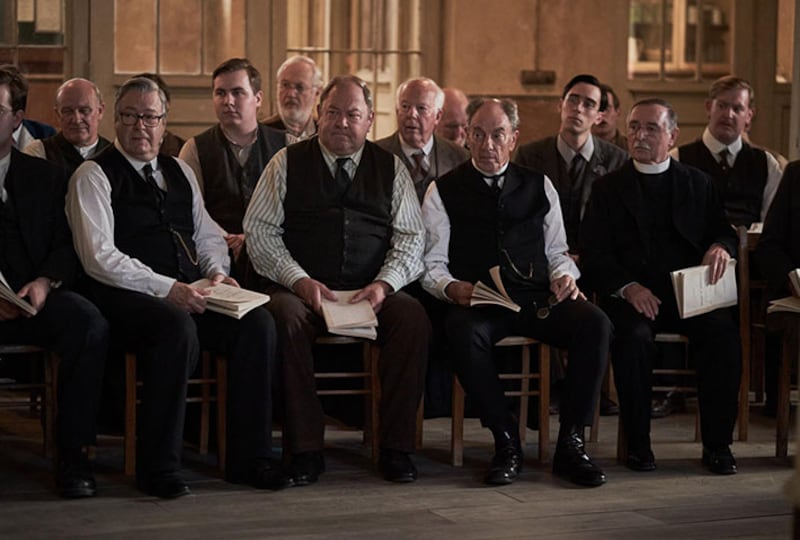
The Ramsden Choral Society is overseen by a committee that includes Mr. Fyton (Mark Addy), Mr. Trickett (Alun Armstrong), and Alderman Bernard Duxbury (Roger Allam), the last of whom, as the owner of the enclave’s mill, funds the operation, and it runs into trouble when its chorus master chooses to enlist. This puts them in quite a spot, and in response, they begin discussing the possibility of hiring as a replacement Dr. Henry Guthrie (Fiennes).
No one doubts that Guthrie is qualified for the gig, but the fact that he’s an atheist who lived and worked for years in Germany calls into question his fitness, especially at this particularly fraught moment. That Guthrie might be sympathetic to Britain’s enemies is of grave concern, and an offhand comment by Ron Cook’s town vicar (“Let’s just say I prefer a family man”) suggests that his sexual preference is an additional underlying sticking point.

Nonetheless, they meet with Guthrie, a serious man who makes poetic pronouncements about the virtues of art (by quoting a German, no less), and who agrees to the position so long as he’s given free creative rein. Fiennes radiates stately, noble idealism as the conductor, who doesn’t care where he gets additional members for the chorus, going so far as to visit a pub to locate potential participants.
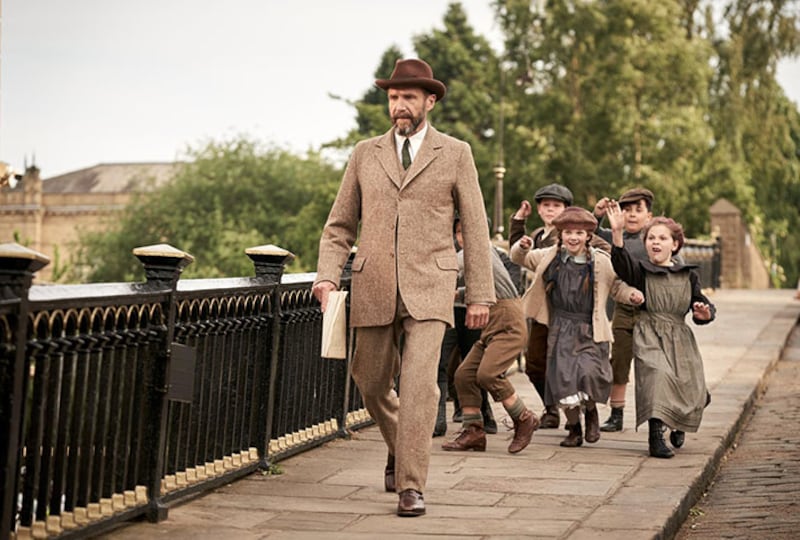
His first rehearsal, however, is marred by a brick through a window, which reveals that there’s great opposition to both him and the piece (Bach’s 1727 oratorio St Matthew Passion). Finding a different, suitable work to perform proves difficult, since Beethoven, Handel, Mendelssohn, and Brahms are also German, making them no-nos in the current climate.
Guthrie convinces his compatriots that the solution to their quandary is Edward Elgar’s The Dream of Gerontius, about an elderly man who, upon dying, becomes caught in a tug-of-war between good and evil forces contending for his soul. With Elgar (Simon Russell Beale) giving them permission, they set about fine-tuning the work, all as they grapple with assorted personal issues.
Bella (Emily Fairn) is anxious for word about her sweetheart Clyde (Jacob Dudman), who’s missing in action, and she strikes up a flirtatious rapport with Ellis. Black Salvation Army nurse Mary (Amara Okereke) begins a coy relationship with Mitch (Shaun Thomas) and demonstrates her singing ability. And as Fyton and Trickett cross paths at the home of local prostitute Mrs. Bishop (Lyndsey Marshal), Guthrie diligently checks for newspaper reports about naval battles because, as is soon disclosed, his lover is aboard a German warship.

The Choral is sprinkled with additional mini-dramas. Pianist Robert (Robert Emms) pines to be Guthrie’s special “friend” and, ultimately, rejects conscription on conscientious-objector grounds. Clyde, meanwhile, returns from Europe with one arm and is promptly rejected by Bella (a big blow, considering his rampant horniness) and hired by Guthrie—who recognizes his immense artistic talent—to replace Duxbury in the role of Gerontius.
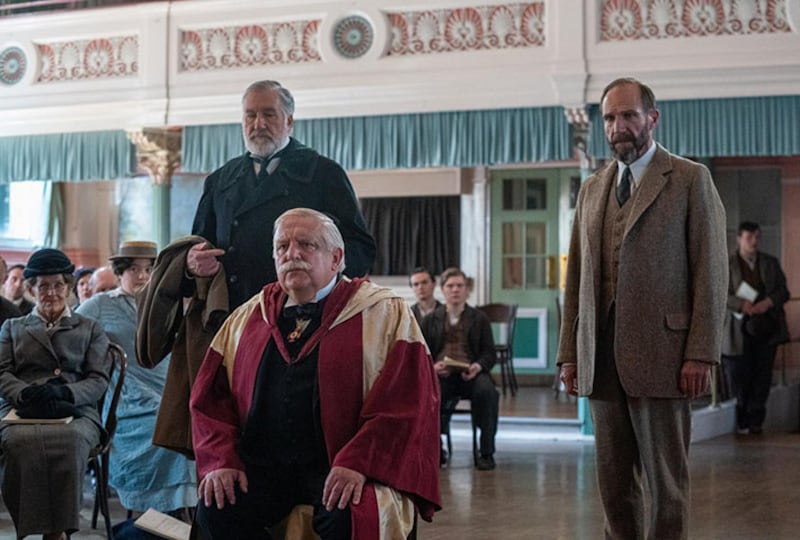
This switcharoo sparks the chorus’s biggest gamble: reworking The Dream of Gerontius into an opera about the ongoing war. If this is a dicey proposition, however, it plays out with the same even-keeled blandness as everything else in Hytner’s film, whose various points of concern are all rendered small, trivial, and—worst of all—lacking stakes that might jolt the material to engaging life.
Fiennes mourns the likely loss of his paramour and frets about Elgar balking at his revisions, but The Choral maintains strict two-dimensionality wherever possible, neutering any traces of complication through obvious, simplistic plotting.

As with a scene in which eager young men head off to war on one train, and broken veterans return immediately afterwards on another, the film addresses the traumatic horrors of WWI, and the blissful ignorance of so many who chose to join it, with all the subtlety of a slap to the face. At the same time, though, its gentle tone and pace never waver, meaning that it’s at once sluggish and transparent—a deadly combination that even the great Fiennes, briefly showing some spark when he lashes out at Duxbury for his mediocre singing, cannot counteract.
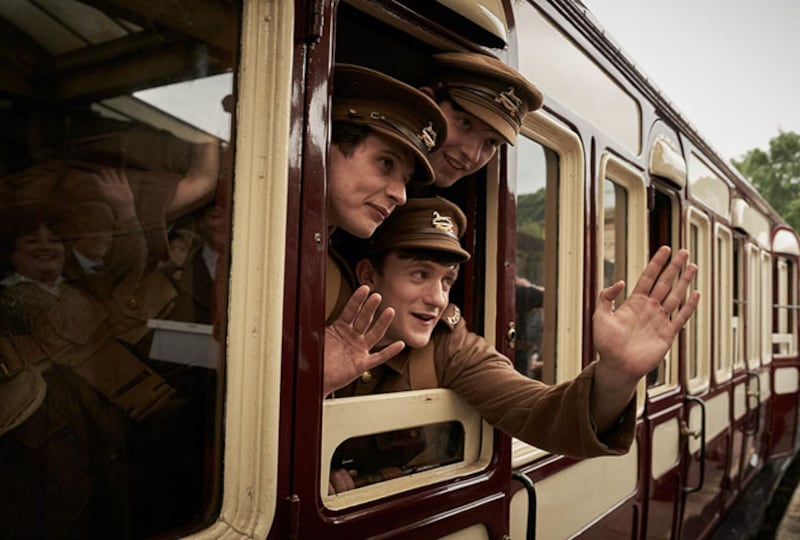
The Choral admirably refuses to alleviate its melancholy with forced uplift, and its final shot of Lofty, Ellis, and Mitch (their heads sticking out of a train window) is more touching than anything that preceded it. Yet one image a movie does not make, and Hytner and Bennett’s inability to impart something fresh, suspenseful, or truly tragic about WWI stops the film in its tracks. Fiennes’ performance is, unsurprisingly, the proceedings’ highlight, but he could do this in his sleep—a condition that The Choral is apt to induce.