Following the stellar one-two punch of last year’s Blue Moon and The Lowdown—in which he gave the finest performances in movies and television, respectively—Ethan Hawke has done it again.
The newly minted five-time Oscar nominee gets rugged and ruthless in The Weight, a hard-bitten thriller shouldered by the headliner’s intensity.
With a steely glint in his eye that’s almost as intimidating as his lack of overt expressiveness, Hawke is a severe man of action in Padraic McKinley’s feature debut about a group of convicts tasked with carrying out a dangerous mission in the backwoods of Oregon. Electrifying a taut tale of tough times and the desperate men they breed, the actor makes sure that, even when it could stand to be a tad weightier, this genre film—premiering Jan. 26 at the Sundance Film Festival—packs a wallop.
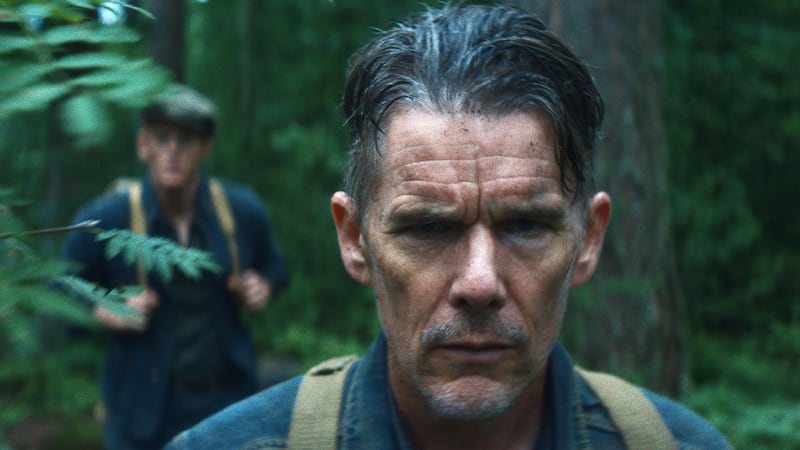
Four years into the Great Depression, Murphy (Hawke) is struggling to keep himself and his young daughter Penny (Avy Berry) fed, clothed, and housed, his financial strain so great that, with a hint of shame, he discreetly passes his Eugene, Oregon church’s collection plate without first contributing to it. Murphy is a WWI veteran and ace mechanic who brags to his little girl that he can fix anything. Unfortunately, that doesn’t extend to poverty.
When the duo is evicted from their apartment—another embarrassing turn of events exacerbated by Penny selflessly selling her beloved teddy bear to a neighbor’s son—things go from bad to worse, with Murphy checking out a wrong-side-of-town apartment and, for his efforts, getting into a fight with thugs who are actually cops. The result is prison, and though Murphy promises Penny that he’ll soon reunite with her, all evidence suggests that she’s destined for foster care and, afterwards, adoption.
Murphy gets the first of numerous breaks when he’s sent to a convict labor camp where he and other inmates can shorten their sentences through hard labor. This operation is overseen by Clancy (Russell Crowe), a warden who loves baseball and doesn’t suffer fools lightly, and during his stint at this outpost—where he and others are tasked with clearing roads by breaking enormous rocks—Murphy meets racist Rankin (Austin Amelio), socialist Singh (Avi Nash), and understated Olson (Lucas Lynggaard Tønnesen).
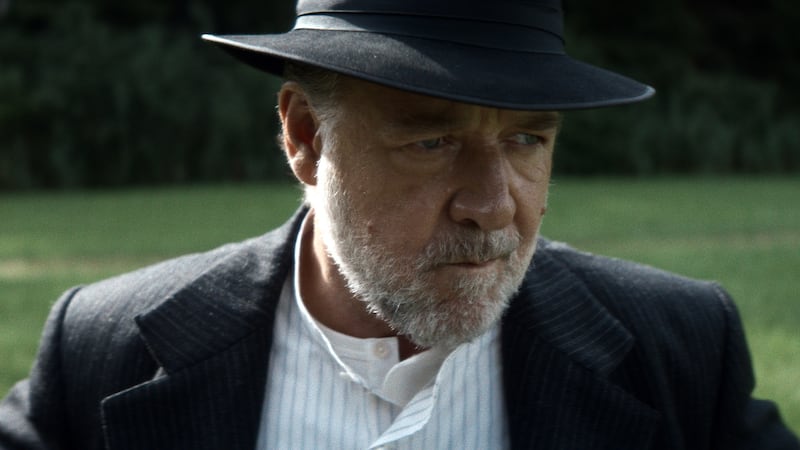
Thanks to a clever bit of on-the-fly engineering, Murphy impresses Clancy, and he continues to do so back at the warden’s cabin, where he repairs a busted-up Ford Model 18 (demonstrating his skillfulness) and, during a bout of target practice with live birds, blasts one the second it exits its cage (underscoring his ruthlessness).
These are qualities coveted by Clancy, who knows a guy in need of individuals fit for a treacherous undertaking, and who’s willing, as compensation, to sign Murphy’s papers early so he might reclaim Penny before she’s lost in the child welfare system.
Hawke’s protagonist readily agrees and enlists Rankin, Singh, and Olson for the cause, and they’re all shipped off to the Black Hawk Gold Mine, where Clancy’s buddy Taggert (Alec Newman) informs them that FDR is confiscating the nation’s gold (to address the financial crisis) and, before theirs is stolen, Murphy and his mates are going to spirit it to safety across the Oregon wilderness.
It’s difficult to miss that something about this deal is raw, and the fact that Taggert wants the quartet accompanied by curt guide Amis (Sam Hazeldine) and beefy guard Letender (George Burgess) only heightens those suspicions. With few options, however, Murphy and company set out on their trek.
With a stubbly goatee and plain-talking demeanor, Hawke radiates anger, anguish, and a rigid sense of purpose in The Weight, his Murphy a man for whom nothing matters but accomplishing his assignment and returning to his daughter. In terms of sternness, he’s matched by Anna (Julia Jones), a Native American loner who wants to flee her circumstances and blackmails Amis into letting her tag along.
As Matthew Booi, Matthew Chapman, and Shelby Gaines’ script later reveals, Anna was raised in a military school designed to westernize indigenous women, and between that tidbit and Singh’s recurring socialist pronouncements, the film casts its heroes as the marginalized and oppressed, forced to do the bidding of the wealthy and influential in order to achieve some measure of freedom and community.
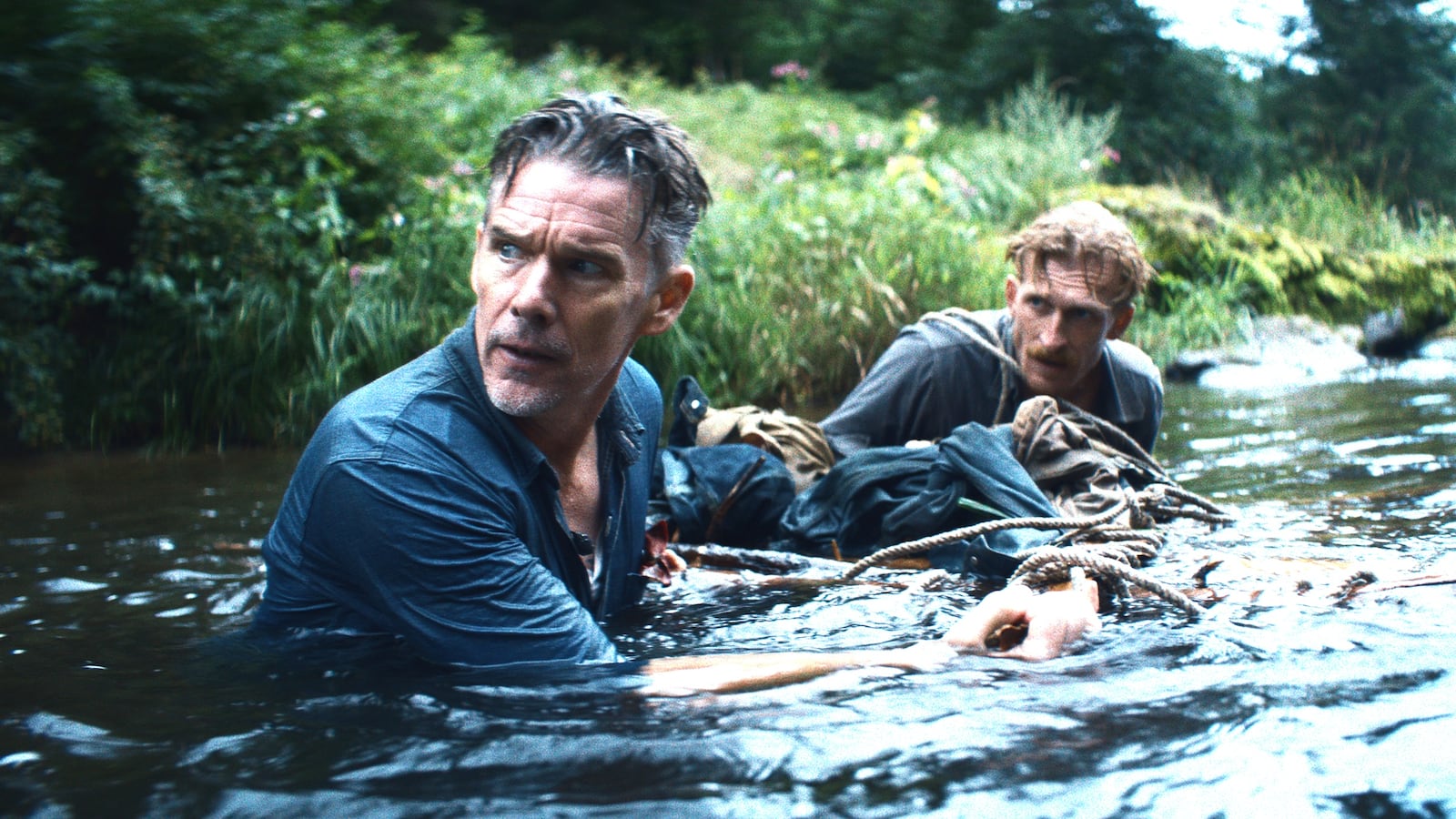
To its slight detriment, The Weight doesn’t dig deeper into such issues, thereby rendering them mere window dressing for a survival saga about down-and-out misfits trying to make it to another day. There’s a mildly frustrating thinness to the proceedings, although McKinley keeps things tense via a series of gripping set pieces, the first of which involves the gang crossing a rickety rope bridge that can’t sustain their weight, along with that of their heavy cargo. This is followed by run-ins with shady locals, river-traversing calamities, and shootouts with strangers who’d like nothing more than to relieve the travelers of their loot.
The director stages these suspenseful incidents with moments of beautiful, unnerving quiet, his vistas of misty forests, barren roads, and towering treetops conveying the awesome environment’s peril—an impression augmented by Latham and Shelby Gaines’ ominous score.
Aesthetically speaking, The Weight is occasionally showy, be it a nocturnal murder seen in sharp lightning flashes or scene transitions that cut back and forth between the present and immediate future. Yet Matteo Cocco’s cinematography has a textured beauty that overshadows any sporadic affectations.
Loyalty and duplicity are at war with each other in this rural land, and while Murphy’s morality is never in doubt, the material has an edginess thanks to the questionable motivations and allegiances of his companions.
Furthermore, even if his character isn’t difficult to read, Hawke embodies him with an unyielding determination and shrewdness that’s anything but monotonous, as well as a resilient physicality that he displays in multiple encounters that threatens to end this journey before it reaches its destination.
Between this and his prior two marquee performances, Hawke, already one of American cinema’s boldest and bravest talents, seems to have hit a new gear, operating at a level that suggests there’s no register he can’t play, no note he can’t hit.
Regardless of whether The Weight earns him the same acclaim as his 2025 output, it’s confirmation that he’s as fearless and ferocious as they come—and, perhaps, cut out for the sorts of action-movie roles which he’s, to date, sidestepped.