
Sexual politics take a turn for the steamy in Vladimir, the story of a middle-aged college professor who, while coping with a scandal involving her husband, becomes fixated on a hunky new faculty member.
Based on her novel of the same name, Julia May Jonas’ Netflix series (March 5) is perpetually hot and bothered, and it boasts a Rachel Weisz performance that nimbly navigates the intricacies of desire, obsession, and creativity. Yet neither is enough to enliven this overlong, repetitive, and scattershot affair, which—vainly echoing everything from the charming Michael Douglas film Wonder Boys to TV’s The Chair and Lucky Hank—takes satiric aim at various targets and, to a tee, misses them all.
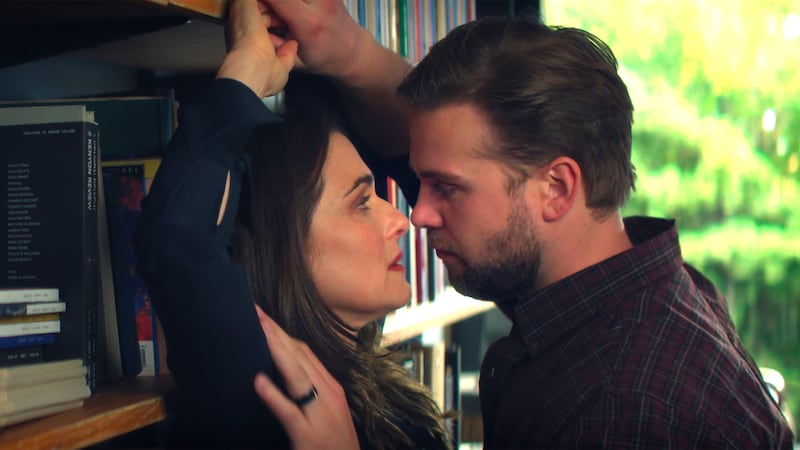
At a northeast liberal arts college, Weisz’s unnamed protagonist teaches the popular “Women in American Fiction” class, about which she quips, “A bit broad, don’t you think?” That groan-worthy pun is part and parcel of Vladimir’s cutesy voice, which primarily comes via Weisz. She habitually breaks the fourth wall to address the audience—a device that grates on the nerves, not least of which because the series’ writing has a strained sense of humor that’s exacerbated by its heroine’s self-satisfaction.
Weisz’s smirky, suggestive comments to the camera are as incessant as they are flat, and yet the actress does her best to convey the complicated inner tumult of her professor, whose life is in upheaval courtesy of her husband John’s (John Slattery) copious indiscretions with his students.
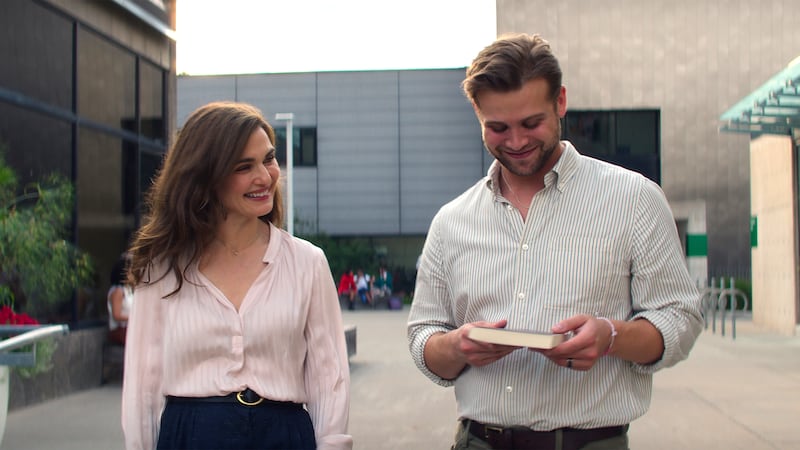
Those dalliances now threaten to end his career, and for Weisz’s character, they’ve shone a spotlight on her as well, with students and faculty unsure whether to pity her for having been treated poorly by her husband, or to scorn her for not speaking out (like a good feminist) against her loutish spouse.
The reason Weisz’s professor hasn’t taken a public stand is that she and John have, for decades, shared an open marriage. She views his problems as his own. She additionally considers the judgments of her peers as unreasonable, given that she’s the byproduct of an earlier age in which non-conformity was to be embraced. Vladimir recurringly pokes fun at the weirdo culture of contemporary academia, where students hold radical views on sex and relationships, and professors and administrators—such as Weisz’s colleague Florence (Miriam Silverman)—are overly sensitive, politically correct kooks who are all-too-willing to go along with whatever their charges demand.
Vladimir captures its chosen milieu’s hypercritical prudishness, but its mockery isn’t particularly sharp, and its eroticism is only intermittently livelier. Having written a celebrated first novel and then never followed it up, Weisz’s protagonist is shaken by the arrival of Vladimir (The White Lotus’ Leo Woodall), who’s coming off his own debut book’s success, and who immediately catches Weisz’s eye—and awakens her lustfulness.
Despite being husband to adjunct teacher Cynthia (Jessica Henwick) and the father of a three-year-old daughter, Vladimir is the immediate and all-consuming object of the narrator’s desire, and there’s nary a moment when, while in his presence, she isn’t thinking about him touching, kissing, or seizing her in a passionate embrace.
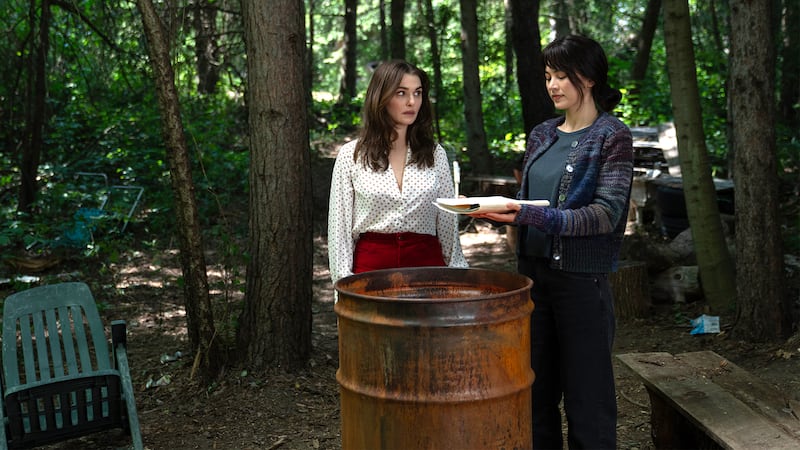
Weisz’s character’s intrusive fantasies are an initially cute feature of Vladimir, at least until they become so omnipresent that they lose their potency. In a 100-minute feature film, a few such reveries would have served as a playful expression of the professor’s need to feel wanted and of how that hunger is tangled up with her stunted creativity. In an eight-episode show that runs nearly four hours long, however, they grow monotonous fast, especially since they all play out in the same fashion.
Nonetheless, Weisz makes her academic a reasonably captivating stew of conflicting impulses and ideals, all of which are heightened by tensions with her adult lawyer daughter Sid (Ellen Robertson)—whom she wants to baby, including with regards to her relationship with girlfriend Alexis (Tattiawna Jones)—and her frustration with John, a cad whom Slattery embodies with a confidence and poise that’s unbowed by others’ condemnation.
Weisz and Slattery have a lived-in chemistry that sells their couple’s unique “arrangement,” although the series’ inability to give the latter a single funny line makes most of their scenes exasperatingly dull.
Speaking of which, Vladimir imagines Woodall’s writer as a cheery blank whose every word and gesture is ambiguous (to us, and to Weisz’s professor). His apparent cluelessness about his older colleague’s interest in him is one of many instances in which Vladimir comes across as clunky and phony.
This problem is also a consequence of the material’s length. In a shorter saga, the sensitive and friendly Vladimir’s naivete might have been believable, but here, it resonates as doltish—and, worse, as a transparent storytelling construct designed to simply keep Weisz’s character in extended disarray.
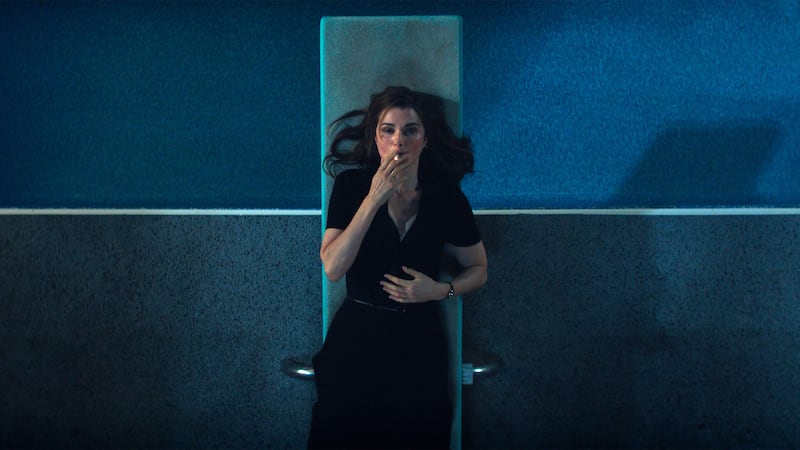
Randy innuendo abounds in Vladimir, and when coupled with Weisz’s daydreams about getting it on with Vladimir, the series occasionally gets the pulse racing. Weisz, meanwhile, skillfully evokes her character’s fears, insecurities, longing, and anger.
It’s a shame, then, that the show never totally coheres. Whether it’s the barely formed Cynthia (a plot pawn who fails to come into clear focus) or Weisz’s character’s unconvincing backstory with fellow professor David (Matt Walsh), the action is slack and superficial, as well as rarely as funny as it wants to be.
Through Weisz’s interactions with her students and daughter, Vladimir strives to generate prickly comedy about contrasting generational attitudes toward intimacy and identity. Those attempts, alas, prove too gentle to amuse, and the idea that Weisz’s professor becomes “unblocked” as a writer via her rekindled libido is at once corny and, worse, underdeveloped. That the character has resumed writing is almost a narrative afterthought, merely glimpsed on the proceedings’ periphery until the finale.
If Vladimir gets anything right, it’s the screwy moral paradigms that now govern so many university campuses—a notion epitomized by a realistically vexing subplot involving Weisz’s character being accused of screwing a former student out of a scholarship as retaliation for the young woman sleeping with John.
Those concerns, however, are ultimately secondary to wannabe-spicy shenanigans that disprove the series’ belief that sex leads to artistic inspiration.