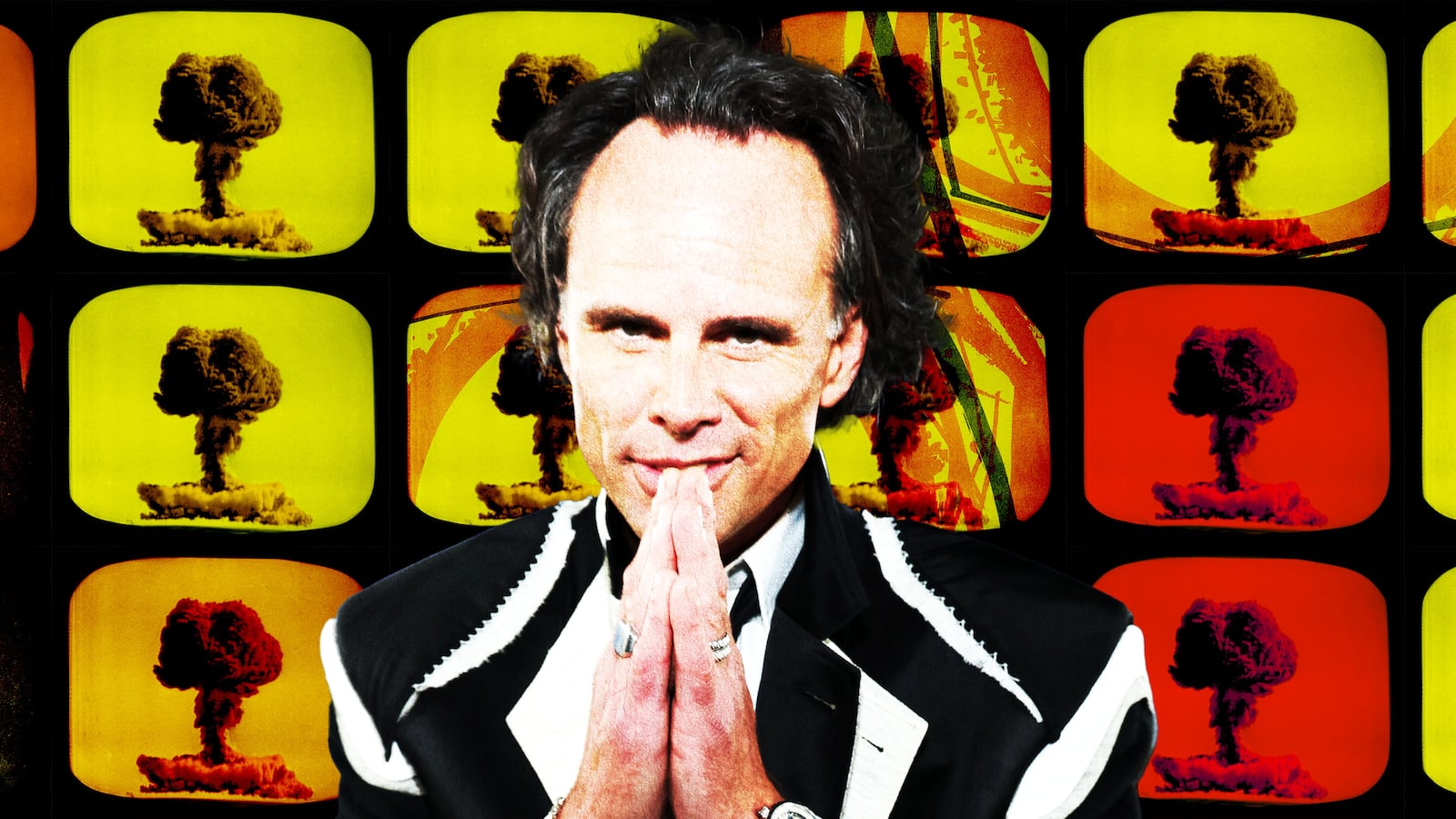
From The White Lotus and Saturday Night Live to GoDaddy’s Super Bowl commercial and Walmart’s current ad campaign, Walton Goggins has been omnipresent in 2025. He continues his unstoppable hot streak with Season 2 of Fallout, his stellar Prime Video series based on the best-selling role-playing video-game franchise.
A hilarious action-packed epic about a post-apocalyptic wasteland where the only laws are murder, betrayal, and survival, Fallout is a shotgun blast of sci-fi insanity. At its center is Goggins’ Ghoul, a 200-year-old zombie cowboy kept alive by radiation and fueled by cynical viciousness, whom the actor embodies like the most ruthless gunslinger this side of the Man with No Name. Missing a nose but full of nasty wisecracking attitude, he’s the most uniquely deranged and magnetic character in a series teeming with them.
He assumes an even greater role in its follow-up run, premiering Dec. 17, which has him partner up with good-hearted Vault dweller Lucy (Ella Purnell) on a trek to New Vegas, a gone-to-seed Sin City where he hopes to find answers about the fate of his wife and child.
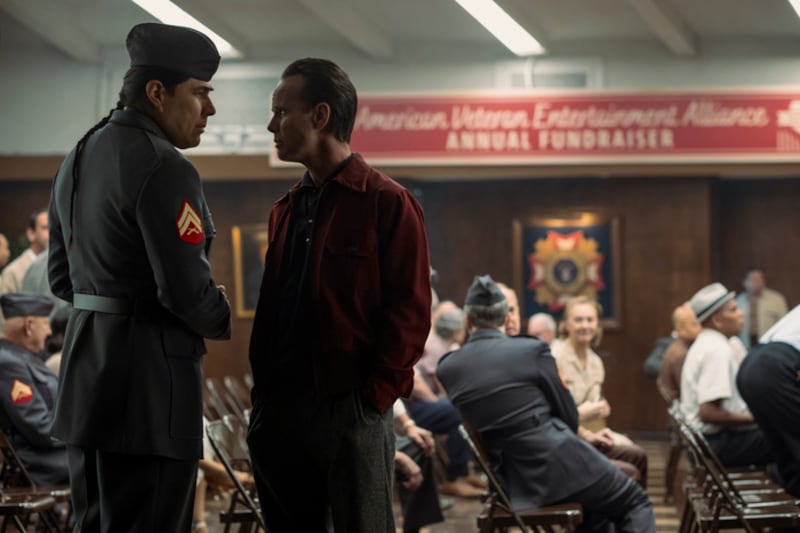
At the same time, creators Graham Wagner and Geneva Robertson-Dworet’s saga routinely flashes back to the Ghoul’s pre-Armageddon days to chart his prior life as Cooper Howard, a movie star-turned-corporate spokesman. In Season 2, he’s commissioned for an espionage mission—aimed at New Vegas corporate overlord Robert House (Justin Theroux)—to stave off the end of the world.

With a steely glare and a cutting tongue, Goggins’ Ghoul is the bada-- axis around which Fallout pivots, and yet what makes the character so compelling is the fact that—as evidenced by Cooper’s yesteryear plight—he’s more than merely a depraved desperado.
For Goggins, it’s a multilayered role that takes full advantage of both his southern-drawl menace and everyman charm, and his electric performance is proof that he’s still at the top of his game. Despite his jam-packed schedule, he sat down with us to talk about his current ubiquity, the ups and downs of performing beneath layers of make-up, and balancing the good, the bad, and the ugly of the Ghoul.
Between the debut of Fallout, the smash success of The White Lotus, and everything that followed, you’ve had quite a year-plus since we last spoke. Has it been a whirlwind?
You know, I’ve been around for such a long time, and I have had periods that felt like, oh wow, this is a moment. Or now, this is a moment. Or oh, wow, wow, wow, this is definitely a moment. And…this is a moment [laughs].
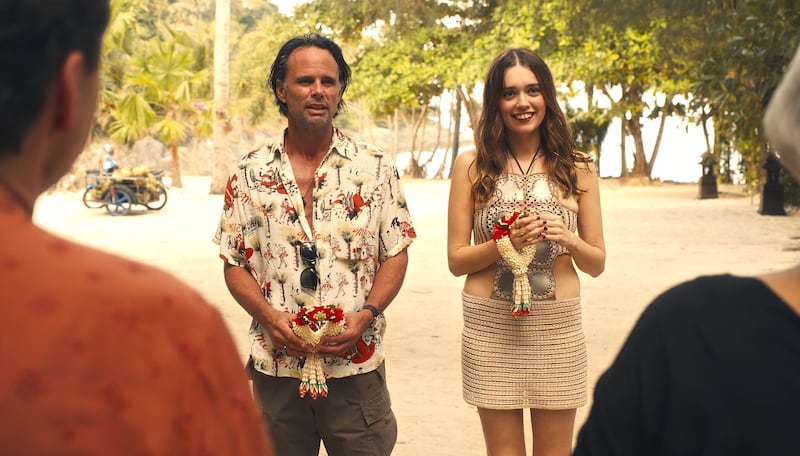
I’m so grateful that I’m at my age, and I have walked the path that I’ve been walking for this long, so I understand what’s happening in real time. I’ve had a number of friends—very close friends of mine—go through similar experiences. Some even bigger, and some smaller. And I’m just wide-eyed and grateful.
Nothing has changed for me. I always show up for every experience or every invitation that I’m given. I’m given more invitations now to experience more things, and that just means I’m showing up more often.
After having your face everywhere, was it a bit of a relief to return to Fallout, where you get to hide under layers of makeup as the Ghoul, who doesn’t look anything like you?
You’re absolutely right about that—and thank God he doesn’t look like me [laughs]. I’ve been doing this for 35 years, and I don’t know how many movies I’ve done, but I’ve done a lot, and I enjoy that 2-2.5-hour experience. But when I had the opportunity, through The Shield, to go on an 84-hour journey over the course of seven years, it spoke to me in a way that movies never did.
While I’ve had some great roles in a lot of movies, this has been a format that I derive an extraordinary amount of pleasure from. I have enjoyed it so much that, instead of keeping myself open or available for opportunities in film, when given the opportunity to go back into a serialized story that I feel like I can really sink my teeth into and bring something to the table with, I’ve chosen to do that.
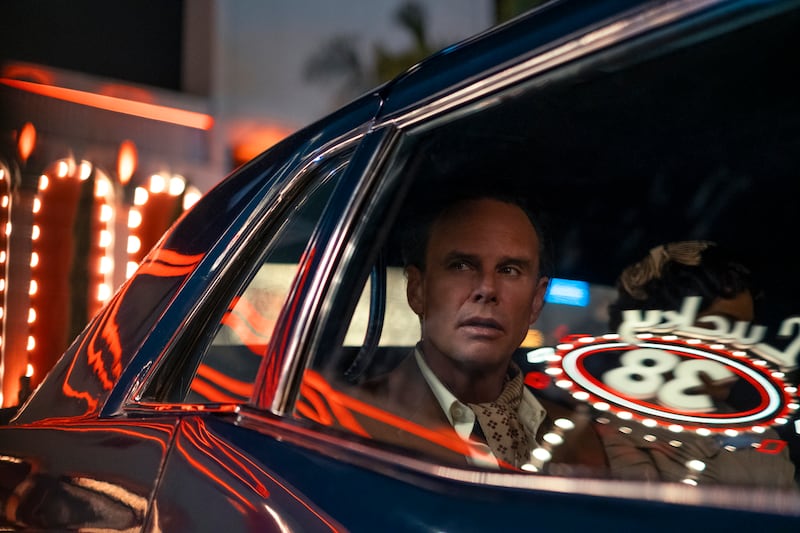
So this isn’t hiding for me. There are some security issues, because you never know if you’re going to come back. I’ve had something that I was really, really passionate about be canceled, you know? Which is out of the blue. But I relish the opportunity to be in an ongoing story. I’m sometimes tired of it after the journey, but give me a week off, and then I look forward to the next chapter. It is a sweet spot for me. It is one of self-discovery.

Is the Ghoul a best-of-both-worlds character, in that you get to play this cutthroat undead desperado, and yet because of his backstory as Cooper Howard, you know—or at least think you know—that he has a good heart lurking beneath his violent exterior?
I have a hard time speaking about any story in the third person because I am the Ghoul, and I am Cooper Howard. I think what you’re asking, which is a great question, is about the duality of this experience for me. To show up to work, and to have absorbed everything that the Ghoul has absorbed over the course of 200 years, and to walk in his boots through this post-apocalyptic world, looking for the things that he’s looking for and encountering how f---ing odd the world is, and to be a way for the audience to enter into this experience, right?
As Lucy, Ella has her way of bringing the audience into the experience. We all do. But the Ghoul certainly has a way, almost like Han Solo—he’s been in this world for a very long time, he knows all the nooks and crannies, and he’s kind of your guide. I’d never thought about it in those terms before speaking to you now [laughs]. Getting to play the Ghoul, and having that experience, which is taxing physically and also emotionally at times, and then to offset that by getting the opportunity to be him 200 years earlier as Cooper Howard…I’m never bored.
Cooper turns out to be a much more complicated and conflicted character in Season 2. Were you surprised by the direction of his backstory?
The answer to your question is yes. It could have gone a number of different ways. We have lengthy conversations about Cooper Howard, and so much of this, as it was revealed to me, puts him—in the Venn diagram of this show—almost at the nucleus of the problem! He’s the nucleus, and he’s on the precipice of this changing world. I understood it, and it’s nothing gratuitous.
It’s all so organic that all these people were connected, and the way in which they were connected. Through a series of events, they come in and out of each other’s lives, for the first time, before the bombs drop. And then there’s this fantastic opportunity to circle back to have their paths cross in the present day.
Fallout’s second season shifts the action to New Vegas. Are you a big Vegas guy? And was it fun navigating a crazy, heightened, post-apocalyptic version of another landmark American city?
Whenever you step on a Howard Cummings production design set, you are in for a big life experience [laughs]. I have spent a lot of time in Vegas; I’ve lived in L.A. for 30 years, and I’ve worked there a number of times. I’ve had experiences where what happens in Vegas, stays in Vegas, and it is a Sin City for all the best reasons [laughs]. I absolutely love it there.
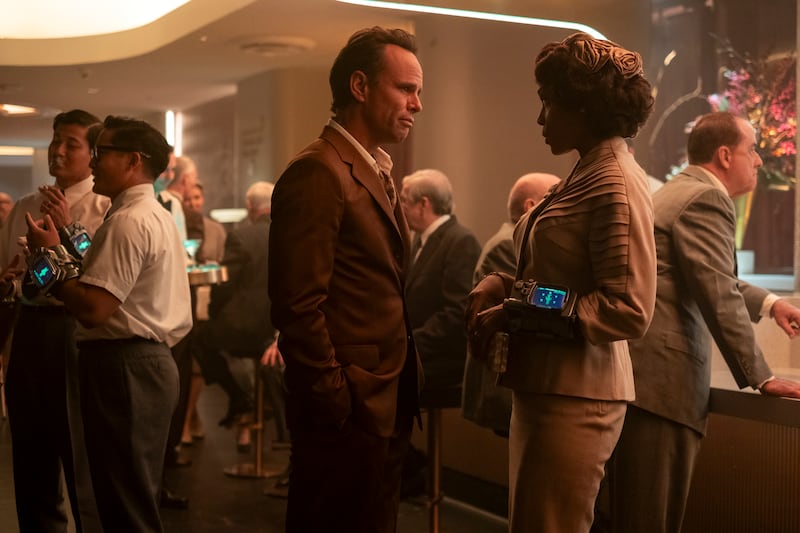
We’re now filming in California outside of Los Angeles, and being on location, sleeping in my van at the base camp—I just stayed in my van—and being out in these desert landscapes, it’s my favorite topography in the world. It’s amazing to get to wake up in the morning, have my coffee, step outside my rig, and then play the Ghoul in the desert all day long. Then to get to step into these Vegas sets and be in the city, and to wear these clothes and to be with Justin Theroux, who’s a really good, dear friend of mine.
That must have been fun.
To get the opportunity to go through this with him and to really figure out the dynamic between these two people [Cooper and House]…you know, he dictated this relationship as much as I did. We just listened to each other. I didn’t know that Cooper [in a later episode] was going to walk out of that room and, in the process of processing how little he f---ing understands about what’s going on, get inebriated and ride a f---ing nuclear warhead in front of a bunch of people cheering him on! [laughs] That’s chaos. That’s insanity, man. It was so exciting. From the beginning to the end, it was a radical experience for me on every level.
You told me last year that the make-up for the Ghoul was a challenge. Was it any easier dealing with it this season?
No, it’s not easier [laughs]. But you know, like having a child, when you have your second one, you think, “Oh, that’ll be easy.” Then you have it, and you’re like, “What the f---? I’m going out of my head!” [laughs]
Everyone goes out of their way to make me as comfortable as I could possibly be. And the truth is, I bought the ticket. My day really starts three hours before anybody else’s, with [prosthetic department head] Jake Garber. I’m good for eight hours, because eight hours of working—which is really eleven hours for me, total—is not a problem. But that ninth hour, I start to stay around people so I don’t start ripping the thing off. Between the ninth and tenth hour, I don’t want to be alone.

And then there have been days where I just looked at the director and said, listen, I’m sorry, you’ve got to turn that camera around, because I’ve got to get it off and get some space. They say we got you, not a problem, and they’ll shoot me out so I can just get a part of my face open.
We’re all in it together, and anyway, is any f---ing job comfortable? If you’re sitting at a computer all day, oh my god, I would kill myself! So that’s not comfortable. And this is not comfortable. But it’s rewarding, and that’s what life ought to be.