“Wuthering Heights” is encased in quotation marks when it appears on screen to make clear that this new version is not a straight adaptation of Emily Brontë’s classic 1847 novel.
Yet that’s a rather mild qualification for the wholesale reinvention Emerald Fennell perpetrates with her follow-up to Saltburn.
Far from taking just a few artistic liberties with its hallowed source material—say, in the vein of 1939’s Oscar-nominated version, which dispatched with the book’s back half—the writer/director’s latest is a grand and goofy reimagining, squandering Margot Robbie and Jacob Elordi in a fleetingly recognizable tale of love, desire, obsession, regret, bitterness, and ire that, at every turn, plays as florid, horny, juvenile fan fiction.
With an aesthetic that’s akin to a cross between a pop-up book, a dollhouse, a snow globe, Tom Petty and the Heartbreakers’ Alice in Wonderland-themed music video for “Don’t Come Around Here No More,” and a 5th Avenue department store Christmas display, “Wuthering Heights”(February 13, in theaters) exemplifies Fennell’s gleefully self-conscious, attention-craving style.
Unfortunately, that approach is an awkward fit for Brontë’s roiling, tormented saga of passion, cruelty, and doom, which is ostensibly why the filmmaker reshapes her famous story to her own ends.
Infusing them with hot-blooded, heavy-panting eroticism, she reduces the proceedings to a modern paperback romance novel, complete with a male protagonist who, at various junctures, sports long flowing locks and an unbuttoned, ruffled white shirt like he was the great-grandfather of Fabio.
Doing away with its traditional framing narrative, “Wuthering Heights” opens at a public execution where every sight—a hanged man’s mouth gasping for air beneath a hood; onlookers (including a nun!) screaming and cheering with lustful excitement—speaks (screams!) to the link between sex and death, pain and pleasure.
Those connections are repeatedly italicized throughout the course of this period piece, whose primary action takes place at Wuthering Heights, the going-to-seed Yorkshire moors residence of Mr. Earnshaw (Martin Clunes). A gambler and drunkard, Mr. Earnshaw surprises his daughter Cathy (Charlotte Mellington) and her attendant Nelly (Hong Chau) by announcing that he’s taken in a strange, scruffy boy (Adolescence’s Owen Cooper). Cathy, eager to take possession of this “pet,” promptly names him Heathcliff.
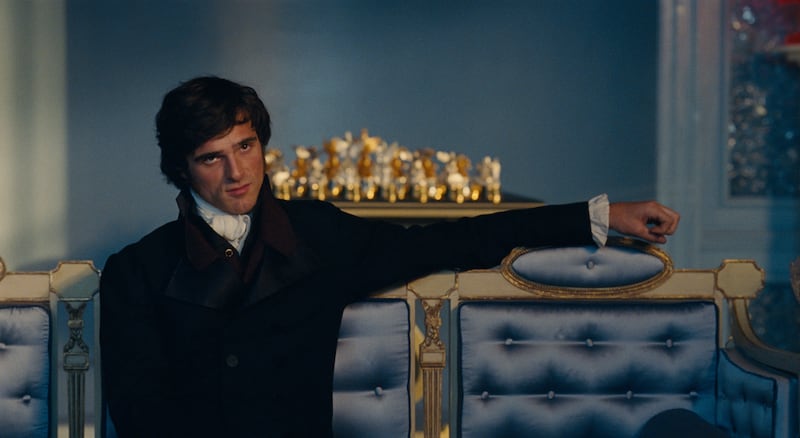
With a transition from a blood-stained sheet to a sweaty scarred back (two recurring, highly charged motifs), “Wuthering Heights” fast-forwards to Cathy (Robbie) and Heathcliff (Elordi) as adults who can’t stop looking at each other with fervent carnal yearning. Fennell raises the temperature whenever possible, as when Heathcliff sits on a pile of eggs (placed in his bed, as a prank, by Cathy) and then runs his fingers through the sticky yoke.
She also creates complications for her protagonists when Edgar (Shazad Latif) and Isabella Linton (Alison Oliver) arrive at nearby Thrushcross Grange. The posh figures end up caring for Cathy after she spies on them and, for her sneakiness, twists an ankle. Upon returning weeks later to Wuthering Heights, Cathy is “transformed,” and given her dreams of wealth and comfort, Heathcliff takes this as a bad sign.
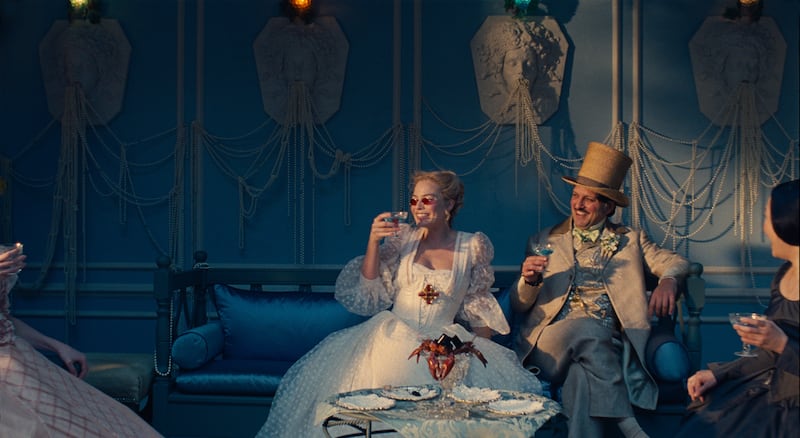
Cathy is enticed by the well-off and doting Edgar, but her heart and loins clearly belong to Heathcliff, who covers her ears and mouth as she watches Wuthering Heights’ servants have animalistic sex involving a riding crop and a horse’s bit. Though she flees this X-rated show, Cathy is aroused beyond recovery, such that even the squishiness of slugs and bread-kneading makes her hot under the collar.
Fennell never stops with such libidinous gestures, envisioning Brontë’s misty moors as a reflection of Cathy and Heathcliff’s unbridled hunger for one another. She’s equally unsubtle once Heathcliff—under the mistaken impression that Cathy detests him—flees the region, leaving the young woman to marry Edgar, thereby initiating a montage of Cathy’s gilded-cage condition (set to Charli XCX’s on-the-nose “Chains of Love”) that’s the height of flashiness.
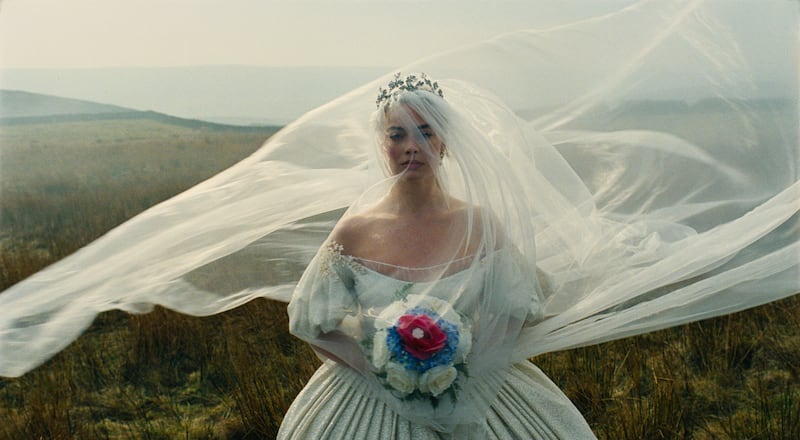
“Wuthering Heights” strips Brontë’s novel down to its bare bones, throws half of them away, adds some anachronistic Bridgerton-esque multicultural flavoring, and casts what’s left, including any repressed emotions or subtext, in obvious and overwrought terms.
Until its final passages, Elordi’s Heathcliff comes across as a reasonable, tempered, and sympathetic hunk—a crude conception of the character that’s paralleled by the film’s Cathy, who’s rendered simply an unfortunate soul caught between reason and duty on the one hand, and Elordi’s irresistible manly loving on the other.
Robbie intermittently cuts through the gaudy sound and fury to locate real, complicated humanity; her reaction to Heathcliff’s return as a wealthy, distinguished gentleman is heartbreaking. For the most part, however, she’s a striking, lavishly dressed Little Red Riding Hood-by-way-of-Cinderella figurine in Fennell’s life-size diorama.
Between Anthony Willis’ score and Charlie XCX’s songs, “Wuthering Heights” doesn’t leave a moment wanting for overbearing sonic accompaniment, and Fennell’s visuals—marked by images framed in doorways and arches—are likewise insistent.
Competing with such showiness, Robbie and Elordi manage merely flickers of chemistry, regardless of the fact that Fennell soon has their star-crossed paramours getting down and dirty in bedrooms, carriages, and out on the moors. This isn’t just unfaithful to Brontë’s work; it’s as degrading to it as Heathcliff eventually is to Isabella. Yet more importantly, it’s depressingly uninspired—a devolution into simplistic drama that’s almost as embarrassing as Heathcliff’s last-act transformation into a quasi-Christian Grey who gets off on humiliation and domination via chains and dog collars.
Between Cathy’s underdeveloped rapport with Nelly, and Edgar’s clichéd plot function, “Wuthering Heights” only tangentially touches upon its economic and class-centric tensions. The film’s portrait of psychosexual longing, cruelty, and torment isn’t more fleshed out, with Fennell prioritizing chest-heaving declarations of affection and animosity, as well as wannabe-sultry couplings, over all other concerns. There’s a distinctly pantomime-ish quality to the director’s third behind-the-camera feature, and that pitched-to-the-last-row artificiality is the cold water on any steaminess.
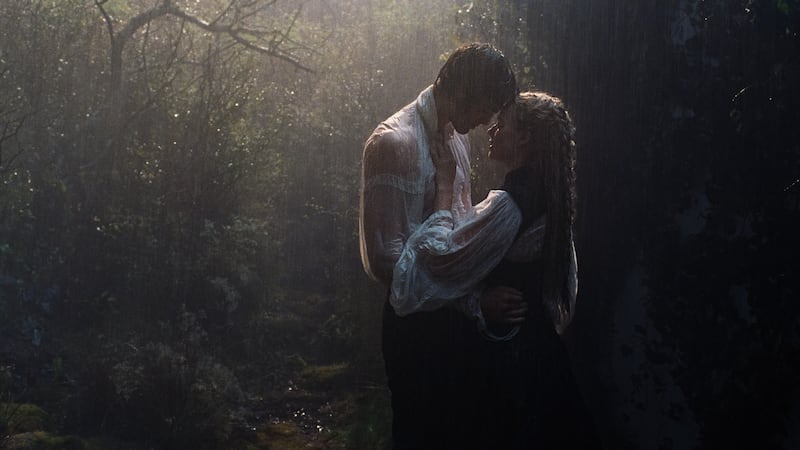
“Wuthering Heights” is ultimately an immature reimagining devoid of its source’s nuance and complexity, and at a certain point, its interest in doing its own thing makes one wonder why Fennell didn’t instead craft an original tale unencumbered by expectations or prerequisites.
IP may get people through the multiplex door, but caught between adhering to Brontë and embarking on its own goofily randy flights of fancy, it’s an adaptation that never reaches the heights it seeks—and, on numerous occasions, crashes and burns.