Pentagon Pete’s Goons Make Admission About His Big Crusade
As many as 250 people are thought to have been killed without trial.

Kylie Cooper/REUTERS
Get The Swamp newsletter delivered straight to your inbox
By clicking “SIGN UP” you agree to our Terms of Use and Privacy Policy.
Pete Hegseth’s Department of Defense has quietly revealed why it halted its Caribbean drug-boat strikes for two months.
The Trump administration’s Operation Southern Spear has drawn condemnation for its extrajudicial strikes on alleged narco-terrorists it accuses of smuggling drugs from South America towards the U.S. The operation has sparked outrage over fears that some of its targets may have been innocent.
And now the Daily Beast has learned that Hegseth’s SOUTHCOM decided to stop the strikes to evaluate its targeting system.


The administration has released video footage showing a drug boat strike in the Caribbean last year.
Donald J Trump/Truth Social
In a quarterly report seen by the Beast, the Lead Inspector General to Congress said that SOUTHCOM had decided to pause the military action in “late June” to “evaluate strike procedures,” and prioritize providing assistance to Venezuela after an earthquake killed at least 6,500 people.
Strikes were resumed in August following the “review to improve targeting and efficiency,” the Inspector General’s report said.
“Following the evaluation, USSOUTHCOM implemented revised targeting guidance to enhance positive identification of DTO (Designated Terrorist Organizations) vessels prior to engagement.”
When the Beast asked SOUTHCOM what those changes entailed, it was stonewalled. A spokesperson said that, “To maintain operational security, specific assessment findings and subsequent adjustments to operations are kept internal.”

SOUTHCOM largely rebuffed the Beast's attempts to get answers.
Luisa Gonzalez/REUTERS
“Operational assessments are a standard, continuous process of military operations used to monitor effectiveness and measure progress alongside established objectives. This process allows leadership to adapt strategies, seize emerging opportunities, and proactively mitigate risks,” the spokesperson said.
When the Beast followed up again, asking whether the re-evaluations had been carried out due to widespread concern about innocent people being hit by the strikes, SOUTHCOM did not give an answer.
When the Beast repeated the question for a third time, SOUTHCOM re-sent an adaptation of its original statement.
As many as 250 people have been killed in the strikes since they started a year ago, with human rights groups branding the action illegal.

More than a dozen Ecuadorian fishermen are suing the U.S. government after they survived a drone strike.
A March attack sank their boat, the La Negra Francesca Duarte II, and left two men with serious burns, The Guardian reported.
The fishermen allege that the attack was part of the broader boat strike campaign. A Washington Post report has suggested that attacks on Ecuadorian boats were conducted by the CIA, and the Department of Defense has denied involvement.
A U.N. report carried out by Special Rapporteur Ben Saul in September found that there had been 68 U.S. strikes in the Caribbean and Pacific.
A note written by Saul and published by the U.N. Human Rights Council at the time said that “such attacks amount to serial extrajudicial killings in violation of the right to life, being unjustified in national or personal self-defense or under international humanitarian law, the international law of the sea, narcotics suppression conventions, or international counter-terrorism law,” according to the BBC.

The strikes were cited in the core congressional impeachment resolutions brought against Hegseth in November.
Republicans in the House blocked the articles of impeachment against Hegseth from reaching the floor by a 211-204 vote.
Hegseth has made clear that Southern Spear is one of his flagship policies. After announcing it at Trump’s direction in November 2025, SOUTHCOM has singled him out as the person directing the strikes.
“On Dec. 4, at the direction of Secretary of War Pete Hegseth, Joint Task Force Southern Spear conducted a lethal kinetic strike on a vessel in international waters operated by a Designated Terrorist Organization,” one such SOUTHCOM memo in Dec. 2025 read.
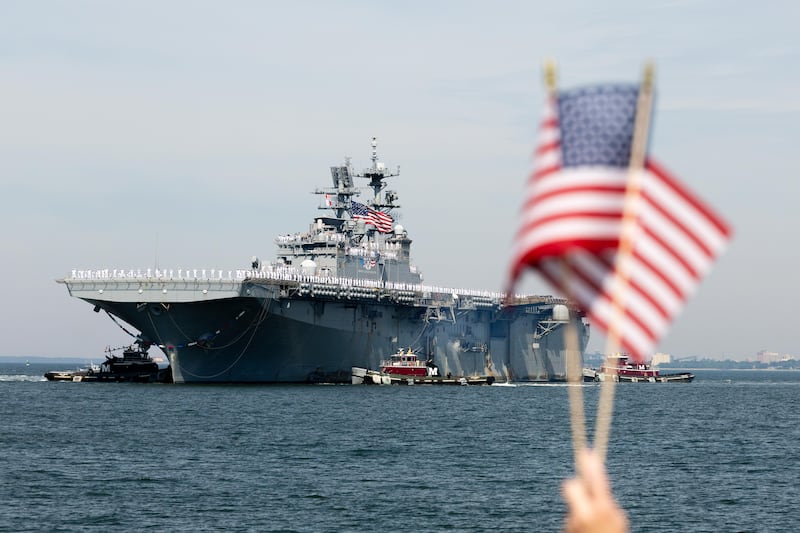
The U.S. rolled out serious hardware for Southern Spear. Seen here: USS Iwo Jima returning to Naval Station Norfolk in June.
Mike Kropf/Getty Images
He also advocated for the operation personally, saying around the time of its announcement in a Pentagon press release that “Nobody would do it better [than the U.S.]” and that “our focus with Southern Spear is these boats and the trafficking that must stop.”
He added: “Don’t get in a boat, because it’s going to end poorly for you.”
In September, the Pentagon issued an update on the operation’s progress, bragging that Southern Spear had seen “a 65 percent reduction in the Western Caribbean, a 60 percent reduction in the Eastern Caribbean and a nearly 50 percent reduction in key areas of the Eastern Pacific,” in “illicit maritime activity.”
But a July Washington Post report cited an assessment by the Drug Enforcement Administration, as well as interviews with current and former officials, which said that it had not reduced the amount of cocaine entering the U.S. It also had not affected the price. Instead, they said it had caused criminal organizations to diversify and find new strategies.
See more of our coverage in your search results.

Got a tip? Send it to The Daily Beast here.
Unlock a year of full access to The Daily Beast for $35.
Monthly
$1
First month then $5.99/month
Annual
$35
First year then $59.99/year
Premium
$79
First year then $119.99/year
*Substack access provided by the next business day, using your subscription email. Choosing the Premium plan constitutes your permission to share your subscription email with Substack and your agreement to Substack’s Privacy Policy.
Looks like you already have a subscription!
- Account (completed)
- Payment (completed)
- Confirmation (completed)
You're all set!
Thanks for subscribing.
- 1Account
- 2Payment
- 3Confirmation
Sign in or create an account
Register below to read this article for free or subscribe
to unlock unlimited access to The Daily Beast.
Monthly
$1
First month then $5.99/month
Annual
$35
First year then $59.99/year
Premium
$79
First year then $119.99/year
*Substack access provided by the next business day, using your subscription email. Choosing the Premium plan constitutes your permission to share your subscription email with Substack and your agreement to Substack’s Privacy Policy.
Already have an account? Sign In
Looks like you already have a subscription!
- Account (completed)
- Payment (completed)
- Confirmation (completed)
You're all set!
Thanks for subscribing.
- 1Account
- 2Payment
- 3Confirmation
Sign in or create an account
Login dialog
Loading comments…