Trump’s EPA Goon Humiliated Live on CNN
Lee Zeldin was caught off guard when the network exposed a faulty EPA hotline live on air.

Get The Swamp newsletter delivered straight to your inbox
By clicking “SIGN UP” you agree to our Terms of Use and Privacy Policy.
Lee Zeldin was left scrambling during a live CNN interview when the network revealed that a phone number he’d given to Iowa residents affected by a dangerous military operation didn’t even work.
The EPA administrator had shared the number for residents living near the Iowa Army Ammunition Plant to report any problems following Wednesday’s controlled detonation of thousands of pounds of hazardous explosives.
But CNN put the contact details to the test, only to discover they were invalid.

Zeldin provided the wrong phone number live on air.
Chip Somodevilla/Getty Images
“Our team called the number just to make sure it was working because they couldn’t find it online. That number isn’t a working number,” the anchor told Zeldin, before explaining that the network would instead display an alternative EPA hotline.

The awkward exchange came after the U.S. Army detonated approximately 9,500 pounds of degraded lead azide at its ammunition plant in Middletown, Iowa. The blast sent a towering plume of smoke into the sky and prompted safety concerns among nearby communities.
Zeldin insisted the government’s efforts had exceeded expectations, echoing President Donald Trump’s assessment of the operation.
“Early reports from Iowa are that the Army’s mitigation efforts have far exceeded expectations,” Trump said on Truth Social.
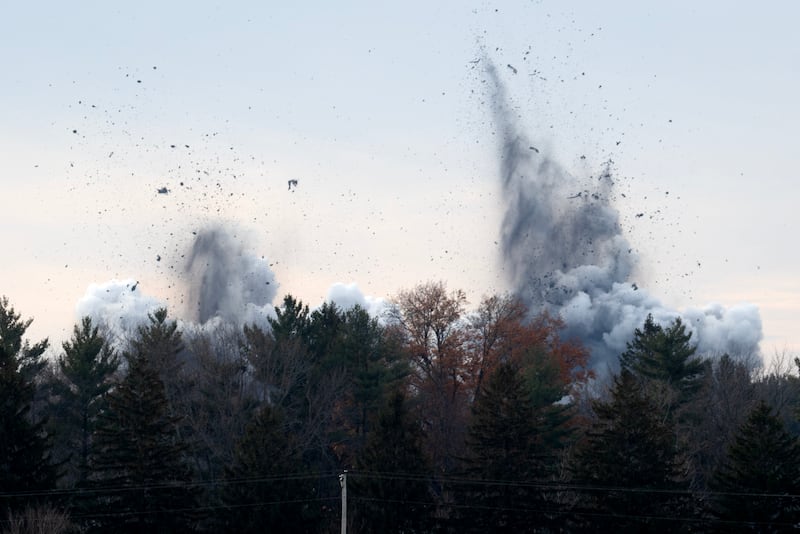
The blast caused a large plume of smoke to rise hundreds of feet into the air above the plant.
Scott Olson/Getty Images
However, the explosion had been preceded by warnings about potentially devastating environmental consequences.
“Everyday Iowans are entitled to know how Middletown came to this situation, and learn why the administration believes this is the best path forward,” Governor-elect Rob Sand wrote on X ahead of the explosion.
Senator-elect Josh Turek wrote that the materials should have “never have been allowed to degrade to this point.” He added: “There is no excuse for such a failure of transparency and communication, especially when the health and safety of the public is involved.”

Meanwhile, Army maps reviewed by The New York Times showed that a failed detonation could spread toxic lead particles across as much as 150 square miles of farmland.
“Consider avoiding the highlighted area or remain indoors with windows/doors closed,” the maps said.
They also warned that “children under six are especially vulnerable to lead exposure.”

A man holds a cat he recently found outside his home near the US Army's Iowa Army Ammunition Plant as he prepares for the detonation.
Jim Urquhart/REUTERS
Lead exposure poses serious health risks, with no amount considered safe.
Young children and pregnant women are particularly susceptible, as even minimal exposure can have lasting consequences. The toxic metal can harm the brain, kidneys and nervous system, while potentially disrupting childhood development and causing complications during pregnancy.
Residents were initially offered temporary relocation through FEMA, but received an emergency alert roughly an hour before the blast instructing them to shelter in place instead.

Trump said the explosion "far exceeded expectations.”
Evelyn Hockstein/REUTERS
The operation was deemed necessary after officials discovered that 68 drums containing the country’s entire stockpile of lead azide had deteriorated to the point that they risked exploding spontaneously.
“Inaction is no longer an option,” Eric Shirley, commanding general of U.S. Army Sustainment Command, said in a statement.
The Daily Beast has contacted the EPA for comment.
See more of our coverage in your search results.

Got a tip? Send it to The Daily Beast here.
Unlock a year of full access to The Daily Beast for $35.
Monthly
$1
First month then $5.99/month
Annual
$35
First year then $59.99/year
Premium
$79
First year then $119.99/year
*Substack access provided by the next business day, using your subscription email. Choosing the Premium plan constitutes your permission to share your subscription email with Substack and your agreement to Substack’s Privacy Policy.
Looks like you already have a subscription!
- Account (completed)
- Payment (completed)
- Confirmation (completed)
You're all set!
Thanks for subscribing.
- 1Account
- 2Payment
- 3Confirmation
Sign in or create an account
Register below to read this article for free or subscribe
to unlock unlimited access to The Daily Beast.
Monthly
$1
First month then $5.99/month
Annual
$35
First year then $59.99/year
Premium
$79
First year then $119.99/year
*Substack access provided by the next business day, using your subscription email. Choosing the Premium plan constitutes your permission to share your subscription email with Substack and your agreement to Substack’s Privacy Policy.
Already have an account? Sign In
Looks like you already have a subscription!
- Account (completed)
- Payment (completed)
- Confirmation (completed)
You're all set!
Thanks for subscribing.
- 1Account
- 2Payment
- 3Confirmation
Sign in or create an account
Login dialog
Loading comments…