Blogs and Stories
Our Crashing Portfolio
AP Photos
The Treasury has invested billions in troubled companies—but how's our money actually doing? Duff McDonald compared our taxpayer portfolio with the S&P 500—and discovered just how bad an investment junk companies can be.
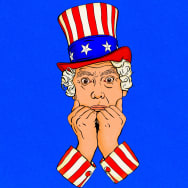
Uncle Sam, you’re fired. Not as a patriotic symbol, of course. But you’re a pretty poor portfolio manager, based on a Daily Beast stress test of the largest taxpayer investments in private industry over the past six months.
When Treasury Secretary Hank Paulson got Uncle Sam into the mutual-fund business by investing taxpayer money in the country's biggest banks with last year’s TARP bailouts, there might have been cause for optimism. The guy ran Goldman Sachs, after all. He knew a cheap stock when he saw one, right? Throw some auto-industry exposure into the mix, and we the people might have thought we were sitting on the kind of balanced portfolio that Suze Orman always touts. We were not. And both Paulson and his successor Tim Geithner have shown that they most certainly do not have the Midas Touch when it comes to investment returns.
Our worst investment was Citigroup. We’ve lost 77.7 percent on our $25 billion October investment in that goat. Why again does CEO Vikram Pandit still have a job?
In fairness, it's not like these guys were tasked with being the best money managers they could be. Instead, they were tasked with saving the system. Sadly, though, it looks like the judgment of the market is that some of the companies they thought worthy our largesse were destined for the scrap heap in any event.
Let’s break it down. If you look at infusions of taxpayer money of $5 billion or more since last October, you will find that, on balance, Uncle Sam is a terrible investor. That’s a total of $268.1 billion invested. As of Friday’s close, our portfolio was worth just $202.4 billion. We’re out almost $66 billion in six months. On an annualized basis, that’s a 32.2 percent loss. Putting all that money into a plain-vanilla S&P 500 index fund would have lost us just 4.4 percent during that time.
How did we calculate this? To simplify, we assumed that all government investments were through buying common stock, calculated the share price the day of the investment, and then how much those same shares were worth Friday afternoon. To be fair, most of the investments weren't in common stock, but rather so-called preferred stock, which is essentially common stock that pays a dividend. In the majority of these cases, that dividend was 5 percent. Factor those dividends in, and our loss still runs about 27 precent—more than six times the decline of the S&P 500. For those scoring at home, it breaks down, in billions, like this:
DATE COMPANY INVESTMENT CURRENT VALUE +/-
10/28/08 Wells Fargo $25.0 $14.1 -43.4%
10/28/08 JPMorgan Chase $25.0 $21.4 -14.3%
10/28/08 Citigroup $25.0 $5.6 -77.7%
10/28/08 Bank of America $15.0 $5.6 -62.3%
10/28/08 Morgan Stanley $10.0 $17.1 +70.7%
10/28/08 Goldman Sachs $10.0 $13.6 +35.5%
11/14/08 U.S. Bancorp $6.6 $4.5 -32.2%
11/25/08 AIG $40.0 $31.2 -22.0%
12/31/08 Citigroup (2nd ) $20.0 $8.9 -55.4%
12/31/08 PNC Financial Services $7.6 $5.8 -23.5%
12/31/08 SunTrust Banks $4.9 $2.2 -53.6%
01/09/09 Bank of America (2nd) $10.0 $6.7 -33.3%
01/16/09 Bank of America (3rd) $20.0 $24.2 +20.8%
01/16/09 Citigroup (3rd) $5.0 $4.3 -14.6%
02/17/09 General Motors $14.3 $11.8 -17.4%
04/17/09 AIG (2nd) $29.8 $25.4 -14.8%
Total $268.1 $202.4 - 32.2%
As you can see, we have the bad habit of buying as the stock prices continue to fall. Didn’t anyone tell Tim Geithner that there is a time to let a losing bet go? We made a $40 billion investment in AIG when its stock was trading for $1.77 a share. (Note to Uncle Sam: Penny stocks…not good.) We doubled down with an additional $29.8 billion when it was at $1.62 a share. We’re now out $13.2 billion on the combined purchases. I know we were bailing out Goldman Sachs—AIG’s largest counterparty—but why didn’t we just let AIG fail and invest in Goldman instead?


The issue behind is leadership. We don't have any. The world's "e con oh me," (to adopt the language of jack-foot, the missing poster - I think his alias was legs, not foot, but the beastie thought police also removed every thing he wrote in their archive - what's up with that?) in America, leadership, relative to the economy is just that, a foursome of lobbyists and congressional committee chair people on a golf course trying to fig a way to shaft me out of my take home pay. e con oh me.
The money Congress dumped into the banks, A.I.G. etc is money we don't really have, so the printing presses are running while the economy contracts world wide and consumers everywhere are sitting on what they have. Sooner rather than later a stick of chewing gum will go for a buck, while 320 gigs of hard drive sells for less than $70.
Doesn't that tell you our elected officials don't have a clue what to do? The corporate bailout seems more like a political payoff then economic solution.
This article begins with a faulty premise. It assumes that the goal of the federal government was to make money from it's investments. It wasn't. If you recall, the goal was to support an economic system driven to the breaking point by greed and a lack of responsibility.
Uncle Sam's real stock market problem was a total lack of oversight by the money police and a total flood of self-interest and greed by the people making the trades.
Let's not get fooled again.
Agreed. Uncle Sam should not be in the business of being a hedge fund manager, especially not with tax dollars. Uncle Sam is the caretaker of the financial system as a whole and should be working for the interests of the public, not private concerns. Propping up these banks sucks, but it is better to do this in the short term than to allow many of them to fail and threaten the financial system as a whole. Its not really an investment, its like being on life support until new regulations work their way through the Congress.
Still chasing after quarterly profits? Isn't that short term outlook part of what started this mess?
Ok, I was never for any of the bailouts. There are plenty of smaller players that could have risen up to might demand that didn't make the foul mistakes of the bloated big banks. They all should have failed. I can only assume we did this to honor the contracts of foriegn countries so that they will continue to do business with U.S. companies in the future. However, we should have honored those contracts and still allowed the big banks to fail... Onward...
Despite the bailouts, this article is not fair. The bailouts aren't for the short haul. They are for a long term. I suppose he states this in the last paragraph, but then he goes back to talking about how the government isn't good at stock picking. The government isn't a stock picker in the first place. It would be like calling be a terrible Doctor...Well sure, but I'm not a Doctor in the first place!
The "investments" by the government are much worst than that because the author failed to include the taxpayer bailout of Fannie Mae and Freddie Mac; and the $306 billion in government guarantees for Citigroup securities and the $115 billion in guarantees for Bank of America securities and the $33 billion in guarantees for Bear Stearns securities. It also doesn't include the $60 billion tax loss carry forward Wells Fargo was able to take with the acquisition of Wachovia. There are so many other costs such as the expansion of the Federal Reserve balance sheet, FHA loan guarantees, zero Fed fund rates, a TALF program and the reminder of the $700 billion TARP that haven't been factored into the author's analysis. The financial meltdown caused by a greed Wall Street and aided an abetted by rating agencies and the Congress is a several trillion cost to the taxpayers. Now the contagion has spread to the auto industry where taxpayers will never see a penny back from the failed Chrysler and will provide tens of billions more to GM. In the near future this failure will spread to health care as the government seeks to impose its wisdom onto the healthcare industry. This will lead to a situation as large as the financial meltdown because the health industry is larger than the financial industry.
The messages are that bailouts are bad and just prolong the problem and that you can't get something for nothing (its costs money.)
Premature! Uncle Sam is going to make it all back through those distressed investments in GM and Chrysler.
Thank you.
As a first time user, your comment has been submitted for review. It can take anywhere from a few hours to a day or two for your comment to be reviewed, depending on the time of week and the volume of comments we receive.
Please log in to leave comments.