Blogs and Stories
In Praise of Tourette's
Getty Images
Nationally syndicated cartoonist and musician Jeffrey Koterba describes how the disease has been his artistic muse—even if it does lead to the occasional embarrassing outburst.
I owe it all to dopamine.
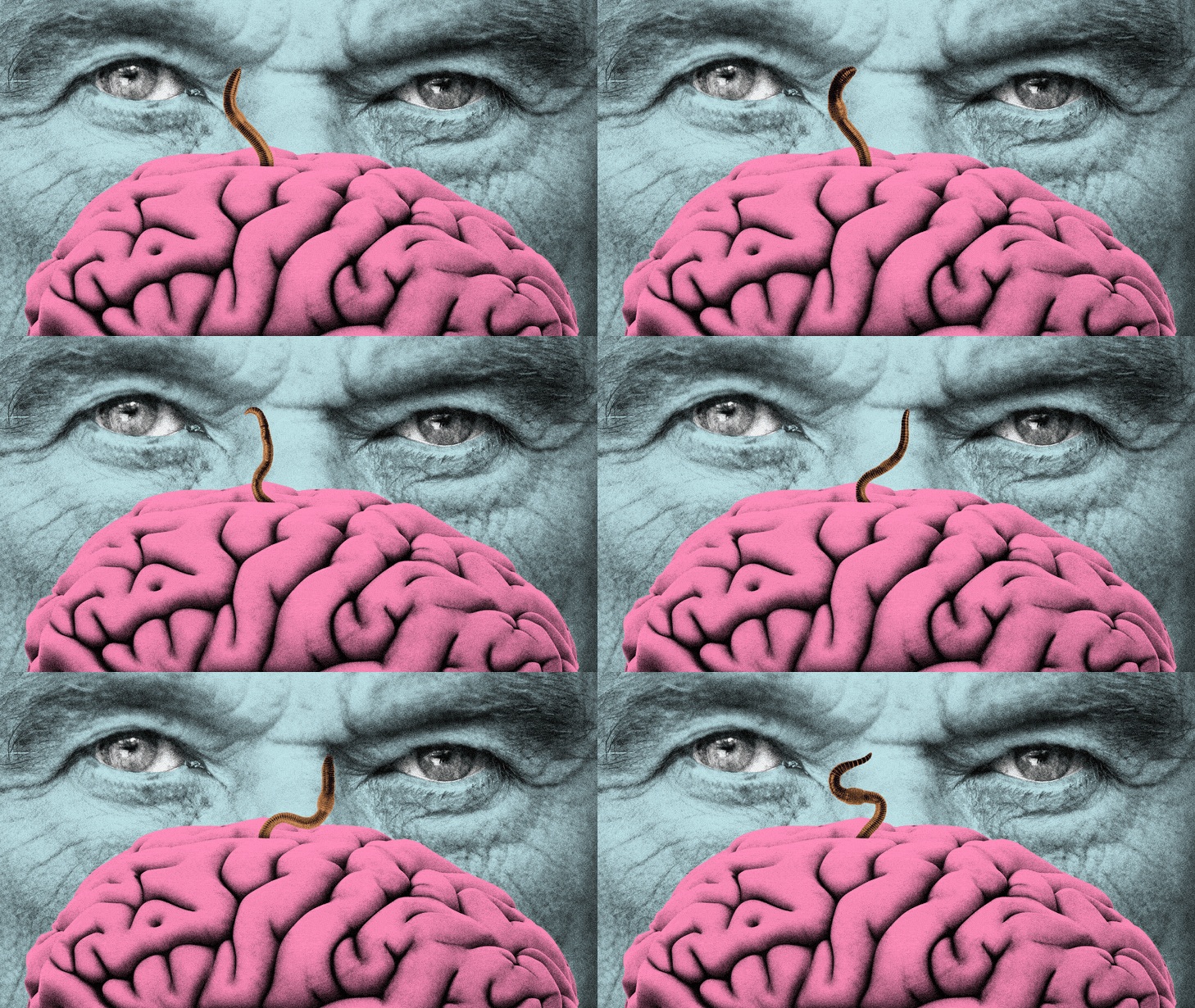
If not for my brain’s excess of this illicit-sounding neurotransmitter (dope), would I be able to come up with six editorial cartoons a week? Without Tourette’s syndrome, would I hear odd phrases and rhythms in my head that lead to songs and guitar solos?
What if without Tourette’s, I might be more creative? How many days of my life have been squandered following my muse on a meandering voyage to nowhere?
Besides dopamine, serotonin might play a role, too, researchers say, as well as other brain chemicals and receptors. Famed neurologist Oliver Sacks—my hero—has theorized that there is a connection between Tourette’s and creativity. Some experts have even floated the idea that Mozart suffered from Tourette’s. But the science probably is better left to the experts who don’t have ink-stained fingers and piles of sketches at their feet. Whatever the case, I’m convinced that while everyone may have a muse, mine gets high—and therefore, even more inspired—on the weird chemical makeup of my brain.
Of course, I didn’t always believe this. In fact, I wasn’t diagnosed until well into adulthood. As a kid, my father said I had “nervous habits.” He had them, too. He was a jazz drummer whose strange eye movements and frequent throat clearing seemed to diminish when he let loose on the tom-toms.
In the late 1960s and 1970s, when I was growing up, there wasn’t the kind of awareness that exists today for anomalies of the brain, at least not in my little world, on the southern fringes of Omaha, Nebraska, near the meatpacking district. So I went for many years believing that my tics and twitches were simply what my father called them, not knowing that, all along, I had inherited from him a peculiar neurological disorder. And it is peculiar.
At any given moment, my brain might tell me that I absolutely must grunt. It doesn’t matter if I’m alone or in public, although more often than not, the desire seems to be stronger when I’m in potentially embarrassing situations—like on a crowded elevator or at a funeral. Likewise, my brain might tell me to blink my eyes, or to stretch my mouth, or to screech like a hungry animal in the jungle at dusk, or to contort my body like a deranged acrobat.
Inklings. By Jeffrey Koterba. 272 pages. Houghton Mifflin Harcourt. $25.
I might also have to step on a speck on the floor, in a very specific way, over and over, or stick my pinky into the “F” hole of my Gretsch archtop guitar, or stare out of the corner of my eye, at a point of reference in the room, which, I suppose, gets into obsessive compulsive behavior, which is often a component of Tourette’s.
I can go long stretches, days or weeks, without a major outburst. Then, without notice, I’ll grunt and thrash about, confounding those in my path. I wish I could think of these episodes as wild lovemaking with my stoned muse, but in the end, my body is left utterly depleted and spent on the floor, my throat raw, sheets of paper left blank and without a single idea.
Whether my body is twitching or calm, my mind is working full-steam, toying with words, repeating phrases. My muse is also capable of connecting two or three completely unrelated concepts, and combining the elements in unexpected ways. Usually, these efforts are time wasters. But it’s that diamond in the rough I count on, the cartoon or song that emerges from the nonsense.


gak001
Absolutely fascinating - thanks for sharing!!!
Thank you.
As a first time user, your comment has been submitted for review. It can take anywhere from a few hours to a day or two for your comment to be reviewed, depending on the time of week and the volume of comments we receive.