A Very Different Interfaith Seder
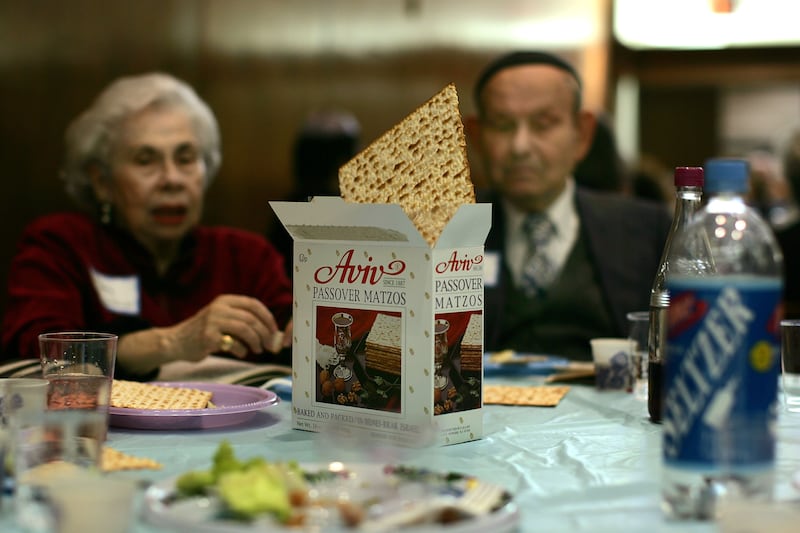
Paul Scham joined about 40 other Jews, Muslims, and Christians for a third Passover Seder this year.
Spencer Platt / Getty Images
Get the Beast Digest newsletter delivered straight to your inbox
By clicking “SIGN UP” you agree to our Terms of Use and Privacy Policy.
Last week, I joined about 40 other Jews, Muslims, and Christians at a third Passover Seder. Now, I realize some Jews (especially Israelis) would consider that a cruel and unusual punishment, but I assure you it wasn't; in fact, I subject myself to it every year.Even more unusual than the company was the venue—a mosque. In fact, the Seder took place at one of the largest and most influential mosques in the country, the ADAMS Center (an acronym for the All Dulles Area Muslim Society), in Northern VA, not far from D.C. The participants came from a variety of backgrounds: secular and religious Muslims, Jews affiliated with various groups, some Christian pastors and laypeople. The theme was peace and two states, but by no means did we see eye to eye on everything.
This was the tenth time this Seder has been held, and the fifth at ADAMS. I've been involved since the beginning, because the main organizer, Andrea Barron, is an old friend of mine, whom I met in Israeli-Palestinian peace work in the early days of the First Intifada. But this isn't your usual anodyne interfaith Seder, where all is prescribed by ritual and controversial topics are avoided. Far from it.
Andrea (and her collaborators) designed the Seder to maximize discussion of what unites us—and what divides us. She introduced discussions of modern plagues, such as religious extremism, terrorism, and ecological factors. A Jew talked about Jewish terrorism, and Muslims attacked terrorism in the name of Islam. Some secular Muslims were very critical of aspects of Islam. A Muslim woman (in full headscarf) talked about her family members who had fought for U.S. democracy in World War II and other wars, in the American army. One Muslim referred to AIPAC as a plague, leading to a surprisingly balanced discussion of what AIPAC is and isn't. Egyptians were sensitive to the seeming anti-Egyptian themes in the text, but were most concerned with relating freedom to the current situation in Egypt. One remarkable Christian evangelical pastor described his work in the West Bank with Orthodox Jews and Palestinian villagers, and even called himself a talmid (student) of the late Rabbi Menachem Froman.
Each year a specific theme is chosen and some of the discussion is shaped around it. This year it was the gap between “aspirations and action,” with particular reference to the frustration of Egyptians with regard to the path of their revolution. I mentioned the disappointments of those of us who have been working for decades on Israeli-Palestinian peace issues.
ADAMS has been a leader in reaching out to Jewish and Christian groups in the area. A few years ago, I was at an event there commemorating Yom Hashoah, Holocaust Remembrance Day, when a Jewish woman talked about how she had been hidden from the Nazis by Albanian Muslims. Imam Majjid of ADAMS had previously organized an interfaith visit to the Holocaust Museum as a response to Ahmadinajad's Holocaust denial conference.
This year, ADAMS provided much of the food for the Seder. We told them in great detail what the laws of Passover are and they followed them carefully, though I emphasize that the food wouldn't be considered kosher for Passover by strict halakhic standards.
The usual goal of those organizing interfaith activities is just to expose people to each other’s customs, which is useful, of course. But a Seder is uniquely formatted to encourage dialogue. In this case, Muslims are invariably surprised at the connections between Jewish rituals and modern politics. In previous years, themes have explicitly included how Zionism is and isn’t related to traditional Judaism, and what most Jews actually believe, as opposed to what is said in the Seder.
We learned this year that ADAMS had reported on the Seder at some national Muslim gatherings, and mosques in Texas, California, New York, and elsewhere had expressed interest in hosting Seders in the future. Ten years ago, during the Second Intifada and right after 9/11, I think very few Muslims would have been interested. Now, I think attitudes have changed enough to enable this to go national and mainstream. I hope it does; I've found it extraordinarily enjoyable, and have also met some remarkable people at these Seders over the years.
See more of our coverage in your search results.

Got a tip? Send it to The Daily Beast here.
Unlock a year of full access to The Daily Beast for $35.
Monthly
$1
First month then $5.99/month
Annual
$35
First year then $59.99/year
Premium
$79
First year then $119.99/year
*Substack access provided by the next business day, using your subscription email. Choosing the Premium plan constitutes your permission to share your subscription email with Substack and your agreement to Substack’s Privacy Policy.
Looks like you already have a subscription!
- Account (completed)
- Payment (completed)
- Confirmation (completed)
You're all set!
Thanks for subscribing.
- 1Account
- 2Payment
- 3Confirmation
Sign in or create an account
Register below to read this article for free or subscribe
to unlock unlimited access to The Daily Beast.
Monthly
$1
First month then $5.99/month
Annual
$35
First year then $59.99/year
Premium
$79
First year then $119.99/year
*Substack access provided by the next business day, using your subscription email. Choosing the Premium plan constitutes your permission to share your subscription email with Substack and your agreement to Substack’s Privacy Policy.
Already have an account? Sign In
Looks like you already have a subscription!
- Account (completed)
- Payment (completed)
- Confirmation (completed)
You're all set!
Thanks for subscribing.
- 1Account
- 2Payment
- 3Confirmation