Did China Just Test a New Satellite-Killer?
The Chinese just fired off a rocket that could turn a satellite into scraps. And they’re not the only ones positioning themselves for a war in space.
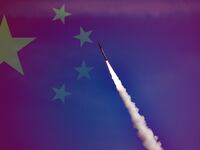
Photo Illustration by The Daily Beast
It’s possible China just tested a powerful new rocket capable of blasting into space with little notice and knocking out America’s low-orbiting satellites.
Possible, but not certain. For sure, the Chinese government launched something from the Korla Missile Test Complex in western China on Oct. 30. Photos circulating online depict a rocket corkscrewing into the upper atmosphere, trailing a winding, glowing contrail in the night sky.
Chinese media, which the country’s Communist Party closely monitors and censors, confirmed the launch of the HQ-19 rocket but insisted it was part of a missile-defense test, the likes of which the U.S. military conducts routinely.
But there’s a catch. In terms of hardware, there’s essentially no difference between a defensive missile-intercepting rocket and an offensive anti-satellite rocket, or ASAT. “The tech is the same,” Jeffrey Lewis, a missile-defense expert, told The Daily Beast via email.
And that ambiguity creates a loophole in the world’s informal agreement to keep weapons out of space—an agreement that, to be fair, the United States, Russia, and China have all been violating with greater and greater frequency as military tensions on Earth’s surface expand into space.
Get the best of The Beast delivered right to your inbox
By clicking “SUBSCRIBE” you agree to our Terms of Use and Privacy Policy.
Indeed, the U.S. Missile Defense Agency tested a missile-interceptor similar to the HQ-19 on the same day the Chinese launched their own rocket.
Whatever its purpose, the HQ-19 test was a seemingly impressive one. Blasting off the high-tech Korla test site, the two-stage, solid-fueled rocket—more than 20 feet from tip to tail—lanced into the air at speeds up to Mach 4 and then began a frenetic series of maneuvers, resulting in the winding contrails that Chinese social media users photographed and shared.
The maneuvers have a point—they help the rocket burn off excess energy and zero in on a moving target. The U.S. Army’s Terminal High-Altitude Air-Defense missile, which entered service in 2008 and protects American bases in the Pacific, performs essentially identical maneuvers.
THAAD, which can fly as fast as Mach 8, is primarily a defense against attacking rockets, especially nuclear-tipped intercontinental ballistic missiles, or ICBMs, during the middle (“midcourse”) or end (“terminal phase”) of their flight. The military calls that its “anti-ballistic missile” mission, or ABM.
But THAAD, much like the U.S. Navy’s own SM-3 ship-launched missile-interceptors, can hit satellites in low orbit, too. In fact, in 2008 the Navy did exactly that, taking a dying spy satellite out of commission. “ICBM-range nuclear warheads a midcourse ABM system is trying to hit are flying through space at the same altitude as many low-Earth-orbit satellites,” Brian Weeden, a technical adviser to the Colorado-based Secure World Foundation, told The Daily Beast via email.
So if the HQ-19 is similar to THAAD and the SM-3—and it is—then of course it can kill satellites. Lots of different kinds of rockets can kill satellites, as long as you aim them carefully. In perhaps the most notorious example, in 2007 China hit one of its own old satellites with a rocket, scattering thousands of chunks of dangerous debris across low orbit.
The aiming is the hard part, since you’ve got to precisely track a target satellite—a process the military calls “situational awareness”—before you can hit it. And that’s where China has problems. “The U.S. is far and away more capable than China in this regard,” Gregory Kulacki, a senior analyst with the Union of Concerned Scientists in Massachusetts, told The Daily Beast in an email.
Where Beijing’s space-situational-awareness network is mostly limited to radars, telescopes, and infrared sensors on the ground inside China, the United States’ own network includes sensors on the ground and at sea all over the world—not to mention sophisticated surveillance satellites in very high, virtually untouchable, Earth orbits.
So yes, China might have tested a satellite-killer. But it’s hardly alone in that regard. And in one way that really matters, China is still playing catch-up when it comes to knocking satellites out of orbit.
See more of our coverage in your search results.

Got a tip? Send it to The Daily Beast here.
Register below to read this article for free or subscribe
to unlock unlimited access to The Daily Beast.
Monthly
$1
First month then $5.99/month
Annual
$35
First year then $59.99/year
Premium
$79
First year then $119.99/year
*Substack access provided by the next business day, using your subscription email. Choosing the Premium plan constitutes your permission to share your subscription email with Substack and your agreement to Substack’s Privacy Policy.
Already have an account? Sign In
Looks like you already have a subscription!
You're all set!
Thanks for subscribing.