Facebook Comes Under Increasing Fire for Its White-Male Board
The social-media company's board is under renewed criticism for a lack of gender and ethnic diversity.

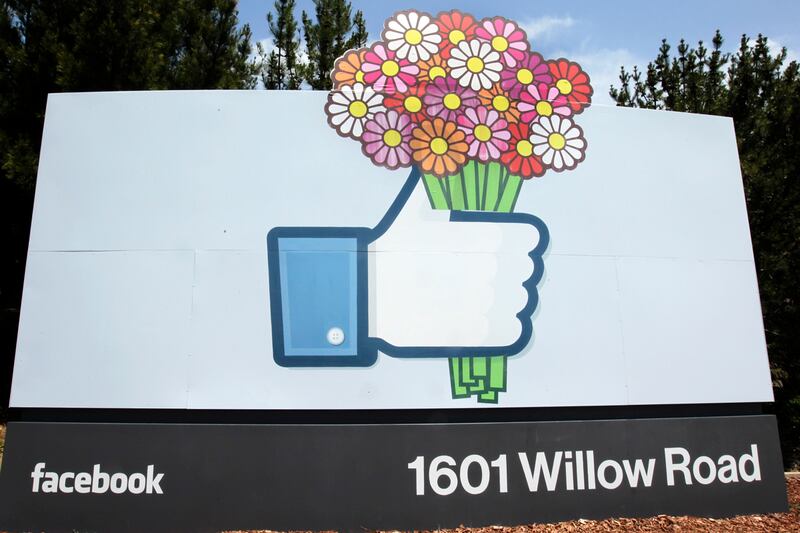
Paul Sakuma / AP Photos
Get the Beast Digest newsletter delivered straight to your inbox
By clicking “SIGN UP” you agree to our Terms of Use and Privacy Policy.
As Facebook dominates the news with its initial public offering, activists are seizing the moment to pressure the company to add some estrogen and ethnicity to its white-male board.
A women’s rights group called Ultraviolet, which has been running an online petition that claims to have attracted more than 50,000 signatures, is escalating its push, posting a new YouTube video called “Do Women Have a Future at Facebook?” The video features photos of successful women like Hillary Clinton getting their heads cropped off and replaced with the smiling face of Facebook founder Mark Zuckerberg.
“Facebook has grown off the backs of women, who make up the majority of its users and are responsible for the majority of sharing and fan activity on the site,” the group says on its site. An all-male board, the group says, is “not just wrong, it’s bad for business.”
Women make up 55 percent of Facebook’s users, according to social-media research firm Socialbakers.
A related campaign, called Face It, criticizes the lack of ethnic diversity on the seven-member board. “Seven white men: That’s ridiculous,” the group says on its site, alongside headshots of the men. The campaign, which lists dozens of human-rights groups and corporate executives as supporters, also has its own YouTube video. Called “Face It, Facebook,” the video cites a recent Zuckerberg letter to investors that says: “Facebook was not originally created to be a company. It was built to accomplish a social mission—to make the world more open and connected.”
That message is at odds with the pale-faced board, activists say.
Facebook had no comment, citing a “quiet period” mandated by the Securities and Exchange Commission amid the company’s IPO.
Facebook does have a high-profile female executive, chief operating officer Sheryl Sandberg, who oversees the company’s business operations, including sales, marketing, and communications. An outspoken advocate for women, Sandberg sits on the board of the global women’s rights group Women for Women International. As a host of Newsweek and The Daily Beast’s Women in the World summit earlier this year, she addressed the lack of women in high-ranking jobs head-on, saying, “In every area, women have steadily made progress—except at the top. Where are we? Are we stalled?”
Zuckerberg has said that he doesn’t care about the gender of members of his board of directors, telling The New Yorker last year: “We have a very small board. I’m going to find people who are helpful, and I don’t particularly care what gender they are or what company they are. I’m not filling the board with check boxes.”
Susan Stautberg, co-chairwoman of Women Corporate Directors, an organization for female corporate board members, says Zuckerberg’s thinking is flawed. “If you’re trying to expand a company globally, then you want someone on the board who has built a global brand,” she says. “Most of these guys on Facebook’s board all have the same skills—they’re mostly from Silicon Valley and Washington. You want someone who has worked in China and India and rising markets. You want someone who has marketed to women. When you’re putting together a board, you don’t want your best friends, you want the best people.”
Facebook’s board members are Zuckerberg; Marc Andreessen, cofounder of venture-capital firm Andreessen Horowitz; Jim Breyer, a partner at venture-capital firm Accel Partners; Peter Thiel, a partner at venture-capital firm Founders Fund; Donald E. Graham, chairman and CEO of The Washington Post Company; Reed Hastings, chairman and CEO of Netflix; and Erskine Bowles, president emeritus of the University of North Carolina.
Facebook isn't the only social-media company with an estrogen-free board. Other companies with all-male boards include Twitter, social-gaming site Zynga, and Internet-radio site Pandora. LinkedIn has one woman on the board, as does Groupon. Google has three.
Having zero female directors does not appear to be a good business plan, research shows. Companies with women on the board perform substantially better than companies with all-male boards, according to a 2011 study of Fortune 500 companies conducted by the research group Catalyst. The study showed that over the course of four to five years, companies with three or more female board members, on average, outperformed companies with no female board members by 84 percent when it came to return on sales and by 60 percent when it came to return on invested capital.
Still, women are not exactly snapping up board seats, a separate Catalyst study found. Women held 16.1 percent of Fortune 500 board seats in 2011, compared with 15.7 percent in 2010. Women of color held 3 percent of board seats. Less than one-fifth of companies had 25 percent or more female board members. About one in 10 companies had no women serving on the board.
Facebook may secretly be on the lookout for a female board member, according to a recent Bloomberg report. Citing unnamed sources, Bloomberg said Facebook had enlisted the corporate-recruitment firm Spencer Stuart to help seek some diversity. Spencer Stuart says it does not comment on clients due to confidentiality agreements.
See more of our coverage in your search results.

Got a tip? Send it to The Daily Beast here.
Unlock a year of full access to The Daily Beast for $35.
Monthly
$1
First month then $5.99/month
Annual
$35
First year then $59.99/year
Premium
$79
First year then $119.99/year
*Substack access provided by the next business day, using your subscription email. Choosing the Premium plan constitutes your permission to share your subscription email with Substack and your agreement to Substack’s Privacy Policy.
Looks like you already have a subscription!
- Account (completed)
- Payment (completed)
- Confirmation (completed)
You're all set!
Thanks for subscribing.
- 1Account
- 2Payment
- 3Confirmation
Sign in or create an account
Register below to read this article for free or subscribe
to unlock unlimited access to The Daily Beast.
Monthly
$1
First month then $5.99/month
Annual
$35
First year then $59.99/year
Premium
$79
First year then $119.99/year
*Substack access provided by the next business day, using your subscription email. Choosing the Premium plan constitutes your permission to share your subscription email with Substack and your agreement to Substack’s Privacy Policy.
Already have an account? Sign In
Looks like you already have a subscription!
- Account (completed)
- Payment (completed)
- Confirmation (completed)
You're all set!
Thanks for subscribing.
- 1Account
- 2Payment
- 3Confirmation