God Bless This Commonsense Pope for Speaking the Truth
Francis at the White House spoke less as a Catholic and more as a man who wishes to represent all of humanity.
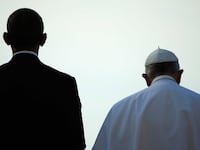
Jonathan Ernst/Reuters
Get the Beast Digest newsletter delivered straight to your inbox
By clicking “SIGN UP” you agree to our Terms of Use and Privacy Policy.
God bless the common sense of this very uncommon pope. Pope Francis’s first address in the United States, given on the White House lawn, could not have been simpler, more straightforward, and more genuine had he used that phrase dear to Americans, “We hold these truths to be self-evident.”
There is no question his remarks will be seen by some as a kind of progressive manifesto because of his pleas for economic justice and sane environmental policies, yet within the context of his church and his teachings, and his understanding of what makes the United States a great nation, his logic was unassailable.
“Freedom,” he said, “remains one of America’s most precious possessions,” calling on everyone in this country to “preserve and defend that freedom from everything that would threaten of compromise it.”
Of course he emphasized religious freedom—potentially a difficult question when the state imposes rules and edicts on believers, whether making institutions pay for birth control, or bureaucrats issue marriage licenses to same-sex couples. But the core of the pope’s message, the heart and soul of it, was tolerance.
“Together with their fellow citizens, American Catholics are committed to building a society which is truly tolerant and inclusive,” Francis told some 15,000 people invited to hear him speak on the South Lawn. Catholics, as he sees them, and would lead them, are committed “to safeguarding the rights of individuals and communities, and to rejecting every form of unjust discrimination.”
Addressing the question of climate change, Francis did not speak as if his words came from heaven, he talked like a man who has seen the world and who speaks for humanity, in every sense of the word.
“It seems clear to me that climate change is a problem which can no longer be left to a future generation,” he said. “When it comes to the care of our ‘common home,’ we are living at a critical moment of history. We still have time to make the changes needed ….”
For Francis, this urgent message fits into a broader picture of a just global society.
“Change demands on our part a serious and responsible recognition not only of the kind of world we may be leaving to our children, but also to the millions of people living under a system which has overlooked them.” Citing a telling phrase spoken by Rev. Martin Luther King Jr., Francis said, “We have defaulted on a promissory note and now is the time to honor it.”
We will hear a great deal more from the pontiff in the days to come, as he speaks to a joint session of Congress tomorrow, and addresses the United Nations on Friday. And there will be remarks, most likely, that will not please America’s progressives: a refusal to contemplate women as priests, a deep resistance to same-sex marriage, disappointments regarding justice for people sexually abused by priests, and no movement, certainly, on the question of abortion.
But on the fundamental questions of humanity’s survival and the need to live together as one great, tolerant family, the message will resonate widely, and be understood easily by Americans who believe in reason as well as faith, or, indeed, who have no faith at all.
The Church of Francis is not a church of fundamentalism, fanaticism or even “creationism.” His church (though not that of all his clergy) is a church that accepts the humanness of humanity and the benefits of science.
As the head of the Pontifical Academy of Sciences in Rome told me a few months after Francis was elected pope, “If we don’t accept science, we don’t accept reason,” and “reason was created by God.” As the pope himself likes to say, the Lord is “not a magician with a magic wand.” Faith has its mysteries, which may be accepted as such, but science—including the science of climate change—has its near-certainties, and those must be accepted as well.
So, welcome to the United States, Pope Francis. Thank you for reminding us in your own way that we are endowed by our creator with certain unalienable rights, among them life, liberty, and the pursuit of happiness.
See more of our coverage in your search results.

Got a tip? Send it to The Daily Beast here.
Unlock a year of full access to The Daily Beast for $35.
Monthly
$1
First month then $5.99/month
Annual
$35
First year then $59.99/year
Premium
$79
First year then $119.99/year
*Substack access provided by the next business day, using your subscription email. Choosing the Premium plan constitutes your permission to share your subscription email with Substack and your agreement to Substack’s Privacy Policy.
Looks like you already have a subscription!
- Account (completed)
- Payment (completed)
- Confirmation (completed)
You're all set!
Thanks for subscribing.
- 1Account
- 2Payment
- 3Confirmation
Sign in or create an account
Register below to read this article for free or subscribe
to unlock unlimited access to The Daily Beast.
Monthly
$1
First month then $5.99/month
Annual
$35
First year then $59.99/year
Premium
$79
First year then $119.99/year
*Substack access provided by the next business day, using your subscription email. Choosing the Premium plan constitutes your permission to share your subscription email with Substack and your agreement to Substack’s Privacy Policy.
Already have an account? Sign In
Looks like you already have a subscription!
- Account (completed)
- Payment (completed)
- Confirmation (completed)
You're all set!
Thanks for subscribing.
- 1Account
- 2Payment
- 3Confirmation