Gun Buybacks Mostly a Waste of Time and Money, Experts Say
Weapon-buyback programs fail to get the right guns out of the wrong hands. Eliza Shapiro reports.

David McNew/Reuters, via Landov
A new assault weapons ban. Stricter background checks. An armed guard in every school in America.
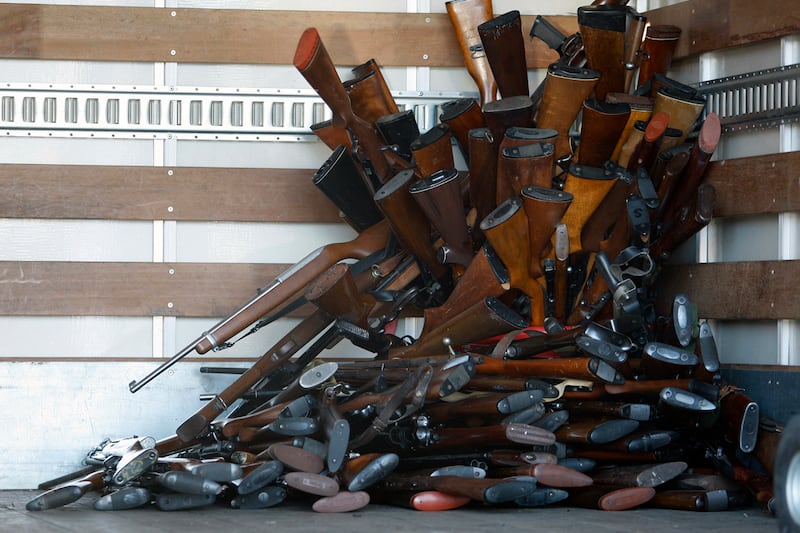
In the two weeks since the massacre at Sandy Hook Elementary School, politicians across the spectrum, gun-control advocates, and even the National Rifle Association have thrown out all sorts of ideas they hope can help avoid another tragedy like this one.
But here’s one that even the staunchest gun-control experts say might be a complete waste of time: gun buybacks. Operating largely on the local level, gun buybacks have been around for decades, mostly in crime-ridden neighborhoods such as Brownsville in Brooklyn, and Chicago’s South Side.
On December 21, 40 members of the House of Representatives signed a letter to John Boehner and Nancy Pelosi calling for $200 million to conduct a one-time federal buyback program. New York Rep. Jerrold Nadler emailed his constituents about the proposal, saying a national program would help “remove the current stock [of assault weapons] from circulation and should be part of any effort to reduce gun violence.”
On the surface, such programs seem simple. Residents can hand their weapons over to the city in exchange for cash or even gift certificates to grocery stores. The guns are then destroyed. That’s how it’s worked in places like Bridgeport, Conn., and San Diego, both of which have broken records for the number of guns collected and money doled out just since Sandy Hook.
Get the best of The Beast delivered right to your inbox
By clicking “SUBSCRIBE” you agree to our Terms of Use and Privacy Policy.
If sounds too good to be true, that’s because it is, experts say.
The people most likely to commit crimes are also the people least likely to be turn in their weapons, research has found. And the highest-risk weapons are the least likely to be traded in at buybacks.
“The theory underlying gun buyback programs is badly flawed,” a 2004 report by the National Research Council found. The study pointed out that replacement guns can be easily found for guns turned in for cash, and the ones that are turned in are often old or malfunctioning.
A Los Angeles Times op-ed called gun buybacks little more than a public relations move: “Really cutting down on the bloodshed will require meaningful legislation and tougher enforcement. That’s harder to pull off than a gun buyback program: Good PR almost invariably is simpler than good policy.”
And successful buyback programs can be extremely expensive for local governments. “Let’s say you pay $100 per gun, and you get 2,000 guns,” says Jon Vernick, co-director of the Johns Hopkins Center for Gun Policy and Research. “That’s $200,000—would it be money better spent elsewhere?”
But whether or not the most dangerous weapons are being turned in by the most dangerous criminals, there’s no arguing with the record numbers of firearms turned it at buybacks since Newtown.
A buyback program in Camden, New Jersey, one of the state’s most dangerous cities, collected a state record of 1,137 guns the weekend after the Newtown shooting. The state—unprepared for the quantity of guns brought in—had to issue nearly $40,000 worth of IOUs after the organizers ran out of cash.
Similar programs were hosted in the Bay Area and San Diego in the days following Newtown.
A buyback event in Miami garnered over 100 guns, breaking a local record.
Los Angeles Mayor Antonio Villaraigosa pushed up his city’s annual buyback program by five months in the wake of Newtown—and L.A also broke its own local record for guns brought in; 2,037 firearms were sold to the Los Angeles Police Department in exchange for Ralph’s gift cards. The popularity of recent buyback programs has prompted calls for buybacks in cities across the country.
Still, “there’s mostly bad news,” Vernick says, “with a hint of good news about gun buybacks.
“There’s mostly bad news with a hint of good news about gun buybacks,” says Vernick.
The upside? Gun buybacks may not be the best way to keep dangerous weapons out of the hands of criminals, but they can be an effective grassroots method of raising awareness about gun violence, Vernick says. “Communities can mobilize around this problem and gun buybacks give them a visible thing to do about it,” he says.
And advocates of gun buybacks point to the example of Australia’s strict gun laws. In 1996, a few weeks after a gunman opened fire in a resort in Tasmania, killing 35, the Australian government conducted a compulsory buyback program for newly outlawed automatic and semi-automatic weapons. Data conducted in the decades since has found that homicides involving firearms in Australia have dropped 59 percent, and there have been no gun massacres since 1996.
“The President can even pitch selling a gun to Uncle Sam as a patriotic act,” writes Matt Miller, a senior fellow at the Center for American Progress, who used the Australian example in a recent op-ed arguing for a federal buyback system, “part of a national rethinking of our gun culture in the wake of Newtown.”
Vernick is skeptical that a federal buyback program, if implemented at all, would get the right guns out of the wrong hands. Still, he says, selling guns for money is a simpler proposition than passing gun-control legislation. “Conducting buybacks is much easier than fighting the political battle,” he says.
See more of our coverage in your search results.

Got a tip? Send it to The Daily Beast here.
Register below to read this article for free or subscribe
to unlock unlimited access to The Daily Beast.
Monthly
$1
First month then $5.99/month
Annual
$35
First year then $59.99/year
Premium
$79
First year then $119.99/year
*Substack access provided by the next business day, using your subscription email. Choosing the Premium plan constitutes your permission to share your subscription email with Substack and your agreement to Substack’s Privacy Policy.
Already have an account? Sign In
Looks like you already have a subscription!
You're all set!
Thanks for subscribing.