Luxembourg and China Team Up on Private Mission to the Moon
The first privately-funded spacecraft to travel the Moon launched last Thursday, but it likely won’t be the last.

The Daily Beast
Get the Beast Digest newsletter delivered straight to your inbox
By clicking “SIGN UP” you agree to our Terms of Use and Privacy Policy.
Cold War competition between superpowers dominated the first decades of space travel and exploration. Individual governments took the lead, bankrolling most of the process in the name of competition and nationalism. Ultimately international cooperation and collaboration took root, and the landscape is already very different. The present and future of space exploration is more collaborative, more international, and involves both space agencies and private companies.
One such project is the combination Chang’e 5-T1 and Manfred Memorial Moon Mission (4M), which launched together last Thursday. Both projects are testbeds for ideas: Chang’e 5-T1 is a prototype for a robotic probe intended to return samples from the Moon to Earth, while 4M is a simple communications experiment encouraging amateur participation. But the intriguing bit is that 4M is a project of the private Luxembourg-based company LuxSpace, while Chang’e 5-T1 is a Chinese project, and the whole endeavor was launched on a Chinese rocket.
Private companies have been involved with spaceflight from very early days, albeit largely as contractors. Today, many companies are jostling to take on many roles: servicing the International Space Station, building the next generation of rockets, and designing spacecraft to carry human passengers. These companies include SpaceX, Orbital Sciences, Sierra Nevada Space Systems, and more.
These mostly focus on propulsion and transport, but 4M is a different concept. It is riding as an auxiliary payload in the Chang’e 5-T1 mission, so all the literal heavy lifting is done by the Chinese Long March rocket. Instead, the focus is on probe design and communications technology, as well as low cost.
The mission itself is simply a small computer powered by solar cells, with an antenna transmitting at 145.980 MHz. That frequency is within the range used by amateur radio operators, so anyone can listen in. 4M’s ham radio handle is JT65B, and you can join in using the freely available Weak Signal Communication Software package. The 4M craft also includes a radiation dosimeter built by the Spanish company iC-Málaga. (The name 4M honors Manfred Fuchs, who ran OHB, LuxSpace’s parent company.)
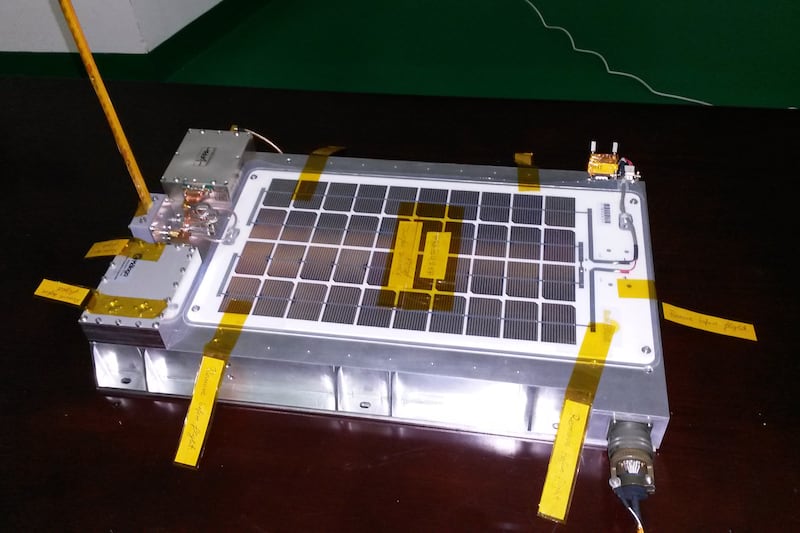
Since it carries no significant research payload, the value of 4M is symbolic rather than scientific: it is the first privately-funded spacecraft to travel around the Moon. But it likely won’t be the last, and just as the first Sputnik was superseded by probes capable of doing research, other privately-funded ventures—perhaps built by universities—will return.
While it is a more traditional project, Chang’e 5-T1 is a test of an important concept as well. The only Moon samples we have were collected by Apollo astronauts during the 1960s and ‘70s. Robotic missions (including notably the Mars rovers) carry their own chemistry labs to do analysis on-site, but that approach has its limitations.
The planned Chang’e 5 mission would land a probe on the Moon capable of collecting samples for return to Earth using a small capsule. Chang’e 5-T1 will test part of that process: the spacecraft will loop around the Moon, then return to Earth orbit, where it will release a small test capsule which (hopefully!) will survive reentry. The rest of the probe—including 4M —will either burn up in Earth’s atmosphere or fall into a “very interesting orbit,” in the words of the LuxSpace website.
In September 2013, NASA’s Lunar Atmosphere and Dust Environment Explorer (LADEE) launched on top of a Minotaur V rocket. (I was present for this launch.) The Minotaur V is built by Orbital Sciences, a privately-owned company, which among other things, recycles ballistic missile technology developed for nuclear weapons. Additionally, the LADEE launch was out of NASA’s Wallops facility, using a privately-funded launchpad known as the Mid-Atlantic Regional Spaceport (MARS). (LADEE completed its mission in the spring with a crash landing on the Moon.)
LADEE and 4M demonstrate complementary ways private companies work with government space agencies—and represent the kinds of projects we’ll continue to see in the future. My fondest hope is that sharing costs and benefits will be good for space exploration... and all of us. While a number of causes often make it fail at this goal, science should benefit everyone. In its small way, 4M could be a sign of positive, open things to come.
See more of our coverage in your search results.

Got a tip? Send it to The Daily Beast here.
Unlock a year of full access to The Daily Beast for $35.
Monthly
$1
First month then $5.99/month
Annual
$35
First year then $59.99/year
Premium
$79
First year then $119.99/year
*Substack access provided by the next business day, using your subscription email. Choosing the Premium plan constitutes your permission to share your subscription email with Substack and your agreement to Substack’s Privacy Policy.
Looks like you already have a subscription!
- Account (completed)
- Payment (completed)
- Confirmation (completed)
You're all set!
Thanks for subscribing.
- 1Account
- 2Payment
- 3Confirmation
Sign in or create an account
Register below to read this article for free or subscribe
to unlock unlimited access to The Daily Beast.
Monthly
$1
First month then $5.99/month
Annual
$35
First year then $59.99/year
Premium
$79
First year then $119.99/year
*Substack access provided by the next business day, using your subscription email. Choosing the Premium plan constitutes your permission to share your subscription email with Substack and your agreement to Substack’s Privacy Policy.
Already have an account? Sign In
Looks like you already have a subscription!
- Account (completed)
- Payment (completed)
- Confirmation (completed)
You're all set!
Thanks for subscribing.
- 1Account
- 2Payment
- 3Confirmation