Entire Town That Set Heatwave Record Is Now on Fire
The entire town of Lytton, British Columbia, has gone up in flames after breaking the record for the hottest temps ever recorded in Canada.
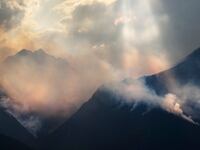
Andy Clark via Reuters
Out-of-control wildfires fed by a historic heatwave that then created rainless thunderstorms have converged on the small Canadian village of Lytton, engulfing the entire town in flames and destroying 90 percent of it, including the city center.
“It’s dire. The whole town is on fire,” Mayor Jan Polderman told CBC. “It took, like, a whole 15 minutes from the first sign of smoke to, all of a sudden, there being fire everywhere.”
#BCWildfire Service is responding to 2 wildfires ~18 km N of Big White. The Long Loch wildfire (K51040) and the Derrickson Lake wildfire (K51041) are in close proximity and estimated to be 300 ha combined in size. Smoke and fire behavior is making it difficult to confirm size. pic.twitter.com/kPSNzrpRsm
— BC Wildfire Service (@BCGovFireInfo) July 1, 2021
Lytton, a town of just 250 people, had earlier in the week topped 121 degrees, setting a record for the hottest temperatures ever recorded in Canada. The entire town had to be completely evacuated as flames jumped fences and incinerated every single building. Winds of up to 45 mph whipped up burning debris. Most residents had no time to collect any belongings as the fire drew down on them, the mayor said.
Brad Vis, a member of parliament that represents the region around Lytton, tweeted that he would not be participating in Canada Day festivities to help manage the disaster, which includes extensive infrastructure damage to roads, water and telephone services. Vis also reported that several people had been injured.
Many took shelter in a nearby town that was also under a fire warning by early Thursday. “At the First Nation band office, the fire was a wall about three, four feet high coming up to the fence line,” the mayor said. “I drove through town and it was just smoke, flames, the wires were down.”

Climate scientist Zeke Hausfather told AFP that the extreme weather was undoubtedly a product of global warming. “Climate is sort of steroids for the weather,” he said. “It’s loading the dice to make these sort of extreme events be more common.”
CBC meteorologist Johanna Wagstaffe said that low-precipitation thunderstorms with strong winds, severe lightening and not much rain had fueled many smaller fires. “I’ve never seen wildfire conditions this extreme,” Wagstaffe said in her CBS report. “We’re going to see conditions like this for the rest of the week, unfortunately.”
Get the best of The Beast delivered right to your inbox
By clicking “SUBSCRIBE” you agree to our Terms of Use and Privacy Policy.
Satellite imagery posted by climate scientist Daniel Swain confirmed that the thunderstorms were “pyro-convective event” meaning they were generated by wildfires they then fueled to become stronger.
Intense heat has killed dozens of people at least—possibly hundreds—across the northwestern United States and western Canada. Dry conditions have led to an increase in fires in the largely wooded province of British Columbia, adding misery to the deadly situation.
See more of our coverage in your search results.

Got a tip? Send it to The Daily Beast here.
Register below to read this article for free or subscribe
to unlock unlimited access to The Daily Beast.
Monthly
$1
First month then $5.99/month
Annual
$35
First year then $59.99/year
Premium
$79
First year then $119.99/year
*Substack access provided by the next business day, using your subscription email. Choosing the Premium plan constitutes your permission to share your subscription email with Substack and your agreement to Substack’s Privacy Policy.
Already have an account? Sign In
Looks like you already have a subscription!
You're all set!
Thanks for subscribing.