Muammar Gaddafi’s Expected Exit Sees Italy Planning Next Act in Libya
The Italians are jockeying for a key role in a post-Gaddafi, oil-rich Libya. By Barbie Latza Nadeau.
Alessia Capasso / AP Photos
Get the Beast Digest newsletter delivered straight to your inbox
By clicking “SIGN UP” you agree to our Terms of Use and Privacy Policy.
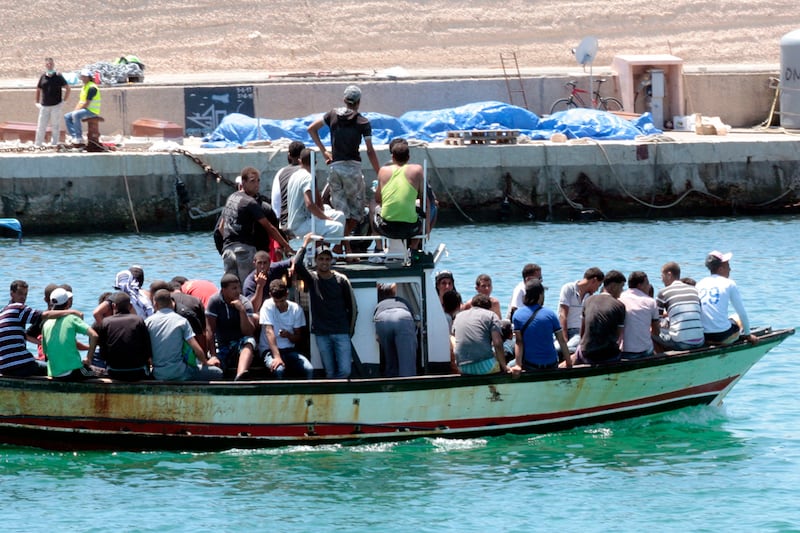
More than 50,000 North African refugees have crashed their rickety fishing boats on the shores of the tiny Italian island of Lampedusa since January, and more than half of those set sail from Libya. Initially, many of the refugees were of sub-Saharan African origin, pushed out of Libya by Muammar Gaddafi’s forces as a form of retaliation against Italy for its part in NATO airstrikes against Tripoli’s forces that began last March. Gaddafi promised to “turn Europe black” to “teach them a lesson.” But in the last month, the faces on the boats have been mostly Libyan, and Italians are increasingly worried that many are Gaddafi fighters with terrorist ties. Italy has stepped up security and screening in recent days, and many of the boats are met by Italian Coast Guard ships. Some have been hauled back to Libyan waters after women and children are removed.
Italy has waffled throughout the NATO-led conflict, not entirely sure whether to back the rebel movement or stick with Gaddafi, who helped Libya and Italy foster a mutually lucrative partnership over the last decade. But as opposition forces close in on the Gaddafi regime, the Italians are pushing to parlay their frontline status, and long political and business history with the North African nation, into a leading role in the new Libya.
Italy’s investments in Libya top $30 billion, while Libya owns part of the Italian soccer team Juventus (jointly owned by Fiat), and also holds major investments in Italian banks. Further, Libya was an Italian colony from 1911 until 1947, after which time Italy played a crucial role in developing Libya’s oil industry, setting up many of the country’s original drilling sites when oil was discovered in 1959. When Gaddafi came to power in a military coup in 1969, Italian firms were already in place.
But the two countries were never as close as when Italian Prime Minister Silvio Berlusconi started courting the Libyan leader. Few will forget Berlusconi famously kissing Gaddafi’s hand on one of his many state visits or Gaddafi’s Bedouin tent pitched on some of Rome’s most lavish villa grounds. The two men shared many interests beyond state business, and Gaddafi even allegedly taught Berlusconi the infamous “bunga-bunga” sex ritual. Berlusconi was pivotal in Europe’s acceptance of the controversial leader, and without the prime minister’s support, it is unlikely Gaddafi would have been at the table of so many European summits.
Berlusconi voiced regret about NATO action, and in March said he might be able to persuade his pal Gaddafi to go into exile. “I’m saddened for Gaddafi and I’m sorry,” he said, hoping he could play a role in securing the Libyan an “honorable exit from the scene.” In June, Italy’s foreign minister, Franco Frattini, strove to maintain his country’s neutrality. NATO forces were using Italian military bases, but he nevertheless called for “an immediate cessation of hostilities” by NATO, citing an impending humanitarian crisis and a change of NATO’s mission from protecting Libyan civilians to a “full-fledged offensive to oust Muammar Gaddafi at any cost.”
By July, however, Italy was backpedaling as the rebels gained power. Nearly a dozen defecting Gaddafi loyalists found safe haven in the ex-colonial power, most recently last weekend, when Gaddafi’s former right-hand man, Abdel-Salam Jalloud, arrived in Rome, where the Libyan embassy is putting him up at a posh hotel.
On Monday, Berlusconi switched to the winning side once and for all, urging Gaddafi to give up for good. “Rebel forces are realizing their aspiration of a new Libya that is democratic and united. The Italian government is by their side,” he said in a prepared statement read on Italian television. "We ask Colonel Gaddafi to stop all useless resistance so as to save his people from further suffering."
As it moves to carve out a major role in a liberated Libya, Italy no doubt is hoping the rebels will forget the Berlusconi-Gaddafi bromance. Frattini has already promised that the Italian oil company Eni will resume oil production immediately after reopening the wells that were hastily closed during heavy fighting. "The facilities had been made by Italians and therefore it is clear that Eni will play a No. 1 role in the future," Frattini told RAI, the state television network. Eni’s stocks rose 7 percent Monday after Frattini said company staff had already arrived in Libya to assess the situation.
The Italians are not alone. Other European countries such as France, whose oil company Total also has assets in Libya, have been increasingly self-congratulatory about their role in liberating Libya. Total’s stock rose 3.5 percent Monday on the news of the impending fall of the Gaddafi regime. British Prime Minister David Cameron, meanwhile, condemned “the appalling dodgy dealings with Libya under the last [U.K.] government,” promising a clean start with the new regime—and citing Britain’s leadership in the NATO-led strikes.
Italy still believes it has paid a far bigger price than its European counterparts and that it continues to do so. The Italians point out that they are now in a position to protect all of Europe from Gaddafi’s fleeing forces—many of which they say may have terrorist ties—and clearly see themselves as in position to play a key role. They maintain that Italy has always been geographically vulnerable to counterattacks, and believe that the nation has weathered the immigration problem stoically and can now boast that it is the adopted home of many Libyans who might want to go back to a better Libya. “Italy has stood up to this immigrant problem alone,” declared Defense Minister Ignazio La Russa. “Now we will continue to do our part and be the first on the ground to rebuild Libya.”
As the battle moves toward an endgame in Libya, a new fight is set to begin among European powers about just who deserves the leading role in rebuilding the oil-rich nation.
See more of our coverage in your search results.

Got a tip? Send it to The Daily Beast here.
Unlock a year of full access to The Daily Beast for $35.
Monthly
$1
First month then $5.99/month
Annual
$35
First year then $59.99/year
Premium
$79
First year then $119.99/year
*Substack access provided by the next business day, using your subscription email. Choosing the Premium plan constitutes your permission to share your subscription email with Substack and your agreement to Substack’s Privacy Policy.
Looks like you already have a subscription!
- Account (completed)
- Payment (completed)
- Confirmation (completed)
You're all set!
Thanks for subscribing.
- 1Account
- 2Payment
- 3Confirmation
Sign in or create an account
Register below to read this article for free or subscribe
to unlock unlimited access to The Daily Beast.
Monthly
$1
First month then $5.99/month
Annual
$35
First year then $59.99/year
Premium
$79
First year then $119.99/year
*Substack access provided by the next business day, using your subscription email. Choosing the Premium plan constitutes your permission to share your subscription email with Substack and your agreement to Substack’s Privacy Policy.
Already have an account? Sign In
Looks like you already have a subscription!
- Account (completed)
- Payment (completed)
- Confirmation (completed)
You're all set!
Thanks for subscribing.
- 1Account
- 2Payment
- 3Confirmation