
Backrooms is unquestionably a horror film, but at its core, it has less in common with slashers, torture porn, and haunted house chillers than with the likes of David Lynch’s Lost Highway.
A descent into an uncanny-valley netherworld that’s both a warped reflection and deconstruction of the modern world, 21-year-old Kane Parsons’ debut feature (May 29) is a waking nightmare that prioritizes atmosphere over jump scares, suggestion over explication. While it occasionally weighs itself down with excessive psychologizing, it casts a surrealistic spell that’s unlike anything else in contemporary cinema.
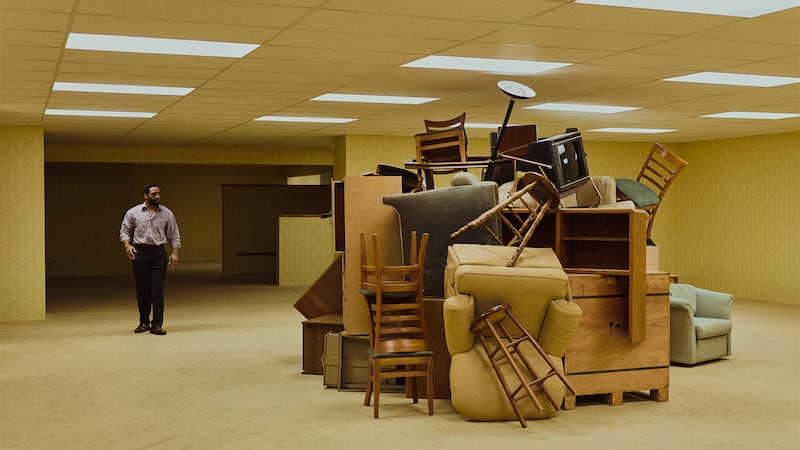
Parsons’ film is an expansion of his viral shorts about the “Backrooms,” an endless series of office-building (or department-store) rooms and corridors with sickly yellow walls, carpeted floors, and tiled ceilings with symmetrical fluorescent lights. Shot on grainy VHS, often in first-person, they were a haunting amalgam of analog, found footage, and liminal horror, the last of which is defined by empty, unreal in-between spaces where recognizable everyday things seem slightly off.
As described by Backrooms’ protagonist, they’re the architectural equivalent of a person describing a dog to someone who’s never seen one and then asking them to draw it.
Though they eventually boasted an oblique narrative frame, Parsons’ bite-sized originals generated unease via abstraction, and Backrooms does likewise, beginning with a 1990-set opener in which an unknown man videotapes his trek through the Backrooms. Breathing heavily as he traverses blank, bright hallways decorated with random pieces of furniture and flotsam (wooden chairs, ship steering wheels, a store’s “No Credit…” advertising banner), this individual searches for the comrades from whom he’s been separated. Before he can reunite with his mates, he spies something inhuman and runs, and the recording abruptly ends when he collides with an unknown figure.
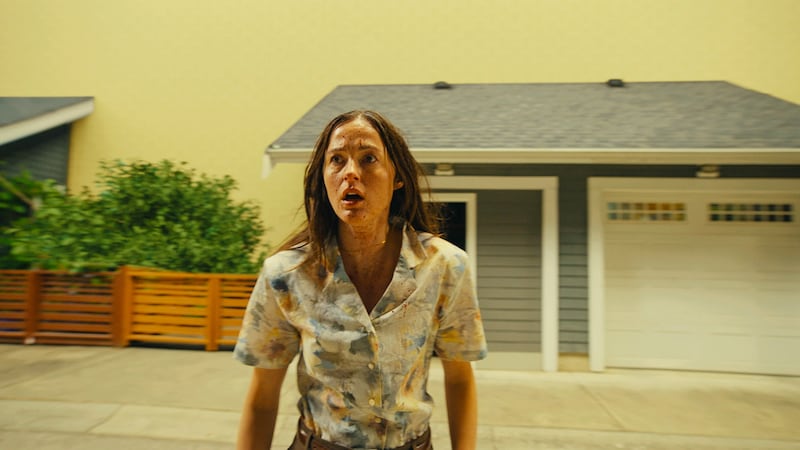
Backrooms provides no contextual explanation for this strangeness, instead shifting its focus to Mary (Renate Reinsve), a therapist fixated on the piece of concrete she made a handprint in (with her mother) before her childhood home was torn down to make way for an apartment building. In her self-help books and audio tapes, Mary preaches that people are stuck in behavioral “loops” which always bring them back to where they started, and the key to escaping these constricting patterns is to open proverbial “windows” and chart new courses.
Subsequent flashbacks to Mary’s adolescence with an unhinged mom who wouldn’t let her leave the house (or open the paper-covered windows in their living room) make it clear that her theory has literal origins, and Parsons pushes these thematic ideas a tad too hard, undercutting the material’s unreality.
The sole client that Mary sees in Backrooms is Clark (Chiwetel Ejiofor), who runs a furniture store called Cap’n Clark’s Ottoman Empire that he promotes in amateurish commercials that feature him in a pirate costume. As revealed by his sessions with Mary, Clark is a lonely and angry divorcé still smarting over his wife’s departure. When asked to role-play the fateful incident that led to her exit, his tirade about money, his drinking problem, and his failed career as an architect expose him as a bitter, cruel little man.
Ejiofor potently evokes Clark’s stew of rage, nastiness, insecurity, and resentment, and his bubbling fury is nicely contrasted with Reinsve’s composed placidness. Nonetheless, shots of Mary detached from others and her sterile surroundings indicate that she, too, is somewhat lost, disaffected, and unmoored, with the director casting virtually every one of his settings as disquietingly antiseptic and askew.
The world of Backrooms is not quite right in all sorts of small, barely perceptible ways, and that’s especially true in the Backrooms, whose fantastic entranceway is discovered by a shocked Clark in the basement of his business.
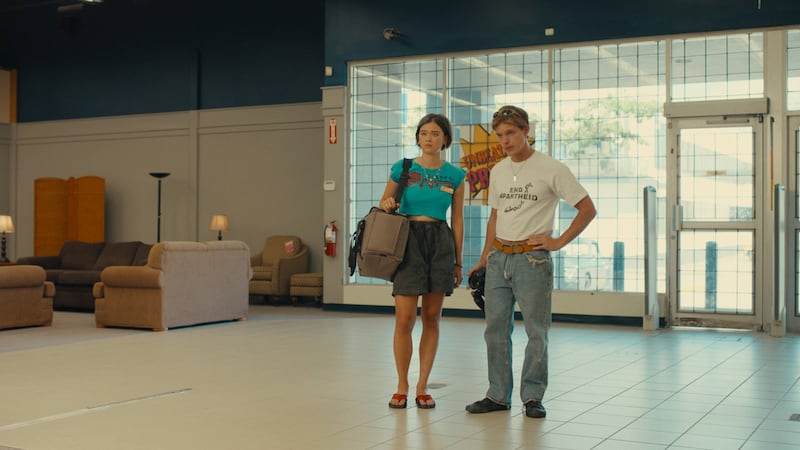
Clark is naturally bewildered and terrified during his initial foray through this dreamlike environment, and after failing to convince Mary of its existence, he enlists his assistant manager, Kat (Lukita Maxwell), and her cinematographer boyfriend Bobby (Finn Bennett) to join him on an excursion, the idea being to document and map the place’s sprawling (never-ending?) layout.
What they discover are cockeyed passages, sidewise doors, piled-up furniture, and other bizarro sights that have no lucid explanation. Backrooms revels in the unknown and irrational, subtly channeling the spirit of numerous touchstones (the films of David Lynch, Severance, Vivarium, early-2000s J-horror thrillers, video games such as Silent Hill and Alan Wake) without ever resorting to homage-y mimicry.
Backrooms’ archival-footage intro is prefaced by a title card for A-Sync, and brief glimpses of a man (Mark Duplass) who appears to work for the corporation are scattered throughout the film. Parsons, however, refrains from fully elucidating the purpose of this outfit, just as he steers clear of offering anything more than dubious conjecture about the nature of the Backrooms. Clark’s climactic speech about this twisted funhouse-mirror locale is reasonably convincing given the action at hand, contending that the enigmatic area is a misshapen reproduction of reality.
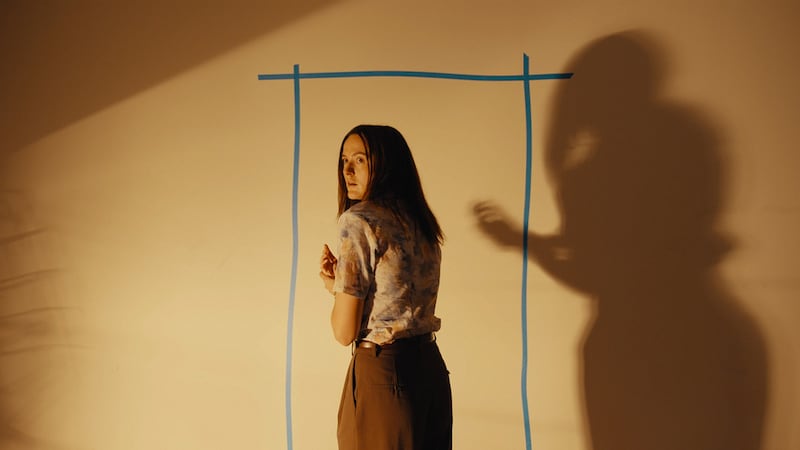
Yet by the proceedings’ conclusion, questions outnumber answers by a significant margin, adding to the far more frightening sense that the universe is full of dangerous and inexplicable mysteries best left alone.
Following in the footsteps of its online predecessors, Backrooms intermittently features characters encountering half-glimpsed moaning-shrieking creatures. Jarring jolts, though, are few and far between, as Parsons puts a premium on an off-kilter mood marked by buzzing overhead lights, heavy footsteps, panicked panting, and interior labyrinths that subtly critique the ugly, inhospitable barrenness and unnaturalness of our personal and professional modern spaces. There’s only a loose sense of up and down, forward and backward, in this hallucinatory realm, and the film is most discomfiting when it assumes Clark and Mary’s first-person perspective as they try to decipher where they are, what they’re seeing, and why this is happening.
An experiential head-trip more than a traditional spook show, Backrooms demands a deadly quiet, pitch-black theater where its trance-like power can best flourish. Even when it says a bit too much, it echoes Mary’s teachings and breaks free of its genre’s past by bucking (and smartly reconfiguring) convention—and, consequently, proves the rare horror effort to warrant the designation “unique.”