A-Lister’s Ludicrous Fake Nose Dooms Disastrous Crime Drama
“By Any Means,” try not to laugh at the “Boogie Nights” star’s latest prosthetic.

For any drama claiming to be “based on a true story,” veracity is important—but only to a degree. Case in point: By Any Means, which, in an effort to make star Mark Wahlberg look like his real-life counterpart, opts to saddle him with one of the most ridiculous and unnecessary prosthetic noses in cinema history.
Since no one has ever heard of his character Gregory Scarpa, the film’s stab at physical photorealism is both excessive and purposeless, turning his schnoz into a senseless embellishment. It’s a distraction of laughable proportions—if, also, the sole distinctive aspect of this otherwise sketchy Green Book-esque period piece.
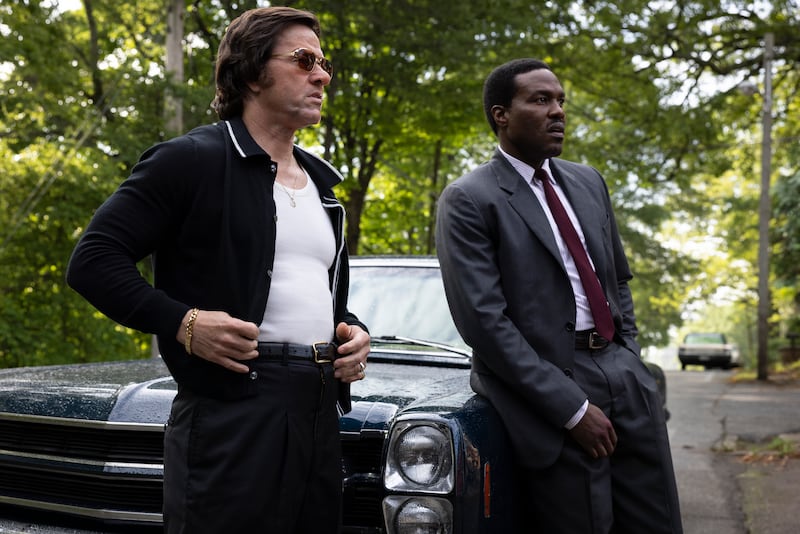
Mark Wahlberg, left, and Yahya Abdul-Mateen II.
Paramount Pictures
A severe step down from his directorial debut The Inspection, Elegance Bratton’s By Any Means (September 4, in theaters) is a story of racist wrongs and the virtuous vigilantism that made things right.
In 1966, FBI Special Agent Wayne Strider (Wonder Man’s Yahya Abdul-Mateen II) relocates with his wife (Nicole Beharie) from Chicago to his home state of Mississippi. Despite his badge, Strider is treated disrespectfully by everyone, be it local cops or his boss (David Strathairn), who refuses to assign him to investigate the KKK and learns—via Strider denting a filing cabinet with his fist—that his newest recruit has a latent angry streak.
No matter his temper, Strider is a composed, sharply dressed agent who thinks that the best way to affect Civil Rights change is to follow the letter of the law. Unfortunately, his belief in the Martin Luther King Jr. playbook takes a hit when his friend Vernon Dahmer (Giancarlo Esposito), an NAACP president and businessman, is murdered by the Klan for advocating for southern Blacks to vote and offering to pay their “poll tax” as an enticement.

Yahya Abdul-Mateen II, left, and director Elegance Bratton on the set of "By Any Means."
Paramount Pictures
Everyone knows that the man responsible for this heinous slaying is Sam Bowers (Ethan Embry), Hattiesburg’s resident KKK bigwig. However, because of the white robe-loving organization’s regional clout, few are willing to go on the record, including Dahmer’s potential eyewitness neighbor Rebecca (LisaGay Hamilton). Thus, Strathairn’s chief, along with a nameless colleague (Josh Lucas), are compelled to seek an alternative avenue to justice.
Get the best of Obsessed delivered right to your inbox
By clicking “SUBSCRIBE” you agree to our Terms of Use and Privacy Policy.
That would be Scarpa, a hitman and enforcer for New York’s Colombo crime family, as well as an FBI informant who—as detailed by a two-years-earlier prologue—was responsible for helping the feds locate the bodies of three missing Civil Rights workers.
Often sporting a toothpick in his mouth, Scarpa strips out of his fancy suits to do his dirty work in white tank tops. His most noteworthy feature, though, is his giant proboscis, which protrudes from his face like an overgrown appendage. There’s simply no ignoring the absurdity of his snout, and not helping matters, Wahlberg embodies the murderer as a caricature straight out of Central Mafia Casting.

Mark Wahlberg.
Paramount Pictures
With his pants worn high and a smug smirk lurking in the shadow of his bulbous beak, the star resembles a cartoon, and his “there are no rules” attitude is equally over-the-top. Strider naturally bristles at their partnership, especially since he’s technically assigned to be Scarpa’s “handler” and is immediately mocked by the thug, who labels him his “driver” and refers to him (because he’s a trailblazing Black FBI agent) as “Jackie Robinson.”
By Any Means’ racial dynamics are straight out of Best Picture winners In the Heat of the Night and Green Book (among others), except without genuine depth, as Sascha Penn’s script is more connect-the-dots schematic than knottily complex.
At first, assuming good cop/bad cop roles, Strider and Scarpa get off on a scary foot when a police officer pulls them over and, to stop the cop from assaulting Strider, Scarpa demonstrates his anything-goes lethality. Subsequent bickering about procedure and vengeance is peppered with tidbits about MLK and Malcolm X (unsurprisingly, Scarpa is a fan of the latter), all as they attempt to track down the bigoted culprits behind Dahmer’s killing.
Nonetheless, the routineness of this chitchat is as enervating as Wahlberg’s performance is campy. Struggling to imbue the material with gravity, Abdul-Mateen II is impressively earnest as the noble Strider. Yet a simplistic story, set to sad jazz trumpet and headed in one predictable direction, undercuts him at every turn.
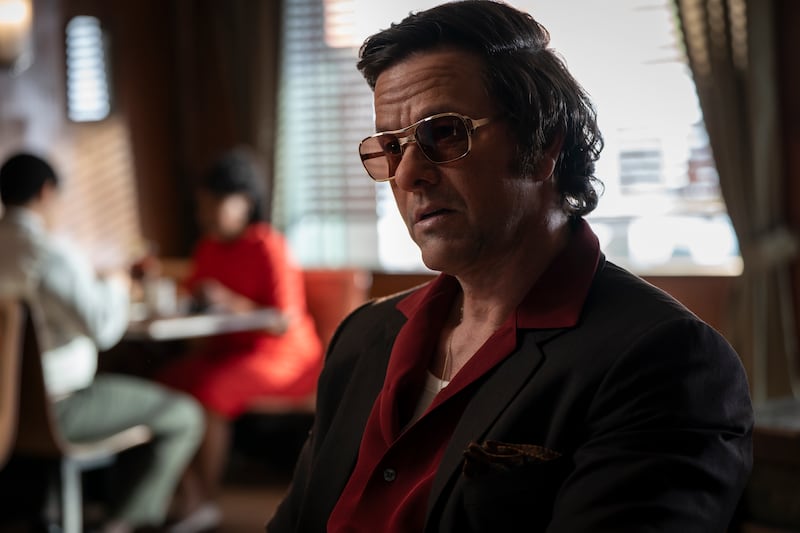
Mark Wahlberg.
Paramount Pictures
A celebration of punishing the wicked with extrajudicial viciousness, By Any Means takes its time having Strider give in to Scarpa’s head-cracking worldview, and there’s something moderately galvanizing about the fact that Bratton’s film refuses to paint his descent into ultra-violence as damning.
Instead, it frames his vigilantism as a reasonable response to despicable, brutal prejudice, and its postscript underscores that he was right to suspect the courts weren’t up to the task. If there’s a bright spot in this saga, it’s an unwillingness to hew to conventional moralizing.
Still, that’s not enough to make up for By Any Means’ two-dimensionality. As Strider and Scarpa hunt their fiendish targets, key plot points and characters are discarded with offhand carelessness. Worse, the proceedings’ conclusion is so anticlimactic as to come across as a mistake; surely, one invariably thinks, the many talented people working on this project understood that they needed a more satisfying finish than the limp denouement delivered here.
That deflating closing note is, in a way, attuned to the film’s sorrowful portrait of its protagonists’ “success.” But primarily, it’s just confirmation that there isn’t all that much to this tale.
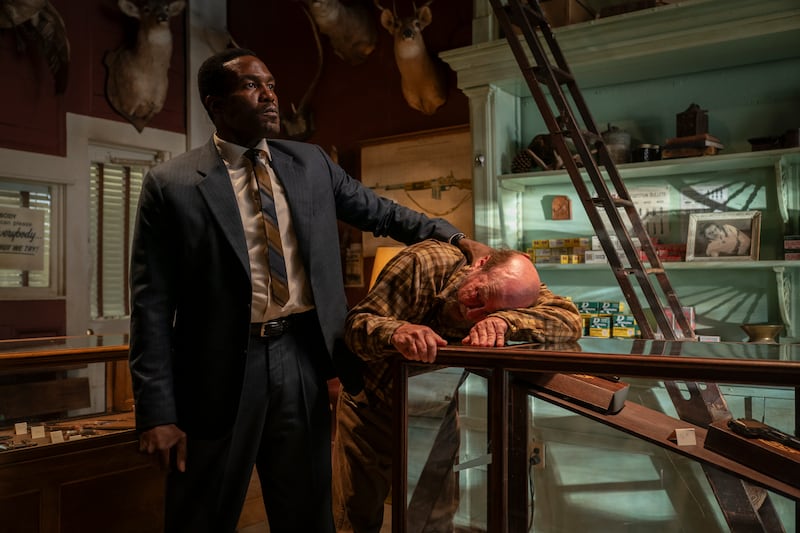
Yahya Abdul-Mateen II.
Paramount Pictures
Lacking memorable images and full of forgettable faces—even the famous ones are used so sparingly as to make no impact—By Any Means feels like half a movie. With a better screenplay, Abdul-Mateen II and Wahlberg might have generated more than the been-there, done-that chemistry they share during the course of their generic quest, and Strathairn, Lucas, Embry, and the rest of their supporting cast might have had the chance to transcend their stock types. As it stands, though, Bratton’s sophomore feature is painfully thin, regardless of its historical roots.
In the end, Wahlberg’s nose isn’t the element that truly undoes By Any Means. It is, however, emblematic of a perpetually posturing project that’s all look-at-me surface and no substance.
Obsessed with pop culture and entertainment? Follow us on Substack and YouTube for even more coverage.

Got a tip? Send it to The Daily Beast here.
Register below to read this article for free or subscribe
to unlock unlimited access to The Daily Beast.
Monthly
$1
First month then $5.99/month
Annual
$35
First year then $59.99/year
Premium
$79
First year then $119.99/year
*Substack access provided by the next business day, using your subscription email. Choosing the Premium plan constitutes your permission to share your subscription email with Substack and your agreement to Substack’s Privacy Policy.
Already have an account? Sign In
Looks like you already have a subscription!
You're all set!
Thanks for subscribing.
Sign in or create an account
Login dialog
Loading comments…