
Three years after Warner Bros. decided that releasing Coyote vs. Acme would be less profitable than shelving it and earning a tax write-off—a strategy it had already employed with the still-unseen Batgirl and Scooby! Holiday Haunt—the film will escape confinement and arrive in theaters courtesy of Ketchup Entertainment.
The wait, it turns out, was worth it.
A clever and madcap underdog saga that, in light of real-world events, now resonates as a case of art foreshadowing life, director Dave Green’s big-screen Looney Tunes feature (August 14, in theaters) is as fleet and frenetic as the Roadrunner who routinely evades its accident-prone title character.
Coyote vs. Acme.
Warner Bros. DiscoveryNonetheless, its heart is with the oft-injured Wile E. Coyote, who in this live-action/animated hybrid is recast as a victim of big business nefariousness—and, more surprising yet, as an exemplar of heartening resilience.
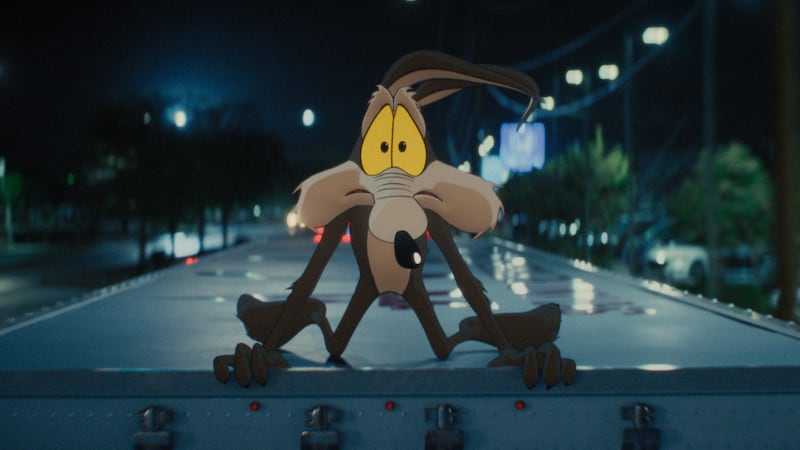
Coyote vs. Acme opens in familiar fashion, with Wile E. failing to catch his speedy prey courtesy of rocket skates and a magnet glove that backfire spectacularly, culminating with an unexpected and excruciating run-in with a fighter jet. Back at his lair, Wile E. files these plans away with the legions of earlier ones that netted him merely pain and suffering.
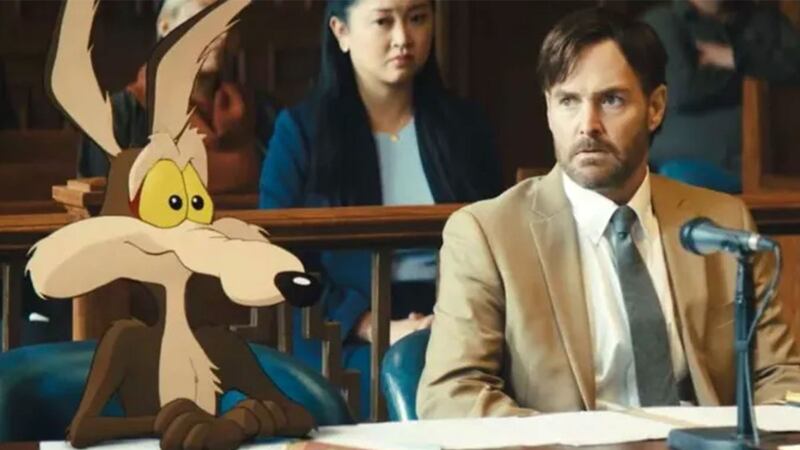
Still, the coyote is nothing if not indefatigable, and when he sees a TV commercial for lawyer Kevin Avery (SNL alum Will Forte), who specializes in cartoon injuries and proclaims, “It’s not your fault. There’s probably someone to blame!”, he realizes that his endless disappointments are the direct result of the devices he purchased from Acme Corporation.
Thus, Coyote vs. Acme establishes itself as a tale about a figurative David standing up to the corporate Goliath that’s done him wrong, and that slant is easy to read as an unintended, apt reflection of the film’s own arduous path to movie theaters.
Samy Burch’s script (based on a story co-conceived with James Gunn and Jeremy Slater) is an unintentional metaphor for itself, and that state of affairs infuses the proceedings with an extra dose of tongue-in-cheek playfulness. Moreover, this meta angle is in keeping with Looney Tunes trademark self-consciousness, and that faithfulness extends to the material’s desire to infuse its low-brow cartoon mayhem with high-brow references—in this instance, the myth of Sisyphus.
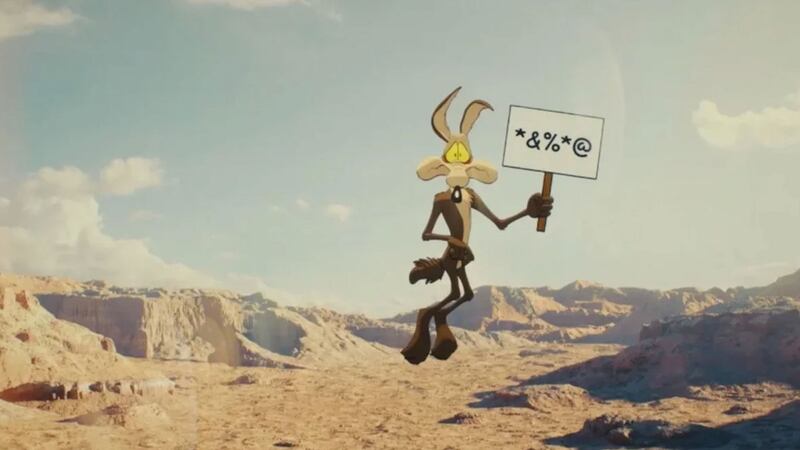
Like that condemned Greek boulder-pusher, Wile E. is doomed to wage a losing battle. Consequently, he’s perfectly paired with Kevin, a low-rent attorney whose modus operandi is settling for paltry sums rather than actively trying to win. Upon meeting the perpetually mute coyote (who communicates through written signs), Kevin views the case against Acme as a vehicle for making his client a quick and easy buck.
Unfortunately, his interning niece Paige (Lana Condor) has other plans. When Wile E.’s lawsuit is filed for every malfunctioning product in the Acme line, Kevin is reluctantly forced to fight, thereby pitting him against his condescending former Harvard Law School classmate and current Acme legal representative, Buddy Crane (John Cena).
Kevin, Paige, and Wile E.’s mission has to do with Project Sisyphus, a mysterious Acme endeavor that, as revealed by a rambunctious thirty-years-earlier prologue, was spearheaded by Dr. Lorre—who, as with most of the film’s animated players, is voiced by the versatile Eric Bauza. Over the course of Coyote vs. Acme, just about every notable Looney Tunes character chips in, from the decidedly unhinged Daffy Duck and incoherently raging Tasmanian Devil to the bumbling Porky Pig and lisping Elmer Fudd.
The early sight of a television advertisement for an annual carrot festival is a tip-off that the series’ famous wascally wabbit also factors into these high-spirited hijinks, and his appearance—as a Deep Throat-esque informer—is as amusing as the rest of his compatriots’ participation.
Despite its cavalcade of two-dimensional luminaries, Coyote vs. Acme is really about the ludicrous relationship between Wile E. and Kevin, with the former’s refusal to quit—no matter his parade of extravagant flameouts—inspiring the latter to bravely combat injustice in spite of the potential for disaster.
Forte’s zany sense of humor is a solid fit for this craziness and director Green smoothly integrates his human and non-human elements, turning the film into a worthy successor to genre ancestors Who Framed Roger Rabbit and Looney Tunes: Back in Action.
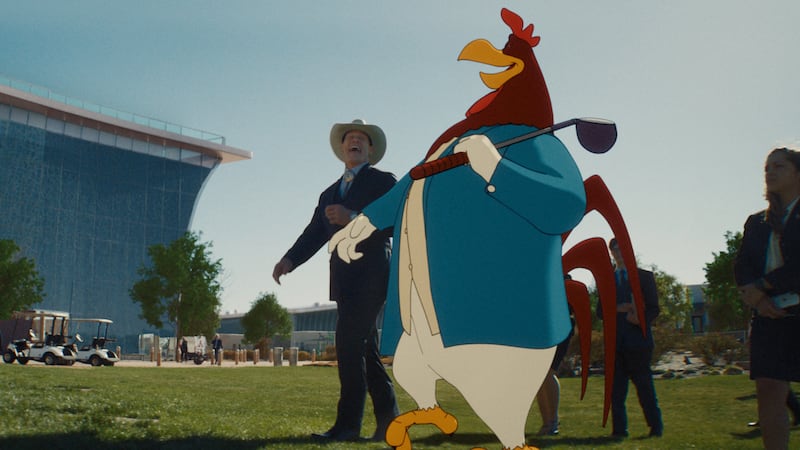
Coyote vs. Acme could be a bit more off-the-wall, and even with its shrewd reimagining of Wile E. as a respectable and stirring quasi-hero, the coyote’s silence holds him back from being a fully engaging lead. Even so, Cena is suitably cocky and smarmy as the villainous Buddy, who likes to boss around his underling Bill (P.J. Byrne) and is loyal to his bigwig boss Foghorn Leghorn, a cock-of-the-walk with a distaste for bird-related turns of phrase.
Cena might have been utilized to a greater degree, especially considering his aptitude for physical stunt work. Yet he and the rest of the cast all operate on the same bonkers wavelength while graciously ceding the spotlight to their CGI compatriots.
Coyote vs. Acme skillfully straddles the line between adult- and kid-skewing humor—one moment, it’s focusing on Wile E. developing elaborate Rube Goldberg-ish traps involving boxing gloves, mallets, microwaves, chainsaws, oversized magnifying glasses, and explosives (which, per tradition, are destined to go kaboom), and the next, it’s making a wink-wink joke about the sex-predator reputation of Pepé Le Pew.
Green keeps the pedal to the metal, such that even when the film lands in court (and, in its finale, a Washington D.C. congressional hearing chamber), it maintains its gonzo silliness. Although not all its rapid-fire jokes land, it has a welcome, wacky consistency of tone and pace.
If it falls slightly short of delivering classic Looney Tunes madness, Coyote vs. Acme is infinitely superior to either Space Jam endeavor and a deserving entry in the storied franchise. That Warner Bros. didn’t see fit to grant it a proper release remains baffling, but that mistake inadvertently gives it a resonance it otherwise would have lacked.
A rallying cry for raging against the machine, it’s a Little Engine That Could whose long-delayed debut proves—wittily and rousingly—its story’s fight-the-power point.