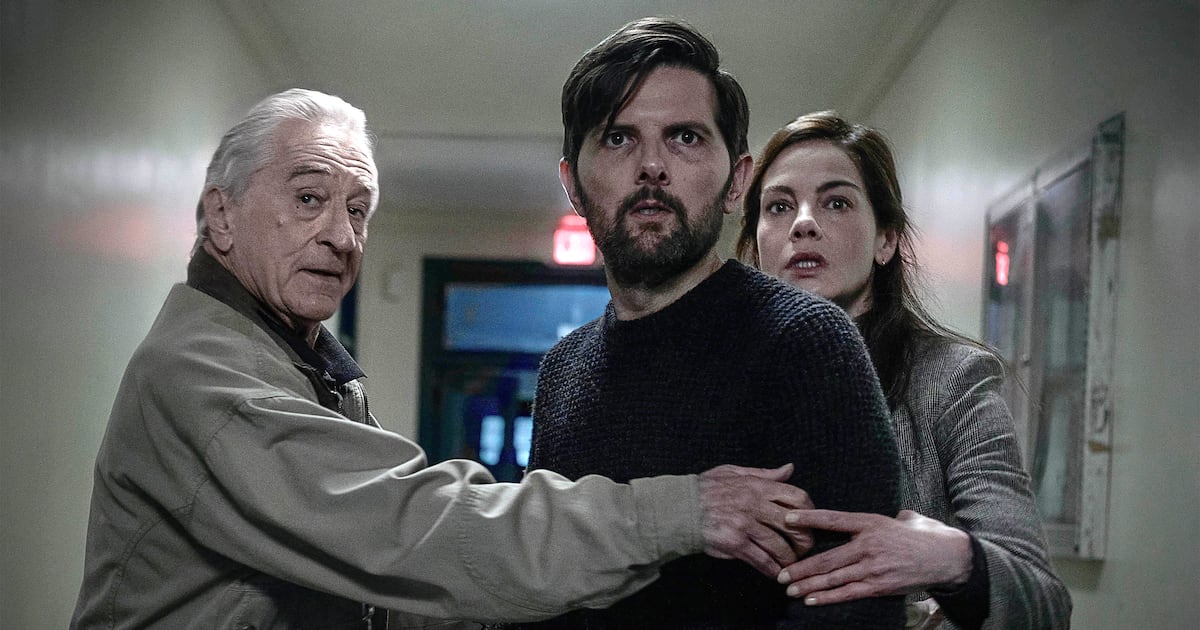
Dark Matter’s first season asked, in insanely intricate fashion, if the grass is greener on the other side. Its answer was a resounding no, as Blake Crouch’s adaptation of his own novel painted a riveting portrait of the byzantine mess made by one man’s attempt to travel from his universe to a parallel one in order to steal his doppelgänger’s life.
A puzzle box that exploited its multiverse conceit to head-spinningly thrilling and touching degrees, it was a harrowing cautionary tale about pursuing the road less traveled.
Crouch’s series concluded on a cliffhanger that promised more unique sci-fi madness, and in its second go-round (August 28), it delivers that in spades. An exhilarating continuation of a story that’s so elaborate it just about requires a diagram, Dark Matter reconfirms its status as the most mind-meltingly compelling genre series since Netflix’s Dark, and a twisty-turny triumph elevated by performances—led by Joel Edgerton and Jennifer Connelly—that are as multi-layered as the various realities in which they exist.
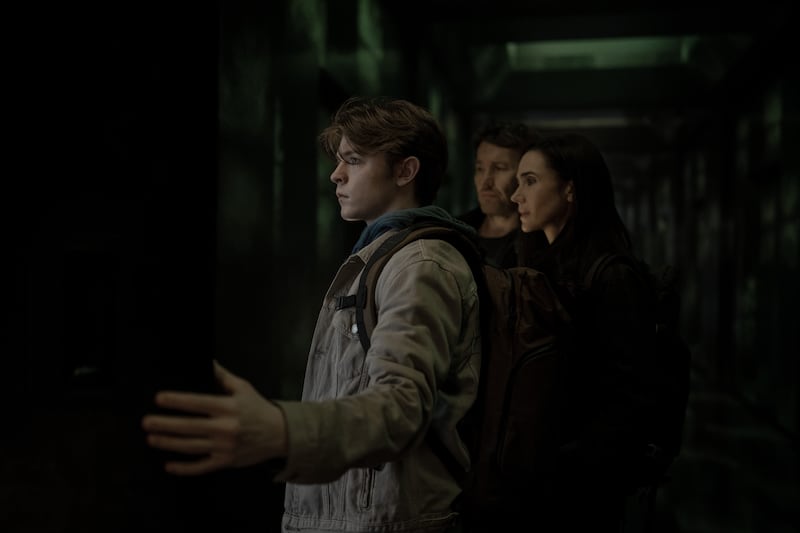
In its maiden season’s finale, Jason (Edgerton), his wife Daniela (Connelly), and their teen son Charlie (Oakes Fegley) fled their world through the Box, a quantum mechanics-powered portal that was previously used by a second Jason, known as “Jason 2,” who wanted to greedily take Jason’s place.
That identity theft sparked chaos, flooding real Jason’s Chicago with dozens of alterna-Jasons. Now, as it turns out, one of those interlopers has been captured by Mitchell McNamara (Chris Diamantopoulos), a mysterious agent who’s desperate to make sense of a situation that, from every reasonable angle, defies logic.
Jason, Daniela, and Charlie, meanwhile, have absconded to another world where they’re trying to stay under the radar at a remote woodland home. Unfortunately, anonymity is hard to come by, as is safety, and after a run-in with another Jason duplicate—and a nosy police officer—tragic events force them to flee once again. To do this, they inject themselves with a chemical compound which induces a state of superposition and, when in the Box, grants them access to a never-ending corridor whose doors open onto different versions of Earth. Moreover, Box users control what lies behind the doors, as their thoughts dictate the types of universes they can enter.
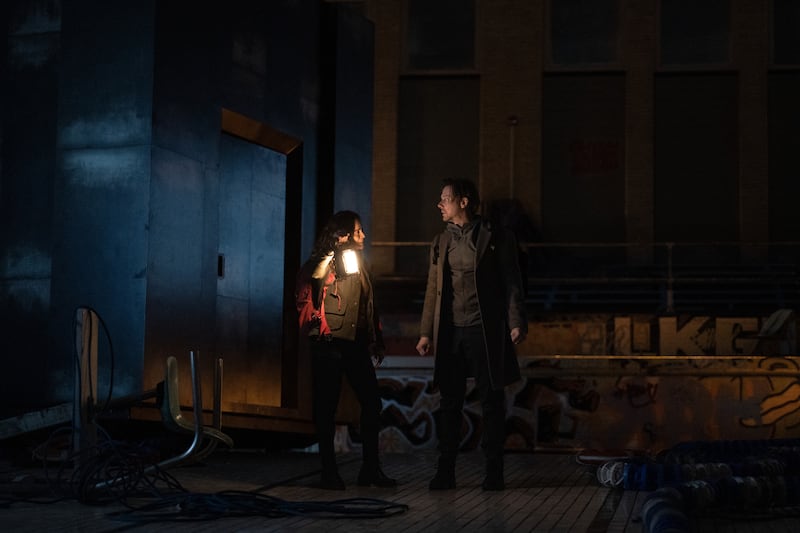
If this sounds complicated, it’s nothing compared to the nuts-and-bolts of Dark Matter, whose scripts are full of convincing-sounding scientific mumbo-jumbo that gives its fantastical action an air of realism, not to mention facilitates a limitless number of facsimiles. Jason, Daniela, and Charlie eventually settle in a tech-free Chicago which their doubles have abandoned for San Francisco. Yet in trying to sustain a low profile with the aid of a private investigator—who’s McNamara’s double—they merely elicit additional suspicion and, inevitably, trouble.
Even with these complexities, the series maintains a rigorous focus on its protagonists’ wild existential dilemmas and the emotional and psychological difficulties they bring about. Dark Matter is rife with Big Questions: Is it possible to preserve noble intentions in the face of boundless power and possibility? What is perfection, and is it enviable? Is it better to fix the mistakes of the past or forge more positive futures? And is mankind destined to forever strive for innovation and progress, no matter that doing so may give birth to as many horrors as wonders?

Crouch weaves these notions throughout his superlative second season without succumbing to speechifying; instead, they’re baked into the fabric of his tale. Consequently, the show is an invigorated clockwork machine, dexterously moving between universes and doppelgängers while investigating happiness, ambition, sacrifice, and the nature of self.
Playing several variations of the same people, Edgerton and Connelly demonstrate amazing versatility in Dark Matter, embodying their characters with a grounded depth and heart that prevents the out-there proceedings from spinning off into the stratosphere. That’s not an easy feat, given that Crouch’s narrative intertwines its players in myriad ways.
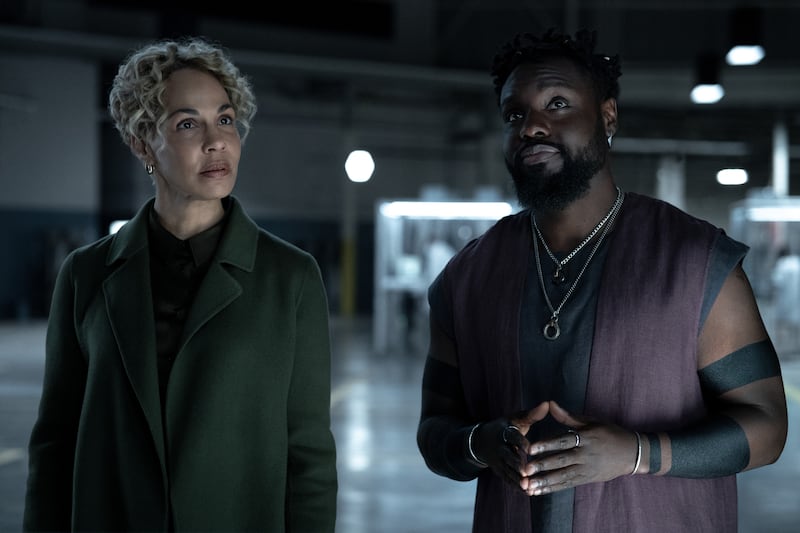
Those include Amanda (Alice Braga) and Ryan (Jimmi Simpson), Jason compatriots who’ve chosen to reside in an idyllic Chicago; Blair (Amanda Brugel), a Jason 2 colleague who became lost in the multiverse; and Leighton (Dayo Okeniyi), the Velocity Labs founder who spearheaded the Box project and is now embarking on an initiative to collect each world’s greatest inventions so he can create a utopia.
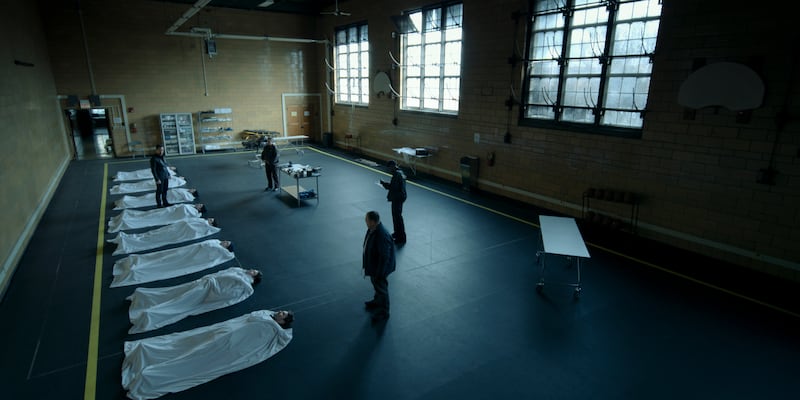
Braga, Simpson, Brugel, and Okeniyi are as adept as Edgerton and Connelly at subtly delineating their characters, such that Dark Matter never becomes prohibitively baffling. Crouch further fleshes out his premise by crafting two semi-stand-alone episodes that bestow some of its duplicates with a grace and compassion normally reserved for the series’ primary figures.
The audio cues (snaps, chimes) that accompany transitions between realities help keep things logistically coherent, at least most of the time. On occasion, viewers may find themselves pausing an episode to make sure they know precisely which Jason, Amanda, and Daniela they’re currently watching. Nonetheless, the trade-off for sporadic confusion is great, considering how much one grows to care about these wayward souls.
Though Marvel may have somewhat sullied the multiverse concept with its failed post-Avengers: Endgame efforts, Dark Matter employs it for a poignant drama about personal and domestic contentment, the ramifications of envy, the limits of altruism, and the inherent, irresistible urges that propel us to want, and do, things we know aren’t right and are doomed to end in (self-)destruction.
Tying itself in endless knots without turning inscrutable, it’s the best kind of science fiction—a mixture of universal desires and hang-ups filtered through imaginative theories and constructs which boast some relationship to reality.
To be sure, Dark Matter requires investment from its audience; this is not the show for those simply craving background entertainment while they stare at their phones. Yet in that regard as well, it’s a delight, demanding a level of concentration that’s paid off by characters, action, and mythology that are at once intensely exciting and affecting. Given that it once again closes without complete resolution, here’s hoping it doesn’t take two more years to make its way back to the streaming platform.