

For most of 2026, Digger seemed like it would be one of the year’s biggest movies. A full five months ago, the film’s first trailer dropped, a quick teaser paired with a clip reel featuring the many highs of Tom Cruise’s career. It signaled that Digger wasn’t just a celebration of all things Cruise, but that the film would show audiences Hollywood’s biggest star as we had never seen him before.
But that’s not all! Digger is directed by Alejandro González Iñárritu, whose films have won an impressive seven Oscars (eight if you count the special achievement award for his short Flesh and Sand). Two of those are directing Oscars for Birdman and The Revenant, which he won back-to-back. The only two other directors to do so were John Ford and Joseph L. Makiewicz. That’s some serious pedigree.

So, Digger was destined for greatness, both critically and commercially. Or at least it seemed. But a swathe of negative reviews came in, crushing its critical aspirations.
The box office was far worse. Last weekend, Digger opened to a dismal $8 million domestically, good enough for fourth place behind Heart of the Beast, Resident Evil, and the Anne Hathaway vehicle Verity, which made four times what Digger did. Despite a friendlier reception overseas, it bombed internationally too, bringing in just $20 million worldwide.
That wouldn’t be terrible for a first weekend if Digger didn’t cost so much. But it’s estimated the film cost between $150 and 180 million, not to mention the sky-high marketing costs. That means the film will likely lose roughly $150 million—nothing short of a historic box office bomb.
This raises the question: Why is Digger performing so terribly? The extremely short answer is that Digger is bad. But the biggest reason Digger is bad is its massive twist, kept tightly under wraps until the movie hit theaters.
[WARNING: Major spoilers ahead]
At first glance, Digger is about the end of the world. Digger Rockwell (Cruise) is a spectacularly rich, aging oil baron who is working to extract oil from Greenland. He’s ignored every environmental warning from those he works with because of the almighty dollar.
Moments after he finishes a call with a scientist in Greenland pleading with him to call off the extraction (which he ignores), he’s informed of a massive explosion there. It sends a giant ice shelf, five times the size of Washington, D.C., headed straight for Europe, the result of which will be catastrophic.
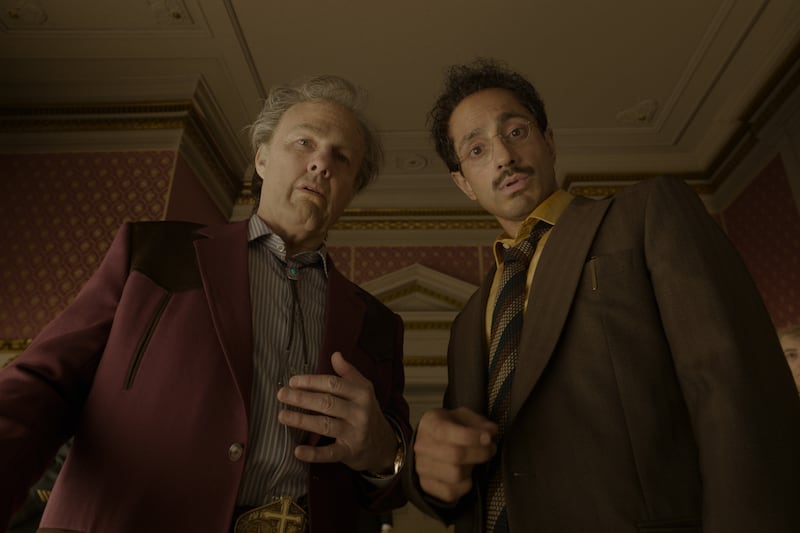
Later, Rockwell stands with U.S. President Compson (John Goodman), as they look out the window, fearing what’s about to happen to the world. Suddenly, a tree falls, and neither of them react. A director calls cut, and a hand emerges from the ground to put the tree back in its position. In this way, Digger reveals its big twist: none of this is real.
In fact, it’s all an in-film play, and Cruise isn’t actually Digger Rockwell, but an actor named Curtis. It was at this point, reader, that I was equal parts surprised and excited. Nothing made me think that reveal was coming, and it flipped the entire film on its head. For the first 20 minutes, Digger is an exercise in bloviation, in which a series of wealthy men shout and grandstand about the end of the world. It’s incredibly exhausting.
Revealing that it’s all been artifice is a bold, exhilarating choice that turns the entire film on its head. Or rather, it should have. The potential is off the charts, and the execution is so underwhelming that the play becomes a gigantic ice shelf headed straight for the film’s chances at being interesting.
It soon becomes clear the play is based on real events that did actually happen in the film’s universe. We learn the play is a satirical comedy called Fossil Fools (if that didn’t make you laugh, it’s unlikely you’ll find a single “joke” in this funny), about the real Digger Rockwell.
To make this work, we need a sense of who these actors playing these characters are, or what their world is like now. But we never get a sense of any of that. There are vague details about some of their backstory, but these people aren’t given the space to be anything different from the characters they’re playing, which renders their place in the film moot. It feels more like the twist exists so the film can try out some fun theatrical effects than to tell a story.

Another big reveal in the final act comes from one of the play’s producers, Kenny (Jesse Plemons). He reveals that he’s actually a Rockwell, and specifically Digger’s nephew. He’s funded the play in hopes of moving past his own frustrations with his family and the chaos they wrought upon the world. Further, Kenny is desperate to give the people of this apocalyptic world a distraction, something to laugh at for an evening before they go back to their miserable lives.
In this, Digger has hints of a far more compelling movie. But just like everyone else in this world, we don’t know anything about Kenny. The idea of a man processing the horrors of his family is compelling in theory, but Kenny is barely in the film, overshadowed by a cacophony of much louder, far angrier men. If this were to work, Digger needed to make Kenny far more central to the movie.
Kenny doesn’t care much about Fossil Fools, and believes, as everyone seems to, that satire is a mere distraction. It’s pointless. Yet Digger exists as a satire of the overwhelming world we live in, one that’s controlled by the richest and most powerful people. And those rich, powerful people shout a lot and don’t get anything done except doom the rest of us to our fates.
We’ve been told this a million times before. Its only purpose, Digger posits, is to distract us from what’s important. But Digger is literally guilty of the same thing. The film sees itself as pointless. And it makes this point quite well, because the twist, like the film itself, doesn’t actually have anything of note to say.
It’s all sound and fury, signifying nothing.
Satire, of course, can illuminate challenging topics and give us a fresh new perspective. But Digger isn’t interested in that. After all, it believes satire to be a meaningless distraction. All it distracts us with is the ideas we’ve heard over and over: Wealth is bad. Power corrupts. Watching it, it’s amazing Digger made any money at all.

Of course, there are other reasons Digger failed. A big one is those marketing costs—a whopping $100 million. It was an influencer-focused campaign, one that found the studio flying people from around the world to… watch a trailer. People have less and less money thanks to eternally rising inflation, so when your social media feeds are full of people telling you everything is the Best. Thing. Ever, it’s hardly convincing.
But to really understand why Digger has flopped so hard, you have to point to the big twist—ingenious in theory, dire in execution, and clearly baffling to moviegoers.