East of Eden is excellent in every respect but one, which makes its sole failing all the more frustrating.
I’m speaking about lighting, or rather the lack thereof, which has plagued countless previous original Netflix productions and which mires Zoe Kazan’s take on John Steinbeck’s classic 1952 novel in visual murkiness.
It’s baffling that the streamer still embraces the unnecessary, ugly gloom that besets its offerings. Nonetheless, that dimness is a persistent aggravation throughout this seven-part miniseries, especially given that it’s otherwise a superlative adaptation anchored by a cunning, complex, and captivating performance by Florence Pugh.
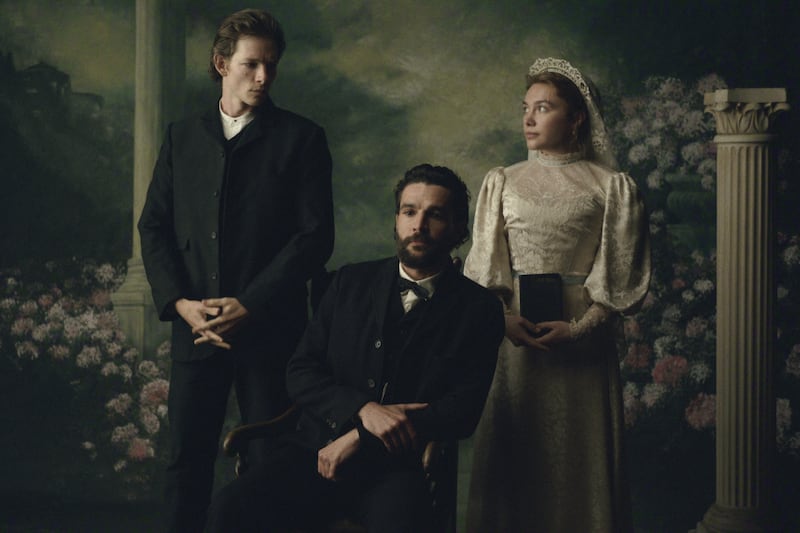
East of Eden (Oct. 1 on Netflix) first hit the (big) screen in 1955, courtesy of Kazan’s legendary director grandfather Elia and star James Dean, though that film covered only the last third of Steinbeck’s tome. With seven hours to work with, Zoe takes a far more holistic approach, putting greater emphasis on Cathy Ames (Pugh), the wicked woman whose life intersects with two brothers in turn-of-the-century Connecticut and, later, Salinas, California.
Capturing the dramatic and thematic breadth of her biblical tale of fathers and sons, brothers and lovers, the creator/writer crafts a novelistic opus that grows richer with each installment—even when one often struggles to see precisely what’s taking place.
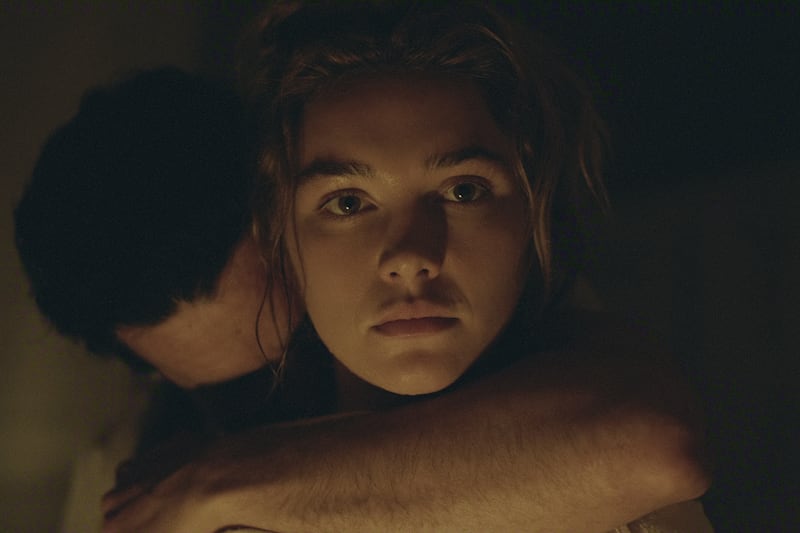
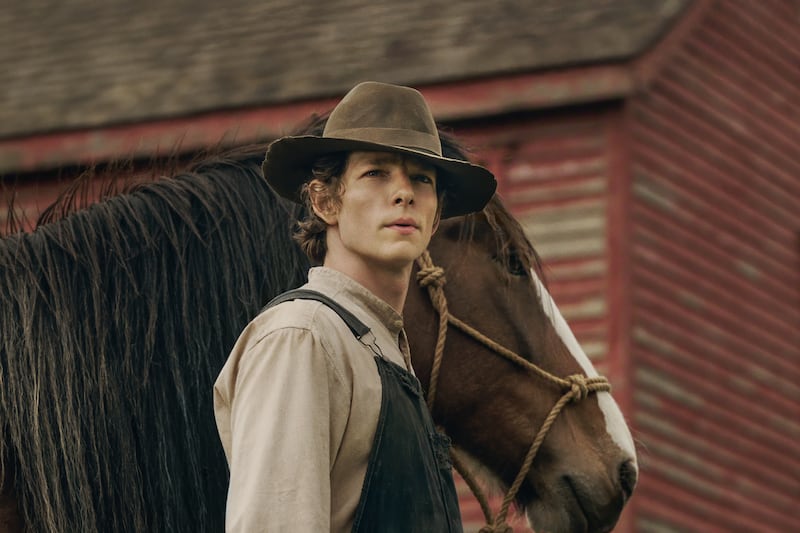
That’s a problem from the get-go, as a horribly bruised and battered Cathy’s arrival at Charles (Mike Faist) and Adam Trask’s (Christopher Abbot) farm is borderline indecipherable, at least until an open door provides a modicum of lamplight. The cause of Cathy’s condition isn’t initially revealed by East of Eden, whose story leaps backward 25 years to detail young Charles (Gus Turner) and Adam’s (Costa D’Angelo) childhood under the guidance of father Cyrus (Tracy Letts).
A stern military vet, Cyrus’ callousness manifests itself in his consigning Charles to care for the family farm despite the boy’s wish to escape and follow in his father’s footsteps, and forcing Adam to join the military (no matter that he’s not cut out for it) because, as he says, “I love you better.”
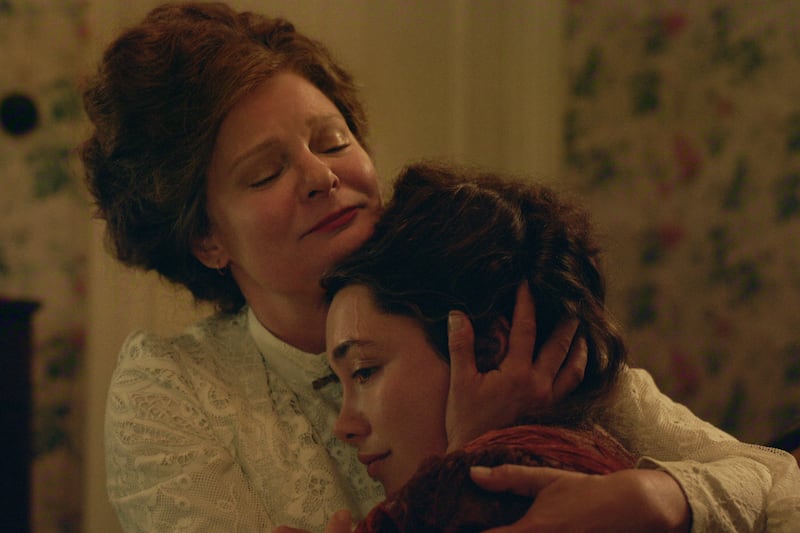
Love and cruelty are inextricably intertwined in East of Eden, which eventually features two separate sets of brothers modeled loosely on Cain and Abel. After their father’s death, Adam returns to the homestead Charles has made profitable, and their quiet lives are disrupted by the arrival of Cathy, for whom Adam falls, despite his brother’s wariness.
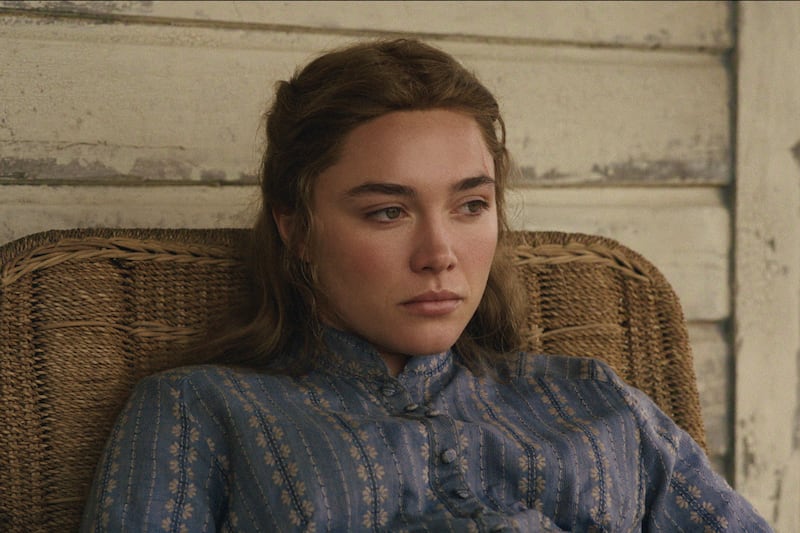
Cathy accepts Adam’s affections, but a flashback to her tormented past reveals she’s far more viperous than she appears. Even so, in Kazan and Pugh’s hands, Cathy is not merely the satanic villain of Steinbeck’s book. For all her deceitful tricks, pitiless abandonments, and homicidal manipulations, she’s simultaneously cast as a victim of male abuse and, thus, more of a wounded, rabid creature than an inherently evil demon.
This does not mean that East of Eden radically softens Cathy; rather, it merely offers a partial explanation for her nastiness (and, thus, her fixation on Alice in Wonderland). Pugh’s portrait of Cathy is full-bodied and nuanced, portraying her poisonousness as motivated by her fury at men’s (and patriarchal society’s) desire to control her and her attendant craving for freedom.
Expressing the warring impulses at the heart of her malice, it’s a tour de force that recognizes Cathy as a scarred, scared, and sinister three-dimensional individual. Still, it refuses to let her off the hook for her awful actions, and those mount once Cathy revolts against new husband Adam moving them to Salinas, California and—following the birth of their twin sons—violently flees to become a prostitute.
Written almost entirely by Kazan and directed by Garth Davis and Laure de Clermont-Tonnerre, East of Eden is an engrossingly knotty tale of desire, autonomy, jealousy, fury, pity, resentment, and forgiveness, capturing Steinbeck’s grand concerns while fixating on its characters’ fundamental humanity.
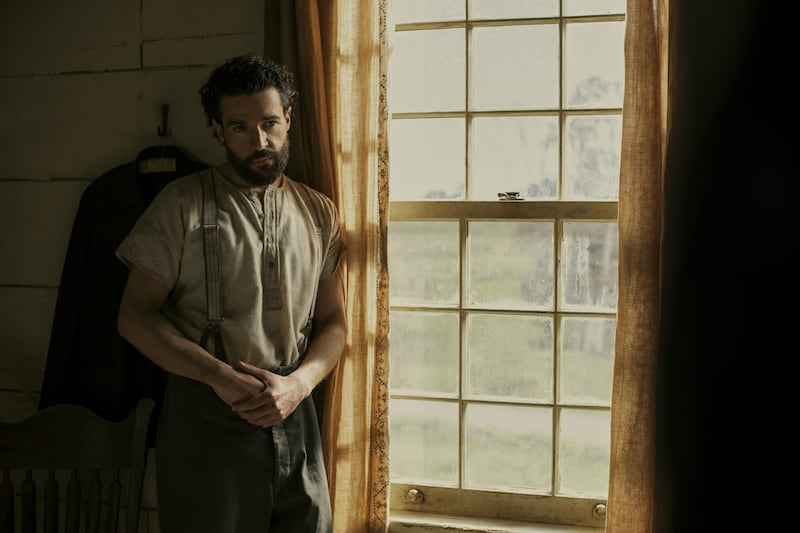
As the tormented Adam, Abbott conveys roiling emotions through a somber, bottled-up visage, whereas Ciarán Hinds is warm and considerate as Samuel Hamilton, the Irish immigrant who helps Adam care for his Salinas property after Cathy’s departure.
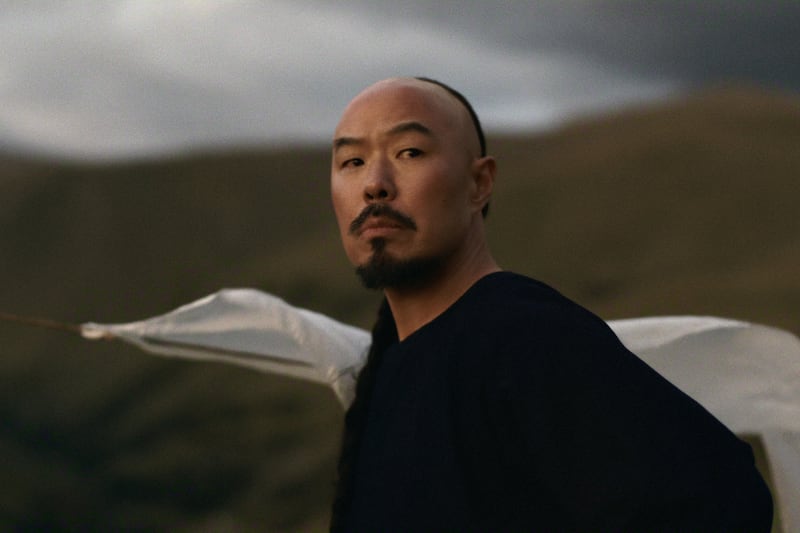
Similarly vivid and empathetic is Your Friends & Neighbors’ Hoon Lee as Adam’s Chinese servant Lee, whom Kazan fleshes out as another person in this fable struggling to find acceptance, contentment, and family in a world that seems determined to separate rather than to unite its inhabitants.
East of Eden is as close to Steinbeck’s novel as an adaptation might get, including during its later passages focused on Adam’s sons Cal (Joseph Zada) and Aron (Joe Anders)—additional Cain and Abel surrogates whose tight-knit bond is strained by their differing dispositions, their father’s less-than-shrewd parenting decisions, and the (secretive) sins of their mother.
Both Zada and Anders capably shoulder the load of the concluding chapters, and in Cathy’s final descent into paranoia, heartlessness, and madness, Pugh, who earned an Oscar nomination for Little Women at just 24, exudes a grandness that’s of a piece with this intensely contentious and poignant epic as a whole.
Consequently, it’s inexplicable that the series is often so overcast that it becomes incomprehensible. Non-Netflix-produced films and TV shows on the platform aren’t hindered by this obscurity, so the fault doesn’t lie with the technology. And as their other work proves, Kazan, Davis, and De Clermont-Tonnerre are perfectly capable of properly illuminating a scene. Yet here we are, straining to watch terrific actors do terrific work with terrific writing and directing (and a superbly operatic, mournful Laura Karpman score), all because the proceedings’ contrast levels are totally out of whack.
There’s no excuse for this aesthetic shortcoming, and while it doesn’t sabotage East of Eden, it does interfere at so many key moments that it holds it back from true greatness. Even so, only the stoniest of hearts will find themselves unmoved by the series’ climactic episode, in which the past and the present collide with tragic force, suggesting that the horrors and mistakes of yesterday are doomed to repeat.
Irrespective of such pessimism, however, it clings to the hope (which Steinbeck himself championed) that the ancestral baggage we carry must not forever weigh us down, because as the saga of Cain and Abel teaches—courtesy of the Hebrew term timshel—our paths are, in the end, our own to choose.