TV has tried to restart and/or expand popular film franchises in many ways, but Elle does something unique in imagining the origins of its Legally Blonde character Elle Woods: It totally ignores what happened in her initial movie so it can repeat what worked the first time around.
Prime Video’s prequel (July 1) is about Elle’s high-school experiences years before she proves, in her maiden big-screen outing, that she’s more than just a vapid, superficial Beverly Hills Barbie.
What it concocts, however, is a story in which she proves that she’s more than just a vapid, superficial Beverly Hills Barbie.
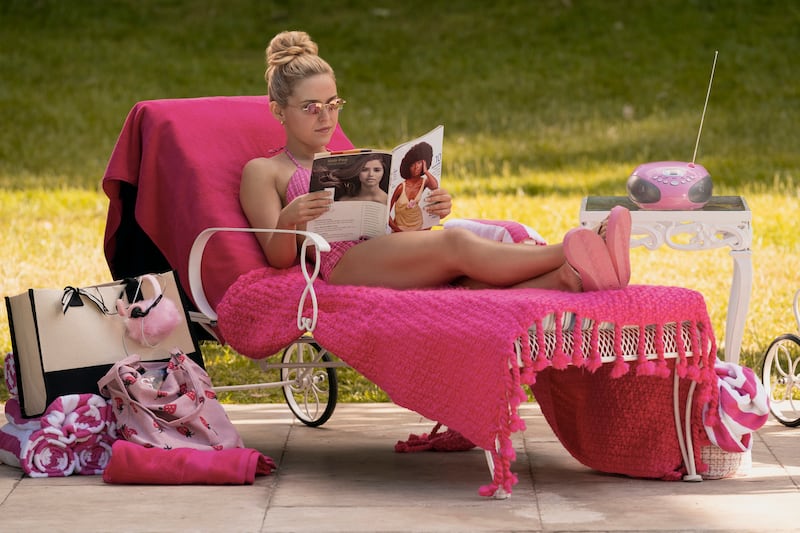
This is both crushingly derivative and makes no sense in terms of the franchise’s timeline—unless, that is, we’re to expect that at some point after this series’ events, she somehow reverts back to her old self so, in Reese Witherspoon’s 2001 feature, she can do this all over again.
Maybe a Men in Black-style neuralyzer is involved in this process?
Memory loss is certainly something one craves while sitting through Laura Kittrell’s eight-part comedy, whose tale picks up with Elle (newcomer Lexi Minetree) as she prepares for a big 1995 junior year primed to revolve around making inroads with the popular girls and experiencing her first kiss with “Hot” Josh (Logan Shroyer). Those plans are not to be, as a professional mishap by her plastic surgeon father Wyatt (Tom Everett Scott) compels the family—including socialite mother Eva (a sparkling June Diane Raphael)—to relocate from sunny California to gloomy Seattle, a transition that the show underlines by turning the lighting all the way down. This is a crisis for Elle and her best friend Madison (Jessica Belkin), and it gets worse when she arrives in the Pacific Northwest and is promptly looked down upon as a trifling ditz.
Elle loves pink, designer clothes, and Cosmopolitan magazine, whereas her grunge-y new peers are into Pearl Jam, flannel, and social justice. Elle slathers itself in fish-out-of-water contrasts and ‘90s nostalgia, the latter of which is so insistent that it suggests the series—despite being a formulaic coming-of-age comedy—is primarily aimed at the 40-something crowd.
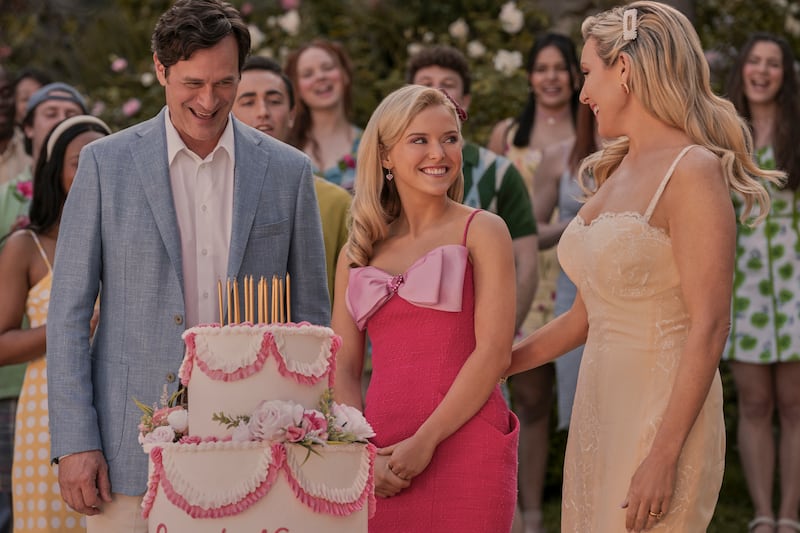
Boasting an endless array of era-specific alternative soundtrack cuts (complete with a title sequence set to Garbage’s “I’m Only Happy When It Rains”) and an equal number of shout-outs to music artists and pop-culture items, it panders with a bluntness that’s indicative of its storytelling.
Elle doesn’t belong in these environs, and though she tries to “get fluent in Seattle,” she’s made to feel unwelcome by the student body. At the head of the mean-girl pack is Kimberly (Chandler Kinney), who, upon seeing Elle strive to fit in by sporting a Nirvana shirt, tells her, “Seattle isn’t a costume and pink isn’t a personality.”
Yet Elle’s portrait of its central locale (and its denizens) is absurdly caricatured, with everyone dour, mopey, and oh-so-serious, such as Dustin (Zac Looker), a big-haired classmate who’s all about raging against the machine and, thus, wears a Rage Against the Machine t-shirt. Unlike her prior compatriots, who obsessed about their outfits, social standing, and Days of Our Lives (whose famous possessed-Marlena plot is repeatedly referenced), these kids care about real stuff.
Elle clashes with Kimberly and is scoffed at by Dustin, at least until she shows him how to properly sell stuff at an auction. She does, however, make a quick friend in the office secretary, Donna (Amy Pietz), and catches the eye of hunky Miles (Jacob Moskovitz). Better still, she hits it off with Shannon (Danielle Chand), thereby preventing her from being an abject pariah, and she slowly convinces lesbian record store employee Liz (Gabrielle Policano) that she’s not a bimbo.
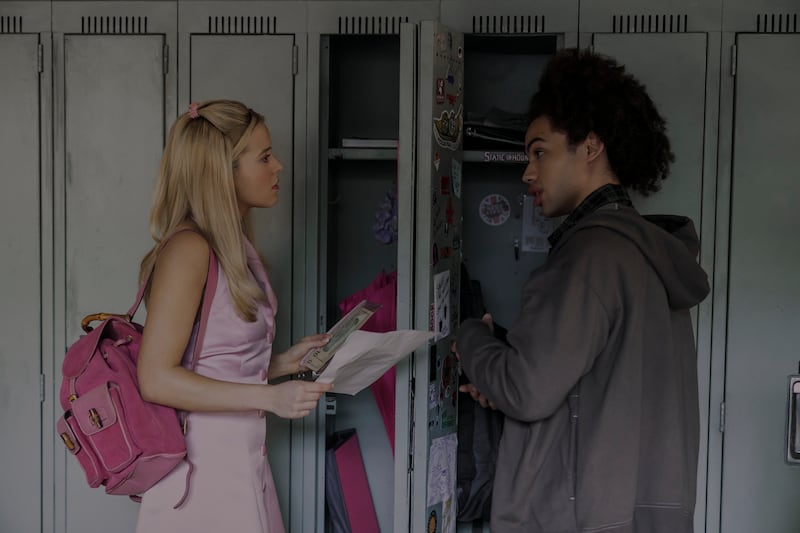
Acclimating herself to Seattle takes time, but it happens, even as she applies for a Cosmopolitan internship that would earn her a trip back to L.A.—a move that’s encouraged and welcomed by her BFF mom Eva, who busies herself by working for the mayoral campaign of Dean Wilson (the late James Van Der Beek).
Elle gets her tiny chihuahua Bruiser and dons a variety of bold pink get-ups, and Minetree’s performance is appropriately chipper, cheery, and bright, capturing the character’s mix of shallow materialism and altruistic earnestness.
Nonetheless, she lacks Witherspoon’s star power, and her saga is a rehash destined to have Elle become more substantial and activist-ish, and to demonstrate that the very qualities most of her contemporaries dismiss (friendliness, positivity, charm, party-planning, a big heart) are strengths that can be used to affect meaningful change.
Elle’s trajectory is toward maturity and enlightenment (“I’m changing this place and maybe it’s changing me too! And I don’t totally hate it!”). Yet by charting that course, it jumps the gun on its cinematic predecessor, whose starting point was Elle having undergone neither. As such, it’s at once redundant and contradictory.
Not helping matters, its narrative is a hodgepodge of perfunctory teen melodrama (there’s even a love triangle concerning Elle, Miles, and Dustin) and Wednesday-esque conspiracy sleuthing, the latter revolving around Dustin’s suspicion that Principal Anderson (Matt Oberg) is stealing funds from the school coffers—a crime made worse by the fact that he callously fires Donna for using petty cash to aid students in need.
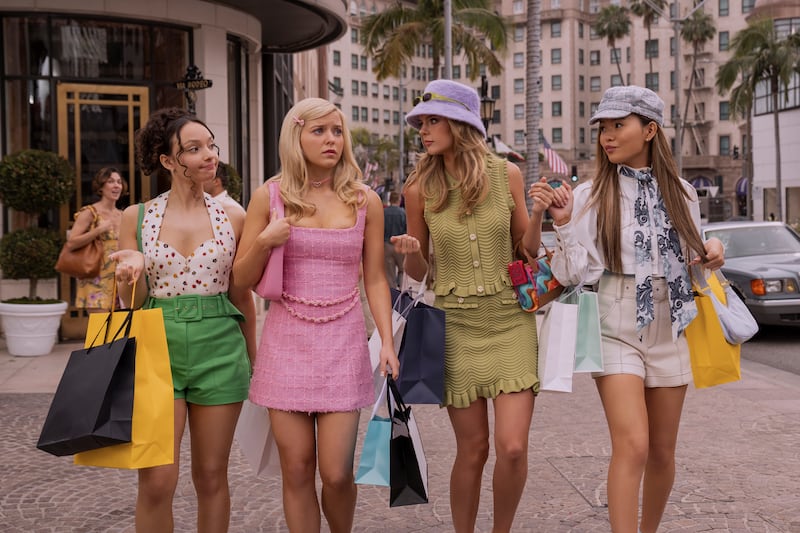
Blockbuster Video, the Hugh Grant scandal, Sleepless in Seattle, Trapper Keepers, and Nancy Kerrigan are just a few of the ‘90s nods littered throughout Elle. Unfortunately, they merely exacerbate the cosplaying nature of this endeavor, whose every gesture is a regurgitation.
Those unfamiliar with Legally Blonde may not be bothered by the been there, done that quality of these proceedings. But then, it’s almost impossible to imagine anyone like that watching it in the first place, so intensely wedded is it to its ancestor. It’s a spin-off of a 25-year-old movie whose endless ‘90s-isms underscore that, for all its Disney Channel scripting, its target audience is Gen Xers with a fondness for their particular past.
That Elle could have been a two-hour movie is ultimately the least of its problems. Unfunny, unoriginal, and distended to pad out eight episodes, Kittrell’s show is simply the latest example of mining IP for reasons that have everything to do with the bottom line and almost nothing to do with inspiration.