
It is more than a bit ironic that the new show Adults follows Gen Z-ers trying to grow up, while HBO’s new series Youth centers on Gen X-ers doing whatever they can to stay young.
Youth, premiering on HBO on Sept. 20, displays the full spectrum of adulthood. The 50-year-old protagonist, Alex, is played by the prolific Sharon Horgan (Bad Sisters), who also created, wrote, and executive produced the show.
She has aging parents with health issues, a son (Aran Murphy) who just graduated high school, and a series of past and present romantic entanglements who fill in a spectrum of manly immaturity.

In the first two episodes, her ex-husband barely parents and gallivants off to space (acting on a TV show). Then there’s Michael (Tim McInnery), who her boss/friend Sam (Sharlene Whyte) sets her up with. He’s not that old, but every time he comes near Alex, she cringes. Finally, there’s Patrick (Rupert Friend), a playful ex-fling, who maybe, just maybe, is ready for a real relationship with Alex, if only she can stay out of her own way.
In press materials, Horgan describes Youth as “auto-fiction-y,” the latest in a trilogy that began with Pulling, about being a young, single woman. The project progressed to Catastrophe, which is about relationships and parenting young kids. Finally, we’ve arrived here at Youth.

In the trailer, Alex says, “When did it all stop being fun?” which pretty much encapsulates Alex’s problems and is a relatable way to describe the phase of adulthood many people find themselves in when everything is a little ruined all the time. She tells Patrick, “I can only handle one calamity at a time.”
Unfortunately, life doesn’t work that way, and all at once her parents and son need her, work is calling, and her burgeoning return to having a love life isn’t going as smoothly as she hoped. Like the lunch meat Alex eats directly from the fridge, being the middle of the sandwich generation isn’t very enticing, yet she has no other choice but to carry on.

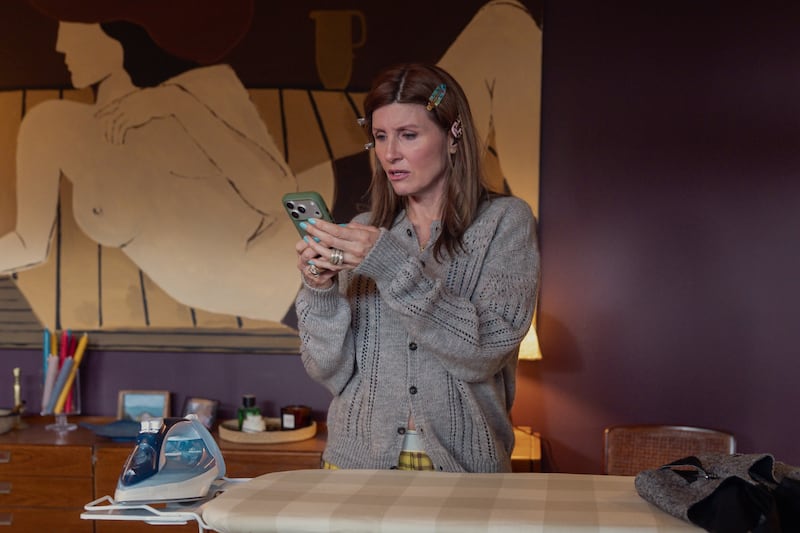
The charm of the show is that while Alex is dealing with deeply familiar problems, she does it far more glamorously while still leaving room for some messy humor. Horgan is gorgeously clad in sexy business wear that for sure goes from day to night (as the magazines always told us our wardrobes must), yet we still see her ironing her blouse while wearing plaid boxer shorts and her hair in clips. She lives in a gorgeous London apartment, with big, bold art on the walls and books spilling out over her bedside tables.
In fact, all the main characters have lavish homes. We never have to hear about how hard it would be to maintain this lifestyle, even though Alex still feels like she’s scrambling to get a foothold in her career. Her job looks like a dream at times—she works for her best friend who runs an impossibly chic literary agency, yet she made a crucial error in judgment in the past that she’s paying for now.

Her sex life is at times enviable and at others starkly real. She’s a walking PSA for UTI prevention and hormone-replacement therapy. She dines in beautiful restaurants and travels for work and fun, yet the hangovers hit harder, and her body isn’t as reliable as it used to be, as demonstrated by her arthritic jaw diagnosis in the first episode.
Sitcom-style formulaic episode writing, complete with “bits” and recurring jokes, works very well on Hulu’s Adults, but Youth is funny in a more realistic way. There are fewer laughs per minute, but they are well-earned and usually a product of Horgan’s reactions to the ridiculous and overwhelming situations Alex can’t stop finding herself in.
The show feels like an Irish twin (of sorts) to the other HBO comedy about life after divorce: the Steve Carell vehicle Rooster. Both shows are beautifully shot and styled and, tonally, a little bit dark without becoming a drama or, worse, a drama pretending to be a comedy (see: The Bear).
What differentiates this show from others in which characters make increasingly poor life decisions that screw up anything good they could have had is that the stakes feel appropriately sized. The characters’ reactions and choices, even when questionable, never make you worried for their mental wellness.
These characters aren’t narcissistic monsters (though the ex-husband comes close). When Patrick asks if she’s running away from him, Alex says, “I’m trying to run away from me.” She knows she’s self-sabotaging but doesn’t quite know the right thing to do in any situation, let alone a romantic one. If she gives up on a relationship, she’ll be lonely, but a relationship takes her away from work and family. Too much family time drives her insane, as does her job, at times, though she seems to love it.
The myth of “having it all” that the lean-in movement perpetuated and sitcoms like 30 Rock made fun of is dead, and Horgan’s Alex is ready to admit it. Not a fairy tale, nor a gritty drama, the comedy of Youth comes from its sometimes sad—but mostly hilarious—basis in reality.