Filmmaker Nicolas Winding Refn isn’t just an acquired taste. He’s an adore-him-or-loathe-him auteur whose neon-drenched genre fantasias are awash in such self-conscious affectation that “polarizing” seems too weak a term to describe the reactions they elicit.
Having spent the past decade making streaming series (Too Old to Die Young and Copenhagen Cowboy) that reconfirmed his commitment to stylized insanity, the Danish writer/director of Ryan Gosling’s 2011 showcase Drive makes his grand big-screen return with Her Private Hell, an orgy of violence, sex, fashion, and sordid glitz and glamour that makes next to no sense.
It will be irresistible catnip for the fervently faithful, but this mannered tale of reunion, desire, jealousy, revenge, betrayal, insecurity, and lurid color filters will leave most scratching their heads—and, often, chuckling at its bats--t bravado.
Her Private Hell (July 24, in theaters) takes place in a sci-fi metropolis whose cityscape is dotted with phallic skyscrapers that protrude from sprawling clouds of mist and encircle the locale’s central building, which is shaped like a giant glittering head. Into one of these Blade Runner-esque abodes walks Elle (Sophie Thatcher), whose eyes and cheeks are embellished with sparkly, pointy makeup.
In a lobby armchair, she finds a slumbering Hunter (Kristine Froseth), whose initial comments reveal that the two of them are set to co-star in a movie. Since Hunter has neither a room nor luggage, Elle invites her to stay in her penthouse, whose gold décor, elevator-esque doors, and long corridors make it seem like Refn’s personal take on Twin Peaks’ Red Room, as do camera pans in and around this space that hum with nightmarish menace.
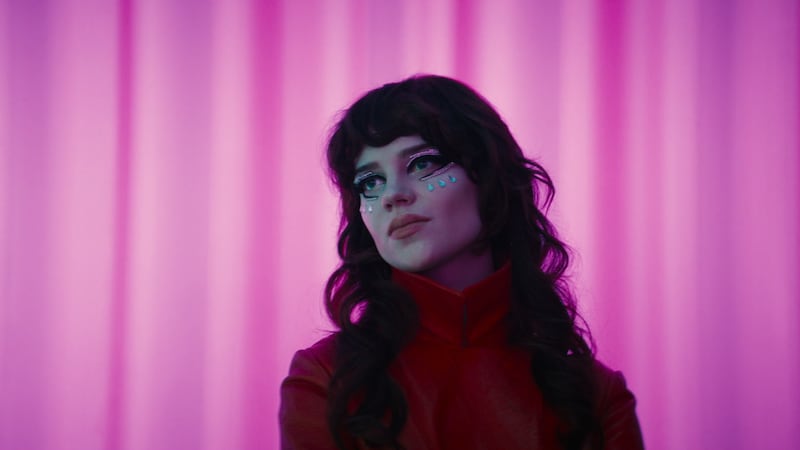
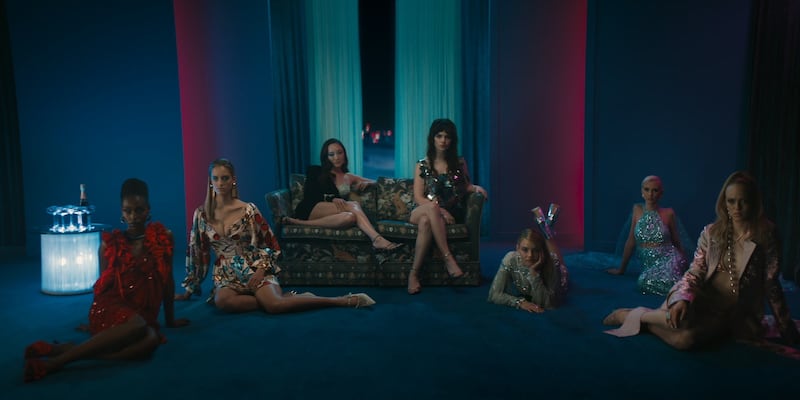
No sooner has Hunter taken in this opulent residence than the two are joined by Dominique (Tuner’s Havan Rose Liu), whose disposition—especially towards Elle—is intensely sexual. Nonetheless, in the first of Her Private Hell’s amusingly batty surprises, Dominique turns out to be Elle’s stepmother. The cause of Elle and Dominique’s strained rapport isn’t initially apparent, but they’re both devoted to their dad/spouse Johnny Thunders (a nearly unrecognizable Dougray Scott). Dressed like he’s cosplaying as The Fonz, Johnny is the film production’s “money man,” and he’s adored by his daughter, who repeatedly and creepily calls him “Daddy.”
Refn saturates everything in luxurious blues, blacks, and reds, including Elle’s long crimson coat. He paces his initial action dreamily, full of snapshots of characters staring into mirrors, posing in overtly erotic ways (such as Dominique lying belly-down on a bed, her hands encased in shiny gold gloves), and emerging from, and being swallowed up by, the mist.
Nothing is real in this phantasmagoric netherworld, and that’s underlined by Johnny telling this trio about the “tragedy” of the Leatherman, a specter with glowing eyes and gloves decorated with razor-sharp diamonds who, when the mist rolls in, hunts innocent women.
The Leatherman lends Her Private Hell its Dario Argento malevolence, whereas Pino Donaggio’s lush orchestral score—which swoops and sways with melodramatic passion—provides old-Hollywood energy. Refn deliriously mixes and matches influences to create something uniquely bewildering. Clarity proves elusive as Elle attends a dress fitting and is pricked by one of the two seamstresses (an apparent sign of success!).
Shortly thereafter, she stars in the movie-within-the-movie, a science-fiction whatsit in which her silver-faced starship commander travels through a wormhole created by an exploding planet, lands on a crystal-landscape world, and engages her comrades (each wearing identical, if different colored, outfits) in a laser-blaster shootout.
“This movie’s gonna be hell,” remarks Elle, and if the walkouts at my press screening are any indication, many will feel as if she’s speaking directly to them about Her Private Hell.
Still, the proceedings’ hypnotic eccentricity is never boring, even though the story is a collection of signifiers, gestures, and motifs tethered together by the director’s trancelike visuals, full of striking framing, fuzzy silhouettes, and pulsating lights.
Refn is a 21st-century aesthete concerned with plush, gleaming textures, beautiful things (à la Johnny), and brutal, sexualized violence, the last of which becomes a recurring fixture in this lunacy once its other protagonist is introduced.
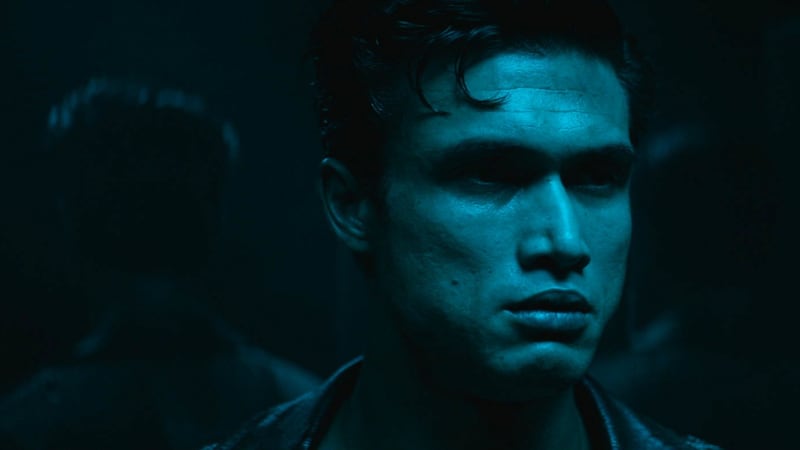
That would be Private K (Beef Season 2 star Charles Melton), “the saddest person in the world,” a military veteran who stalks the city—which, as suggested by a storeowner and the local detective (Hidetoshi Nishijima), is in Japan—searching for his missing daughter. Melton’s demeanor is as harsh, and his comportment as robotic, as his often-shirtless torso is ripped.
It doesn’t take long before his character (whose inner-monologue narration is comically hardboiled) is beating up bad guys, such as an obese man taking professional photographs with a collared-and-chained young woman—a skirmish that features a futurist jukebox, for who knows what reason. None of this is thrilling, but it is jarringly gruesome, aided by sound effects (for punches, stabbings, and creaking leather) that are amplified to the nth degree.
As Private K scours the streets for the Leatherman, Elle “speaks wolf” (i.e., she woofs and howls) with Doninique and Hunter, who convince her to come with them to see Nico (Babylon’s Diego Calva), a random sleazeball who oozes lustfulness. At a nightclub, sex and murder pretentiously seize the spotlight.
Refn can’t stage a single scene without calling attention to his own behind-the-camera presence, and with an early orgasm-and-body-ripping climax, he tips the film into camp. There it stays for its remainder, complete with Elle stuffing her soaked panties into a sleeping Dominique’s mouth and, later, demonstrating that she knows how to handle the gold hatchet gifted to her by her father.
Dropping a piece of birthday cake into Elle’s open, upturned mouth as if she were a mother bird feeding her young, Dominique admits that “it’s a bit performative.” That’s an apt wink-wink summation of Her Private Hell as a whole, and if Refn’s showmanship reeks of self-satisfaction, it’s also inimitable and frequently spellbinding.
It’s futile to try to make heads or tails of the director’s first feature film in 10 years, during which he focused on TV and, according to him, literally died for 25 minutes due to an undisclosed health emergency. Think of it as a sensual and sinister reverie of daddy issues, serial killers, and set and costume design, and prepare to be equally dazzled and driven mad.