Grimm’s fairy tales were often rooted in violence perpetrated against—or by—children. And Damian McCarthy uniquely taps into that classical vein with Hokum.
A folk-horror thriller (May 1, in theaters) whose bloody traumas and self-destructive guilt help put a novel twist on the haunted house nightmare, this creepy nerve-rattler confirms that the director’s excellent 2024 breakout Oddity was no fluke—thanks, in no small part, to an Adam Scott lead performance that’s all the more captivating for refusing to court easy sympathy.
For his third behind-the-camera feature, McCarthy returns to his native Ireland, which American author Ohm Bauman (Scott) visits following an evening in which he believes, while working at his laptop, that he sees a silhouette on his staircase. Ohm is penning the conclusion to a successful trilogy of novels about a conquistador.
In Hokum’s prologue, we see that tome’s climactic scene, in which the crusader, lost in the desert and incapable of accessing the treasure map he’s been following, considers a fateful, brutal act against his young charge in order to continue his quest—a suggestion of (parental) viciousness that echoes throughout the ensuing story.
Inspired by the contents of a keepsake box, Ohm checks into the Bilberry Woods Hotel, a rustic place in the middle of Irish nowhere, where he’s immediately recognized by front desk clerk Mal (Peter Coonan). The same goes for bellboy Alby (Will O’Connell), a fan whose request that Ohm read his manuscript is roundly rejected by the writer, whose misanthropy is tough to miss.
Even hotel employee Fiona (Florence Ordesh), to whom he’s most kind, can’t help but remark somewhat critically on Ohm’s intended ending, which he claims is “challenging” and she decries as “bleak.”
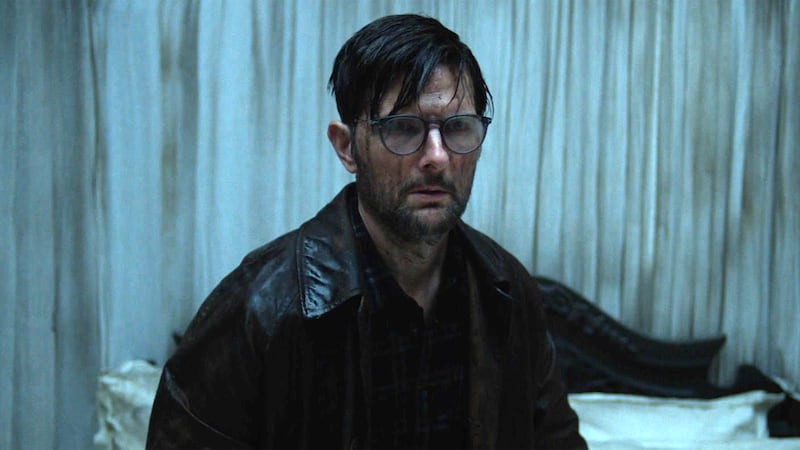
Taking a detour from his torn-in-two everyman role on Apple TV’s Severance, Scott radiates curtness from moment one in Hokum, and initially, it resonates as off-putting. With a drink regularly in hand, his character boasts a caustic bite, and the actor’s willingness to push the envelope when it comes to his unpleasantness is the key to making him fascinating. Not only because it suggests mysterious, painful internal issues, but because it amplifies the film’s edginess. It’s a deft turn, and grows more interesting as Ohm quickly becomes a beleaguered center of attention.
Ohm is in this remote locale to spread his parents’ ashes, and upon completing that task, he encounters Jerry (David Wilmot), a forest hermit who has a fondness for consuming magic mushrooms in his goat’s milk. With a bushy beard and an eccentric disposition, Jerry is a rustic woods-dweller, and his presence amplifies the proceedings’ off-kilter mood.
That’s additionally exacerbated by a host of small incidents, such as Ohm arriving at the hotel and encountering Fergal (Michael Patric) sporting his latest hunting kill (via crossbow), and proprietor Mr. Cobb (Brendan Conroy) scaring two young boys with a fable about a witch that preys upon lost travelers, shackling and dragging them to the underworld.
Between this and the occasional sight of figurines and wood carvings of cherubic children, Hokum introduces plenty of unnerving elements, not least of which is the anecdote that the hotel’s honeymoon suite—which was once frequented by Ohm’s parents—is thought to be haunted and remains, like the elevator leading to it, locked up.
Ohm isn’t a man of superstition, and he responds to talk about paranormal activity with tetchy skepticism. Nonetheless, following a near tragedy that temporarily knocks him out of commission, Ohm is stunned by the news that Fiona has gone missing and Jerry, whose wife met a supposedly untimely fate, is the prime suspect.
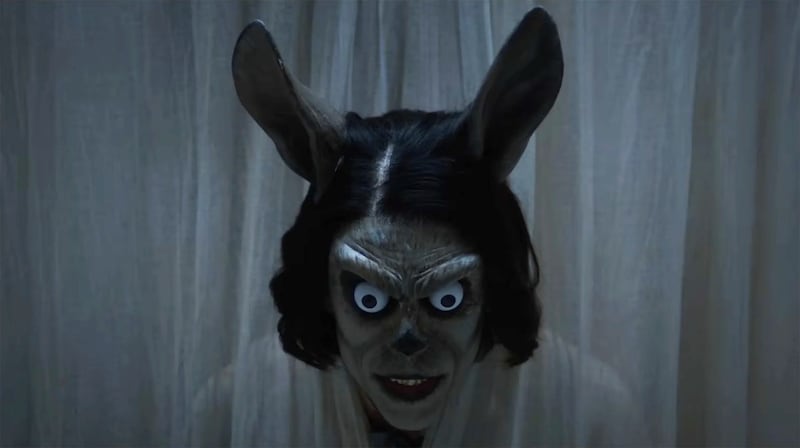
McCarthy builds his narrative gradually, but that’s not to say Hokum is listless. Rather, the director establishes a startling tone from the start and maintains it through repeated jump-scares involving ghoulish faces and unexpected entities appearing out of the blue behind his protagonists, the latter of which results in the material’s finest (and least overtly monstrous) scare.
Cinematographer Colm Hogan’s evocative visuals and composer Joseph Bishara’s moan-punctuated score contribute to the sense that there’s something unreal afoot, and editor Brian Philip Davis cuts to maximize shocks, creating a malevolent edge-of-your-seat atmosphere.
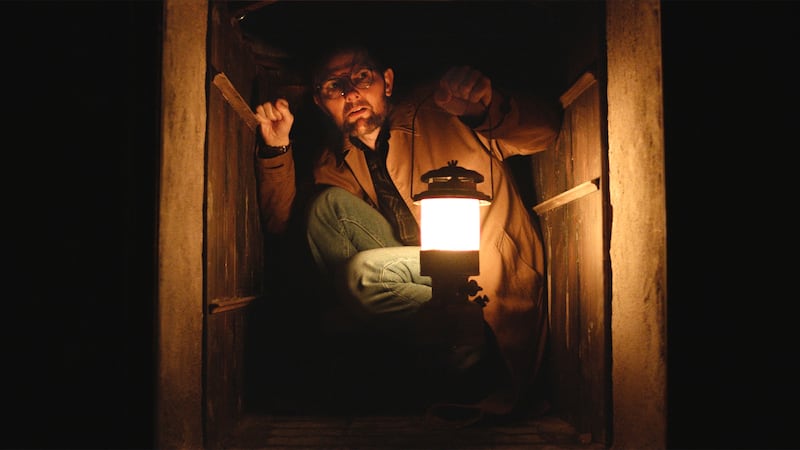
Hokum truly gets going when Jerry tells Ohm that he thinks Fiona might be in the forbidden honeymoon suite. Breaking in, only to get trapped inside, Ohm experiences a night unlike any other, and McCarthy casts his action as akin to a waking dream (or hallucination), with secret doors tucked away beneath desks, a dirty canopy bed decked out with white drapes, and an ancient dumbwaiter that leads to the basement.
Illuminated solely by lanterns, as is Ohm’s path as he navigates hair-raisingly dark corridors, this chamber proves anything but comforting. The unholy forces that soon plague Ohm are similarly disturbing, marked as they are by pale, cracked visages that are barely visible in the gloom.
Scott is a most harried man in Hokum, as well as something of a jerk. McCarthy’s script doesn’t attempt to soften the character, recognizing in him a deep wellspring of bitter hostility aimed simultaneously outward and inward, and as his ordeal progresses, subtle links between his past and the hotel’s slowly emerge.
Nonetheless, the writer/director refuses to make any such notions one-to-one explicit. Instead, he merely hints at the dynamics intertwining Ohm and his strange environs, not to mention the apparent specter determined to make this evening his last.
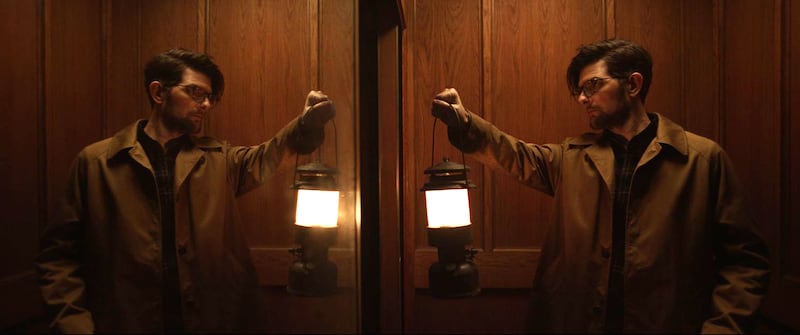
As befitting an affair such as this, McCarthy besets Ohm with dilemmas that both defy logic (including a strange black-and-white TV program starring a guy who’d be right at home in John Carpenter’s They Live) and speak to his anguished condition. Whether it’s in the novelist’s manuscript or at the Bilberry Woods Hotel, tales of children being hurt, or hurting others, abound, as does a persistent—and, for Ohm, personal—strain of regret for mistakes made and crimes that can’t be undone.
There isn’t an image in Hokum to rival the depiction in his previous film of a human-sized, open-mouthed wooden mannequin sitting at a kitchen table, yet McCarthy again demonstrates his gift for crafting illusory situations and alarming surprises. Just as Ohm comes to realize that the supernatural isn’t hogwash, Hokum is further proof that the writer/director is the real deal.