Big Little Lies may be the most influential TV show of the past decade, establishing a modern women’s-melodrama template that’s been mimicked, in various forms, by numerous spiritual offspring, a list of which would include (but wouldn’t be limited to) All Her Fault, The Perfect Couple, Nine Perfect Strangers, Sharp Objects, Little Fires Everywhere, Little Disasters, The Undoing, and Disclaimer.
With its now familiar story of female friends whose seemingly happy lives are complicated by money, jealousy, greed, secrets, lies, adultery, and, of course, murder, David E. Kelley’s smash hit pioneered a pulpy small-screen formula—equal parts sexy, suspenseful, and scandalous—that was primed for must-see binge-watching. And its legacy continues with Imperfect Women, whose saga of love, betrayal, and homicide follows the path charted by its television godmother to a tee.
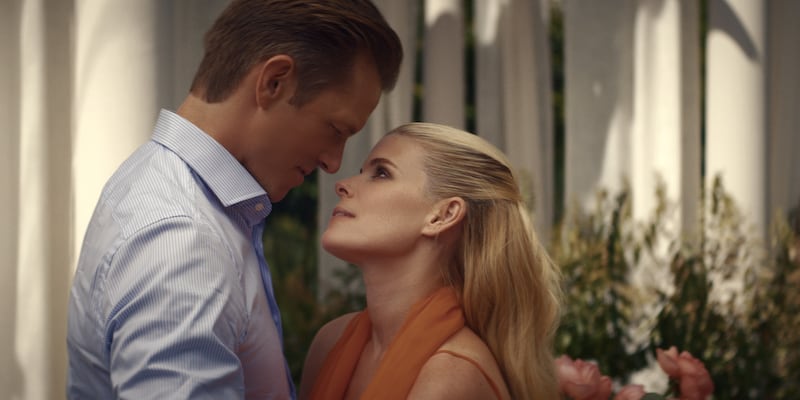
As suggested by its wholly generic title, Annie Weisman’s eight-episode Apple TV series (March 18) starring Kerry Washington, Elisabeth Moss, and Kate Mara is, in most respects, an unimaginative retread. Yet despite its lack of originality (or a conclusion worthy of its set-up), those with an unending appetite for sultry and salacious mysteries about BFFs and the shocking skeletons in their closet will undoubtedly eat it up.
Based on Araminta Hall’s novel of the same name, Imperfect Women concerns three California best friends: Eleanor (Washington), the single philanthropic careerist; Nancy (Mara), the glamorous trophy wife; and Mary (Moss), the frumpy homemaker. Over shots of them joyously dancing together, Eleanor intones in voiceover that what they had was “a kinship from deep in our souls.”
That sort of florid language is par for the course in Imperfect Women, whose narration—from all three protagonists, depending on a given chapter’s focus—is as overwritten as the rest of the dialogue, whose corniness extends from Nancy stating that pain was “a small price to pay for transcendence” to Mary’s English professor husband Howard (Corey Stoll) telling someone, “You’re a firestarter. That’s your true nature.”
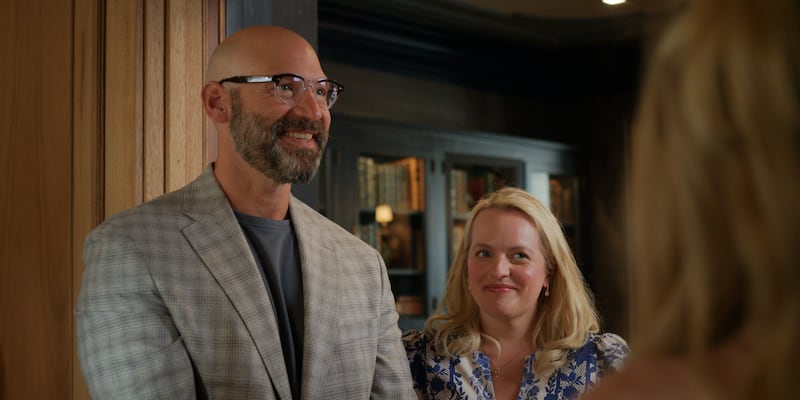
When not over the top, Imperfect Women is clichéd, albeit with a professional sheen that makes its familiar action go down smoothly. Following an evening out during which Nancy talks to Eleanor about the troublesome affair she’s having (and can’t figure out how to end), Eleanor is awakened by a phone call from Nancy’s husband Richard (Joel Kinnaman), the scion of a rich and powerful Hennessey clan—including his dad R.L. (Keith Carradine) and sister Kit (Jill Wagner)—whose business is kept vague but whose evil is endlessly underlined. Richard is worried because Nancy never came home, and his worst fears are realized when the cops arrive to tell him that his wife has been murdered.
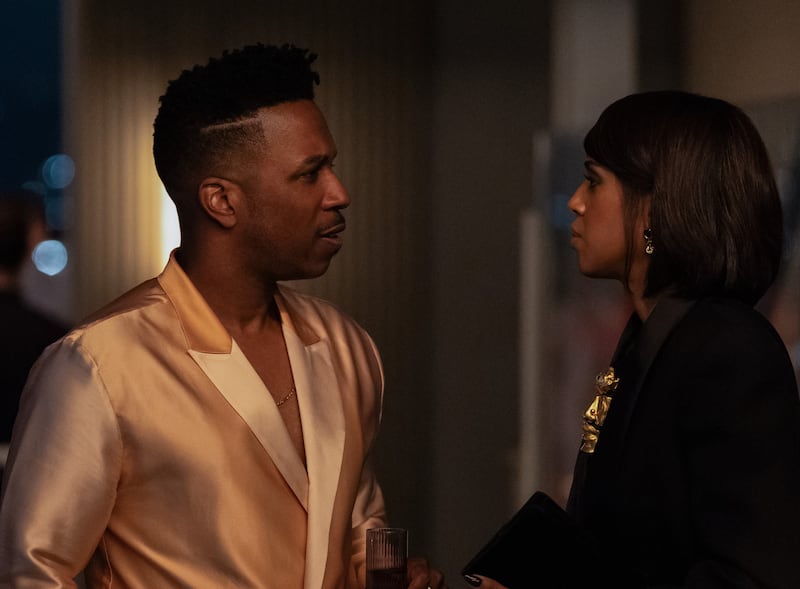
Who could be the dastardly fiend behind this slaying of a charming, beautiful, beloved innocent? Per tradition, Imperfect Women wants viewers to think it could be any of its characters, beginning with Richard, who’s instantly revealed to have a drinking problem and a bad temper. However, in the blink of an eye, Eleanor also starts behaving recklessly, no matter the advice she receives from those closest to her, such as her brother Donovan (Leslie Odom Jr.). In the process, she becomes a potential suspect in a crime that grows more tangled with each new development.
During conversations with Detective Ganz (Ana Ortiz), Eleanor confesses that Nancy was cheating on Richard with a man named David, and in short order, an artist named Davide (Theo Bongani Ndyalvane)—who painted a nude portrait of Nancy that she recently hung in her home—is arrested. Considering that this happens before Imperfect Women reaches its quarter-way point, Davide is quite obviously not the culprit, and Weisman’s series wastes little time moving on to other guilty-looking parties.
It additionally rewinds to before Nancy’s murder to detail her upbringing at the hands of a drunken mother and sexually abusive stepfather, as well as her increasingly strained marriage to Richard, which thrust her into the arms of another.
Imperfect Women is littered with misleading hints and clues, but Nancy’s paramour is as easy to deduce as is the identity of her killer. Consequently, much of the series feels padded, full of incidents that could be easily excised without any profound impact on the story or its outcome. This is, of course, a disease that plagues the majority of today’s streaming efforts, whose urgency and tension are sabotaged by momentum-slaying expansions and diversions. Still, that’s no excuse for narrative bloat, which in this instance would be more ruinous were it not for the show’s lead performances.
Everyone overdoes it in Imperfect Women, and yet Washington, Moss, Mara, Kinnaman, and Stoll’s exaggerated turns give the proceedings their amusing pulpiness. Teary, furious, boozy, and guilt-ridden, they attune themselves well to the material’s cheesy frequency. Subtlety was not invited to this shindig, and that’s for the best. The deeper it immerses itself in this close-knit group’s intertwined lives, the more outlandish it becomes, such that any late gasps of shock will likely be drowned out by the laughter elicited by its ludicrous revelations.
There are flashbacks galore in Imperfect Women, both of the quick-hit and prolonged variety, and their recurring deployment is emblematic of the venture’s repetitiveness. Nonetheless, Washington, Mara, and Moss—each of them representing a different type of modern woman—are a well-matched trio. Their rapport is believable even when the craziness around them is beach-read silly. They ground this whodunit in just enough authentic emotion to keep it engaging, and to at least partially offset the histrionics of its later episodes.
Perhaps the most startling thing about Imperfect Women is that, after largely hewing to convention, it doesn’t indulge in the best aspect of these endeavors: the unpredictably absurd last-second, out-of-the-blue bombshell. Falling back on the predictable at the precise moment it should be shooting for the moon, the show fails to go out with the type of bang that would partially forgive the routine drama that preceded it.
All of which is to say, fans of this genre will be right at home with this tale until the bitter end.