Time stops for no one. Love conquers all. Life finds a way.
These and other clichés are the squishy soul of In the Blink of an Eye, an excruciatingly corny sci-fi drama from the man behind some of Pixar’s most beloved films.
Director Andrew Stanton’s second live-action feature (following 2012’s John Carter) is a far cry from his Pixar gems Finding Nemo and WALL-E, both of which have infinitely more to say about the human condition than this schematic and bathetic bowl of chicken soup for the soul. Prepare to split your time groaning and rolling your eyes.

Debuting at the Sundance Film Festival ahead of its February 27 bow on Hulu, In the Blink of an Eye begins at the beginning, with the Big Bang begetting DNA, cells, tiny creatures, and ultimately 45,000 BCE, Neanderthals Thorn (Jorge Vargas), Hera (Tanaya Beatty), and Lark (Skywalker Hughes), a family who live in a cave on the ocean shore.
Their existence is predictably primitive and fraught with danger, as evidenced by man-of-the-clan Thorn suffering a grievous fall on the coastline’s rocks, thereby requiring medical care from wife Hera that involves makeshift bloodletting surgery.

Man is a vulnerable creature, and In the Blink of an Eye continues to demonstrate that with its two additional tales. In 2025, Princeton University anthropology doctoral candidate Claire Robertson (Rashida Jones) has her research into caveman skeletal fossils—perhaps, wink wink, those of Thorn?—interrupted by news that her mother is dying of cancer. This horrible development forces her to return home, thereby potentially killing her career—and also her relationship with Greg (Daveed Diggs). A statistics student who remains interested in her even though she’s anything but warm and cuddly, kicking him out of bed post-sex and being curt and grouchy at every opportunity, Greg is basically a saint, and if his patience and compassion are borderline-unbelievable, Diggs embodies him with understated charisma.
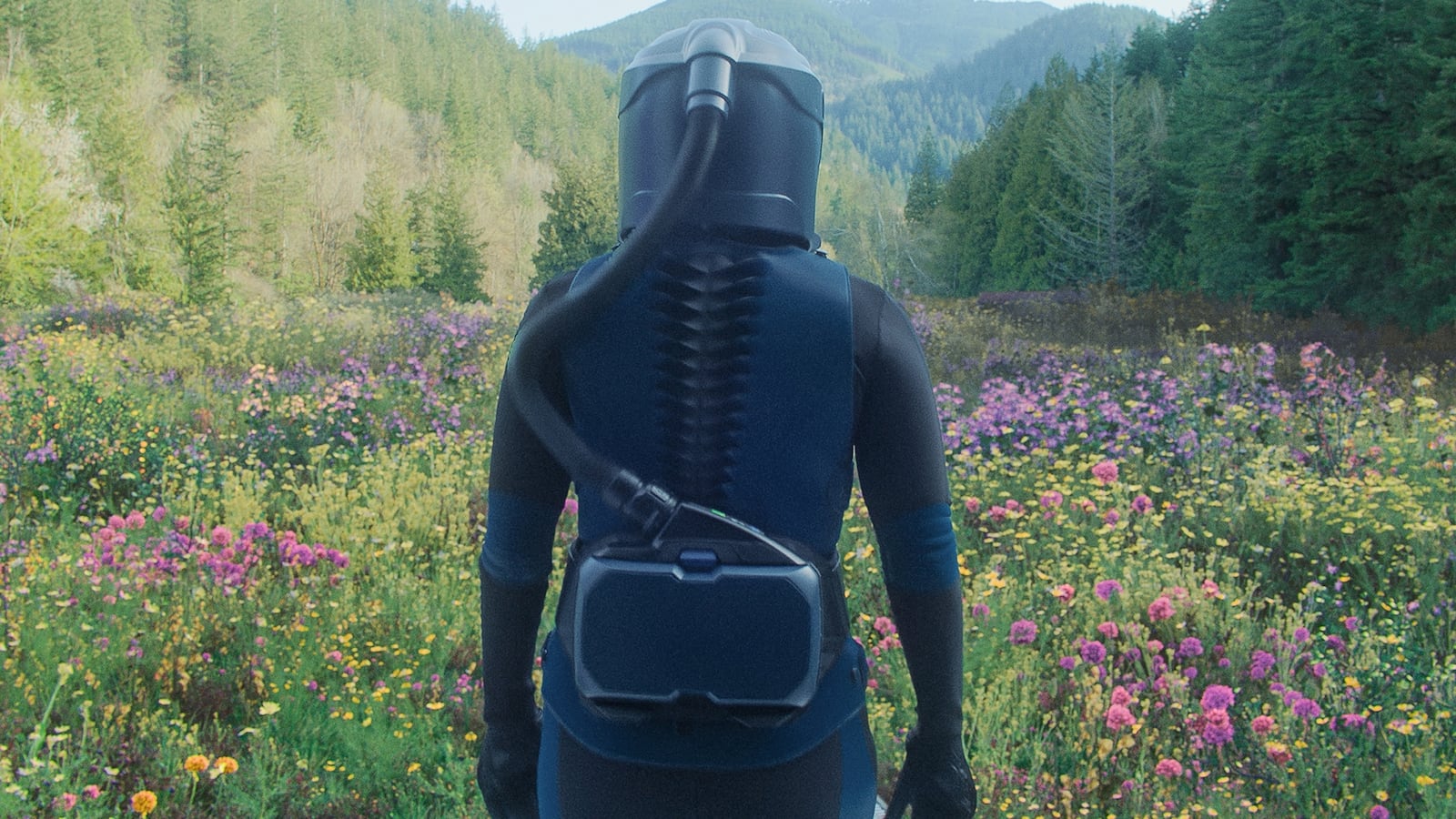
Survival is tough no matter the epoch, and to further prove that point, In the Blink of an Eye turns to Coakley (Kate McKinnon), a space traveler in the year 2417 who’s on a mission to the stars. On this journey, her sole companion is an A.I. named Roscoe (Rhona Rees) that seems only slightly more sophisticated than Siri and Alexa.
Nonetheless, when the plants that provide the ship with oxygen begin to wither due to an unknown parasite, the artificial intelligence proves ridiculously selfless, and Coakley—who, it’s soon revealed, is a metahuman transporting a collection of embryos to a new Eden—is faced with a grave dilemma in order to complete her assignment.
Death is an inevitable part of life, and so is birth—obvious truths that In the Blink of an Eye treats as profound revelations. Colby Day’s script (which was featured on the 2016 Black List) feels like it was written by a college student who thinks he’s just figured out the universe.
The match cuts Stanton employs to tether his triptych together aren’t more graceful. Despite a few superficial similarities to 2001: A Space Odyssey, the film can’t come close to approximating that classic’s bone-to-satellite sequence. Still, these formal shortcomings pale in comparison to Thomas Newman’s warm bath of a score, which coats everything in oh-so-gentle sentimentality.

In the past, the present, and the future, communication is difficult but essential, companionship is vital, and tragedy is inescapable, with Thorn, Claire, and Coakley coping with loss by soldiering onward. In the Blink of an Eye plods along during its early going, determined to keep things as sedate as possible.
When coupled with a dearth of engrossing action (and forward momentum), that placidness murders engagement with these individuals’ plights. Moreover, the film’s temporal flip-flopping makes all its threads hopelessly sketchy, marked by rudimentary plotting and wispy characterizations.
In the Blink of an Eye’s crude clockwork mechanisms are transparent, such that the film repeatedly cuts to the image of an actual clock. Where subtlety is needed, clumsiness reigns, including in its performances.
Jones is charmless as a grieving grump, and her chemistry with Diggs is nonexistent. McKinnon does a moderately more muted variation on her usual McKinnon-y schtick when bantering with Roscoe, and she’s less convincing once her duties aboard the Elixir spacecraft evolve.
By process of elimination, Vargas’ turn is the most interesting of the bunch, but even he’s stuck playing one note—a byproduct of the fact that Day’s screenplay imagines its protagonists as vessels for truisms rather than flesh-and-blood people.
Stanton’s film tills soil similar to Darren Aronofsky’s 2006 epic The Fountain, yet it boasts none of that predecessor’s heartfelt romanticism, spiritual awe, and formal flair. Instead, it simply presents a lot of familiar incidents reduced to their hackneyed essentials, most of them concerned with issues of mortality, perseverance, communion, and inheritance. Shortcut storytelling is the order of the day, rendering its trio of tales slight and silly, and sabotaging their quest for epic emotional grandeur.
After dawdling for the better part of its initial half, In the Blink of an Eye rapidly picks up the pace, leaping forward in time to detail Thorn, Claire, Greg, and Coakley’s transformation into parents (and grandparents). We come to an end and live eternally through our progeny, the film coos, tritely symbolizing this notion via an acorn necklace that Thorn crafts for his daughter, Claire finds in a calcified hand, and Coakley eventually gives to her surrogate kid.

With each new step, Stanton steps directly into something gooey, and he goes for the schmaltzy jugular with a hasty climactic montage of these men and women’s happy and sad times. Without any investment in these stick-figures’ plight, however, this waterworks-courting gesture comes across as merely one final gaffe.
In Claire’s excavation and investigation of the past, and Coakley’s efforts to correct man’s environmentally destructive mistakes, In the Blink of an Eye exhibits traces of WALL-E. But it lacks that animated hit’s grace, wit, and depth. Though it argues that mankind endures by passing its knowledge down through generations, the film appears to have learned little from those that came before it—including, especially, Stanton’s own triumphs.