
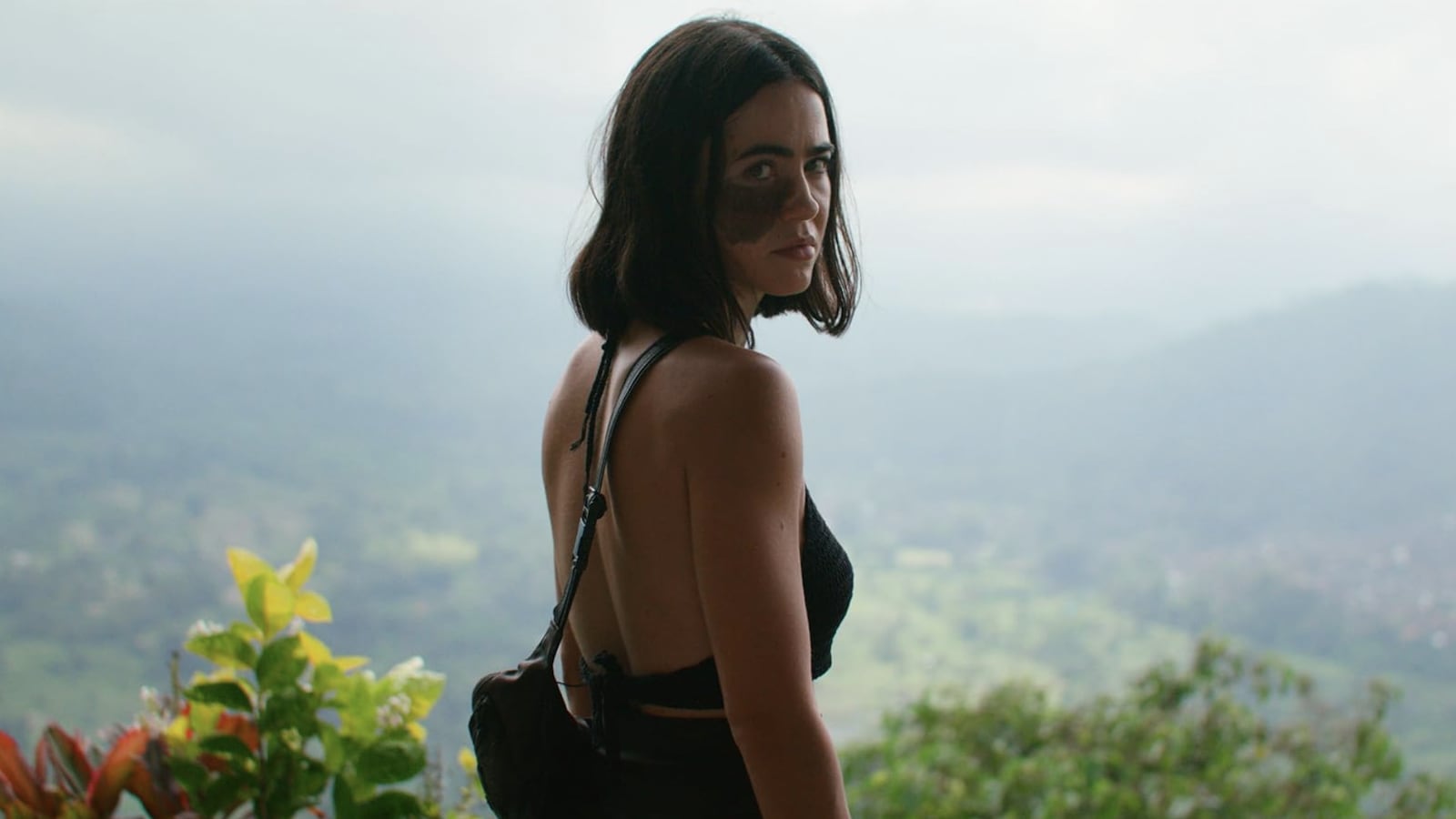
Taking violent aim at professional social media personalities, 2022’s Influencer was a sharp slice of slasher-movie mayhem about a 21st-century angel of death with demented enmity for narcissistic Instagram and TikTok product pushers.
With Cassandra Naud oozing sultry, cutthroat menace as a woman on a mission to rid society of its online “cancers,” Kurtis David Harder’s film made a meal out of inventive influencer murder. Three years later, the writer/director now returns to that grisly well with Influencers, a follow-up (December 12, on Shudder) that expands its critical purview while staying true to the series’ ruthless core. It’s a taut, tense, of-the-moment thriller with real (reel?) bite.
At the conclusion of its predecessor, CW (Naud)—a nomad with a conspicuous birthmark on her right cheek and a habit of slaying pretty influencers by stranding them on a remote Gulf of Thailand island—was left to fend for herself on her isolated killing ground courtesy of would-be victim Madison (Emily Tennant).
All seemed lost for the maniac, and yet at the start of Influencers, CW is gallivanting around southern France with Diane (Lisa Delamar), her French girlfriend, with whom she’s so comfortable that she allows her picture to be taken (a prior no-no) and joins FaceTime calls with Diane’s mother.
This is baffling, and for a considerable stretch, Harder keeps audiences in the dark about how CW found herself in this situation—and, for the remainder of the proceedings, he has playful fun teasing his heroine’s means of escaping her island confinement.

For no reason other than that she’s in love, CW takes Diane on a special weekend getaway (“It’s a big deal”) to a luxurious resort, although in advance of their arrival, Diane has them stop at an abandoned, dilapidated castle where they snap some pics.
Later by the pool, the couple’s tranquility is spoiled by Charlotte (Georgina Campbell), a noisy, self-absorbed influencer who parks herself right next to CW on a lounge chair and begins complaining about everything, including her room—a suite which CW had originally booked before being unceremoniously reassigned to smaller quarters because of Charlotte. At a dinner that Diane forces CW to attend, Charlotte confesses that her job is basically selling crap to little girls, and that she’s not afraid of traveling alone because most creators fly solo, to which CW can only smirk.
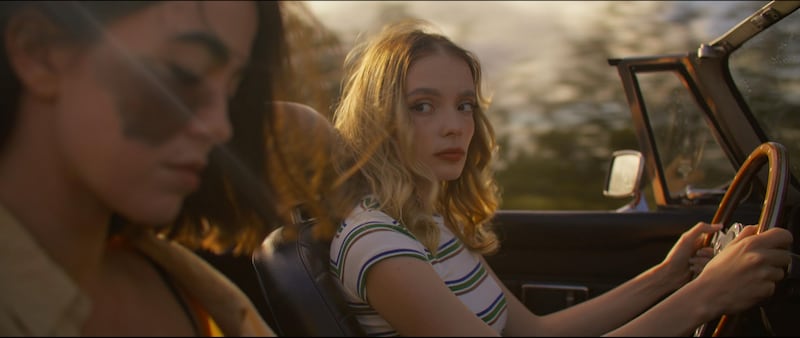
The following morning, CW lies about Diane being sick (to get out of attending a vineyard event) and entices Charlotte to visit the derelict castle, where—spoiler alert, but not really—she does away with the huckster. This is par for the course for the villainess, who loathes the shallow men and women who ply their superficial trades on the internet.
However, Harder twists his material up in knots by repeatedly having CW employ social media (and cutting-edge technology) against the very people who adore it, in the process subtly implicating her as part of (rather than simply the antidote to) the problem. CW is a righteous avenger who wields her targets’ tools against them and, moreover, is almost as incessantly online as they are, suggesting that she’s infected with the same phone-filtered illness that she seeks to eradicate.

CW’s decision to dispatch Charlotte reveals that, no matter her efforts to live a quiet, normal life, her rage at our modern social-media paradigm is irrepressible, and that quickly gets her into big trouble in Influencers, driving her to make rash decisions that necessitate flights to far-off locales.
Compounding her predicament is Madison, who, in the aftermath of the last film’s ordeal, was arrested for CW’s murders because no one believed her story about her tormentor, whom she can’t prove exists. Now a pariah who’s pointedly questioned by snidely skeptical podcasters and harassed by vile prank callers and stalkers, Maidson is a wreck determined to clear her name. At rock bottom, her fortunes turn around when she reads about Charlotte’s disappearance and, via some canny social media sleuthing, determines that CW has resumed her homicidal ways.
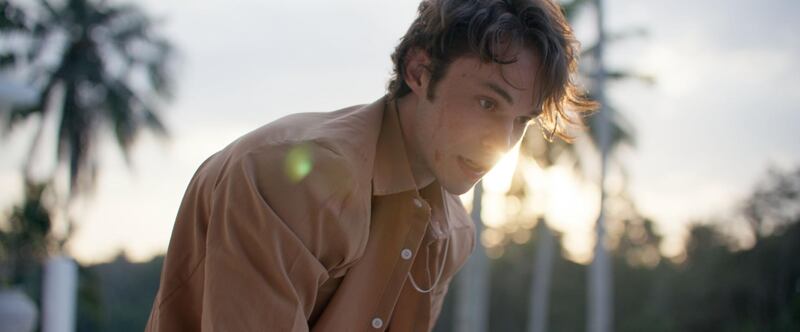
Influencers is 20 minutes longer than its predecessor and, at times, its pacing is a tad slacker (a happy-times flashback sequence could have been easily snipped). Yet Harder’s camerawork remains silky and sinister (complete with rotating imagery and canted angles that speak to CW’s topsy-turvy condition), and he provides his protagonist with a juicy new focus in Jacob (Jonathan Whitesell), an Andrew Tate-esque streamer in Bali who sells ugly misogyny in the guise of pro-masculine empowerment to like-minded scumbags.
Jacob is a regressive peddler of dudebro hate, and in this rancid business, he’s in league with his girlfriend Ariana (Veronica Long), who we know—thanks to the opening scene—is destined to cut her throat as her phone blows up with nagging alerts. Together, they’re a thoroughly toxic pair, and the filmmaker soon intertwines their fortunes with those of CW and Madison, who embark upon a cat-and-mouse game that’s played with iPhones, AI assistants, and butcher knives.

As before, the director has great sympathy for his devil, and Naud embodies her with an iciness that’s barely masked by her outward cheer; whether she’s enjoying a carefree day with her girlfriend, seducing a potential mark, or stalking her prey, CW’s eyes are imposingly cold and venomous.

Cleverly entangling his characters while upping the ante by placing CW in perpetual read-and-react mode, Influencers gains steam down the home stretch. If some of its complications aren’t as cleanly handled as those in its streamlined ancestor, it takes a scathing scalpel to the manosphere, an ugly haven where “guys can be guys”—which is to say, express their most noxious views about wealth, sex, and women. CW’s manipulation of Jacob is the film’s spikiest element, and it maintains her status as a baddie for whom one can easily root.
Influencers’ finale is a bloodbath perpetrated with the sort of delirious glee that comes from genuine psychosis—or, as Harder’s film argues, mad-as-hell-and-not-going-to-take-it-anymore frustration and fury with a 2025 awash in empty navel-gazing, corrupt marketing, and wholesale disingenuousness. Its hacking and slashing is both unhinged and also, it cheekily contends, the only sane response to a world gone to online hell.