


“By Jiminy,” where are they all supposed to be from?
The 1930 movie adaptation of Eugene O’Neill’s Pulitzer Prize-winning play, Anna Christie, was famed for featuring silent movie icon Greta Garbo’s first-ever spoken line on film. “Gimme a whiskey—ginger ale on the side. And don’t be stingy, baby,” her title character says, a moment so totemic that it was marketed with the tagline: “Garbo Talks!”
In the all-star revival of O’Neill’s 1921 play currently at St. Ann’s Warehouse in Brooklyn (to Feb. 1, 2026)—with a wow-looking cast of Michelle Williams in the title role, Tom Sturridge, Brian d’Arcy James, and Mare Winningham—the human voice is again notable, though not as positively. This production contains the most baffling accents or accent choices on the New York stage, and the untethered polyphony hobbles the drama. It’s hard to immerse oneself in theatrical lusty passion and parental estrangement when the voices speaking the lines sound so (literally) all over the place.
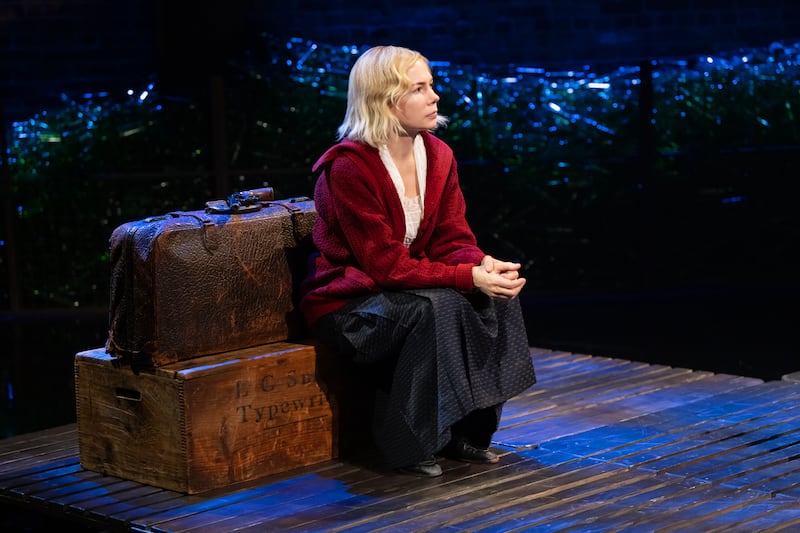
Anna grew up in Minnesota, the daughter of Swedish father Chris Christopherson, a barge captain (d’Arcy James); on reuniting with him after many years apart, she also falls in love with Irish stoker Mat Burke (Sturridge). The action takes place in New York and Provincetown—amid settings of hard-scrabble bars, moody harbors, and a very symbolically freighted Atlantic Ocean lapping at the characters’ feet. “That old devil sea,” Chris says over and over again of the watery expanse he has spent his life on: an arena of danger, betrayal, and also—maybe—escape.
Chris thinks Mat is not good enough for his daughter, while Mat delights in seducing Anna and displacing her father as the significant male figure in her life; then Anna’s secret past as a prostitute comes to be harshly judged by both her father and would-be suitor.
Even before the accent-blurring, director Thomas Kail’s staging feels over-rendered. The production’s principal design feature is a multitude of slatted wooden platforms. These platforms are assembled and de-assembled by a silent group of handsome, burly actors, who sometimes observe the emotional fireworks from the side of the stage—as if doing double-duty from a neighboring production of Querelle.
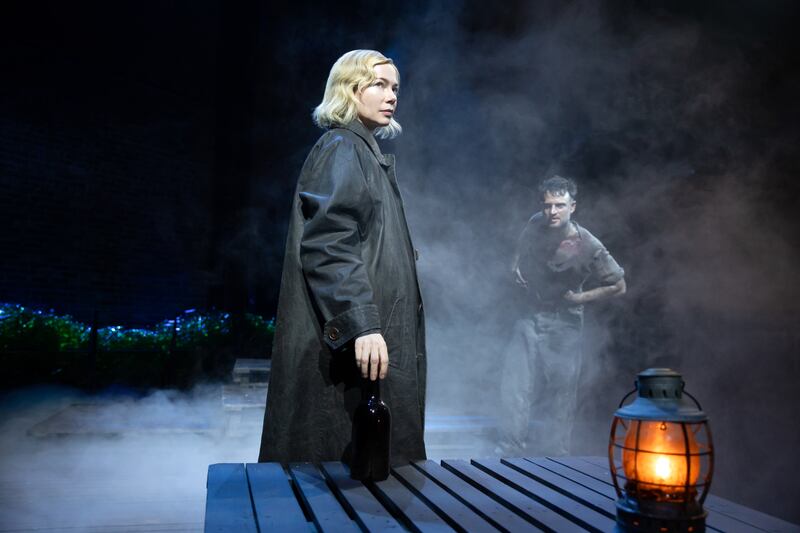
This real-time Task Rabbit ballet is precisely executed, but feels fussily additive rather than meaningful. The same goes for a giant girder orbiting above the characters’ heads, symbolizing the play’s maritime setting. There is also dry ice to convey fog, and characters not simply leaving the stage but—at especially charged moments—standing atop the slatted boards to balletically fall into the arms of the unspeaking muscular men, to be ferried just a few feet away from center stage.
The accents—within the chief characters of Anna, Chris, and Mat—are a mélange: individual voices improbably span regions of countries and continents, sometimes within one passage of text (in my notebook, along with many question marks, I wrote down: Minnesota, Ireland, Yorkshire, Liverpool, Manchester/Liam Gallagher, Scotland, New York, Eastern Europe).
Accents are tough, for sure, but surely in a play the trick is to find the one for your character that works in terms of the text and you being able to maintain it, then stick to it—otherwise your audience may end up puzzling over the voices saying the words rather than the weight and meaning of the words themselves.
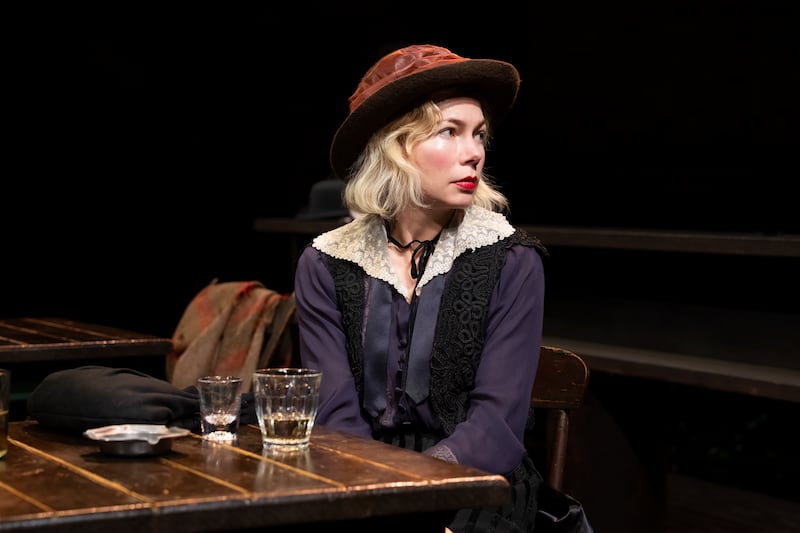
The performances are certainly visceral and heartfelt, even if the show feels like a group of highly individual performances rather than a smoothly operating collective. Williams gives Anna a plausibly scattered energy, running from her past, and trying to both grasp a future and outpace the patriarchal forces seeking to control her; a high point is the moment she acquires a pivotal bit of knowledge over her two male judge-and-juries.
D’Arcy James is characteristically commanding as a one-time absentee dad who knows his own failings and is mindful that judging his daughter’s past harshly will only lead to more years of estrangement. Sturridge plays Mat as feral, barely human (or even upright), crawling, snarling, protean—more in need of a cage than coupledom. The wonderful Winningham is on stage for too short a time as life-wizened barfly Marthy.
With its main characters speaking and acting past each other, this Anna Christie doesn’t convincingly locate a strong rope-line from 1921 to now. Instead, it feels as unmoored as one of its barges, and overall a little lost in the muffling mists of that old devil sea.