Mother Mary is an ungodly mess—albeit one that’s unlike any you’ve seen before.
A deep dive into a pool of pretentiousness whose absurdity mounts with each new quasi-supernatural—and heavily symbolic—development, this dramatic two-hander from David Lowery (A Ghost Story, The Green Knight) concerns an impromptu reunion between a global pop star and her estranged designer and best friend, played, respectively, by Anne Hathaway and Michaela Coel with endless overwrought scenery chewing.
Not that a tour-de-force could fight its way out of this morass of Important Themes, excessive emoting, and florid direction, all of which combine to turn the director’s latest downright insufferable.
Quick flashes of sparkles, stars, and a woman falling and hanging from a cord preface A24’s title card, and those enigmatic sights are in keeping with Mother Mary’s initial mysteriousness.
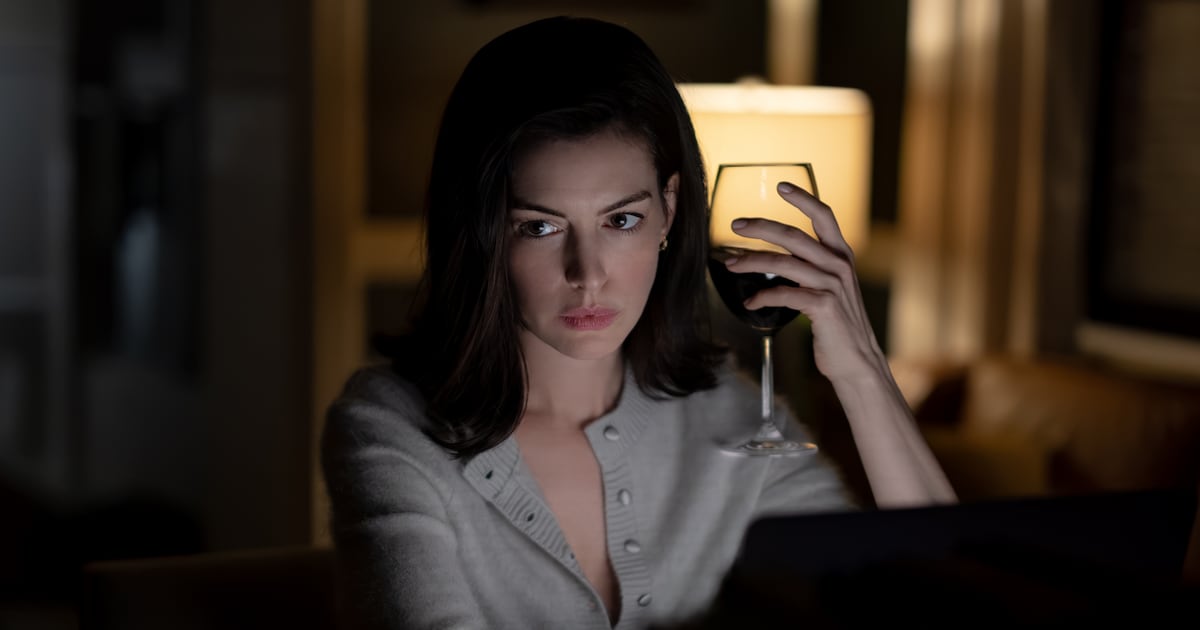
In the aftermath of her latest stage performance, music icon Mother Mary (Hathaway) freaks out as she’s fitted with one of her trademark halo-centric costumes. She promptly flees Los Angeles for England to the rustic rural base of operations of fashion designer Sam Anselm (Coel), whose team (including Hunter Schafer’s blink-and-you’ll-miss-her Hilda) is startled by her appearance. Bursting into her bedroom, Mary informs Sam—her former creative partner—that she needs a dress. While Sam is unhappy to see Mary, she brings her to her cavernous barn workshop to discuss the matter further.
Thus begins Mother Mary’s nearly two-hour face-off between the duo.

Although even before that commences in earnest, Lowery (working from his own script) goes overboard with the affectation, cross-cutting between the two as Sam speaks in voiceover about how Mary is the evil “secret twin” that lives in her skull. Coel infuses this narration with maximum portent, but it’s all for show, since Mary turns out to be a perpetually weepy, anguished bundle of anxieties who’s about as scary as a wet pair of socks.
It’s apparent from Mary’s contrition and Sam’s bitterness that they not only parted on bad terms but seem to have shared more than merely a friendship. As befits its coyness, Mother Mary never overtly outs the pair as ex-lovers, instead content to suggest through a range of charged glances and touches.
Just as shrouded in secrecy are the specifics of their falling out, which hover over the proceedings as Sam verbally pokes and prods at Mary before agreeing to make her a new costume—provided that she has full control over the design and the singer. In response, Mary makes one demand: no red.
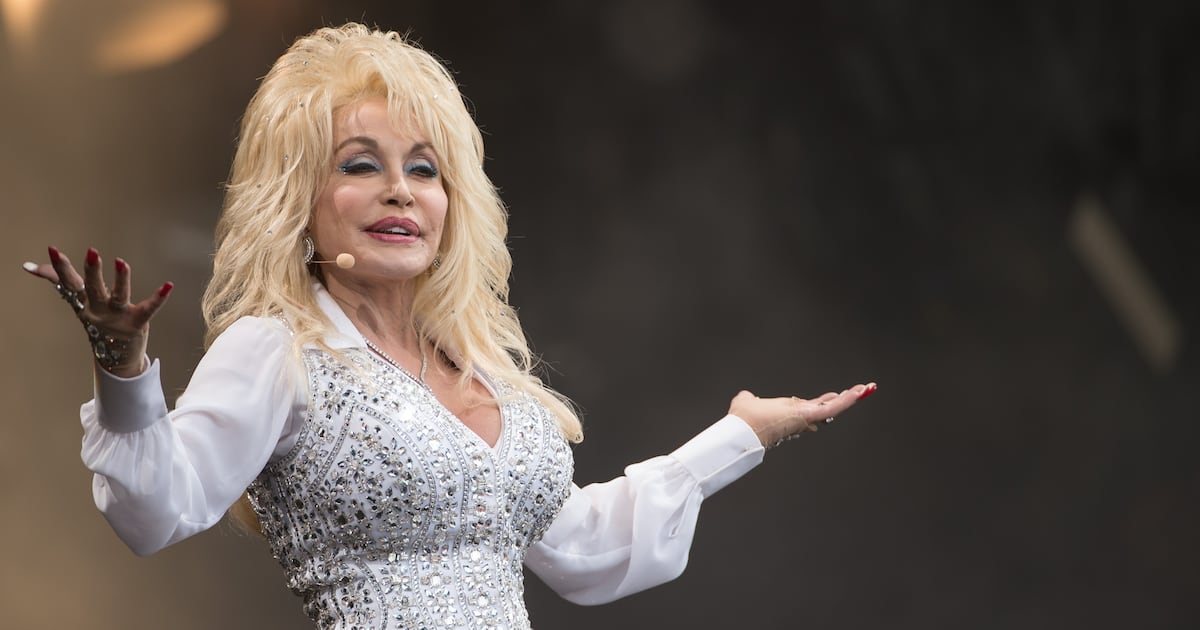
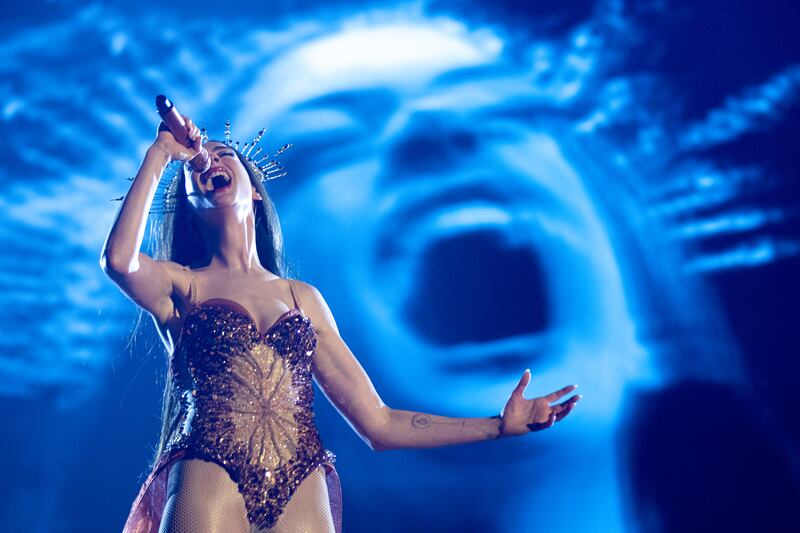
Mary’s entire schtick is remixed religiosity, and in the concert clips interspersed throughout the film, she proves fond of tilting her face upward in beatific supplication, extending her arms outward with palms upturned, and holding the microphone between praying hands.
It’s a convincing if corny gimmick, and in tune with the sad songs (including one written by Charli XCX and Jack Antonoff) that have made her a star. Yet in these scenes, Lowery falls short of the grandeur he seeks. His compositions are as self-consciously beautiful as Hathaway’s moves are mechanically striking.
If Mary is reasonably captivating on stage, she’s borderline intolerable in the company of Sam, her countenance constantly on the verge of tears and her speech drawn... out... to... the... point... of... parody.
Sam is likewise infected with this verbal tic. However, she goes a bit lighter than Mary on the soft gasps and sighs that quickly become a relentless and grating presence. There’s distress, there’s agony, and then there’s the overcooked torment that is the one note Hathaway repeatedly strikes. Despite Mary’s unvarnished, stripped-bare condition, you can see the Oscar winner playing to the back row every step of the way.
Mary and Sam’s psychosexual rapport leads to insults and oblique references to their shared past, and when details about their rift finally materialize, they do little to energize a tête-à-tête that’s drowning in dramatic quicksand.
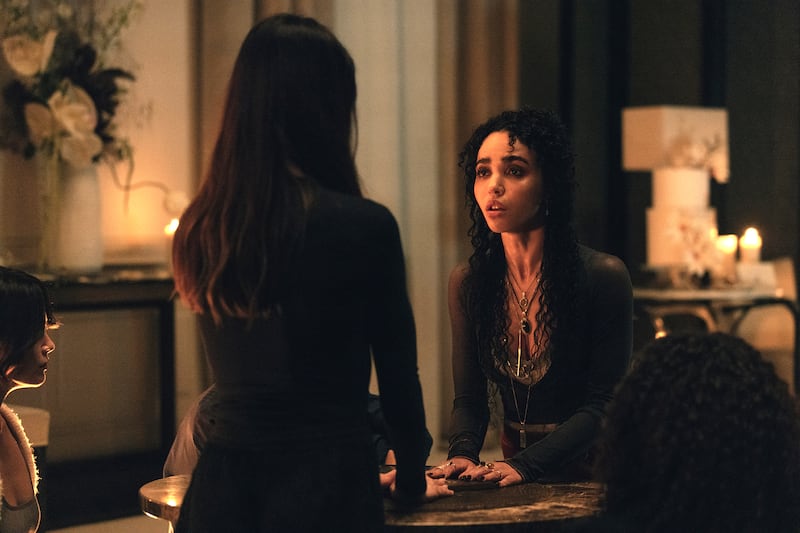
Worse, though, is that after much metaphorical chitchat about this renewed acquaintance, the film succumbs to otherworldly symbolism, starting with Sam’s story about her run-in with an apparition that resembles a flowing, floating piece of red fabric. Mary admits that she, too, has seen this specter, courtesy of a séance conducted by a rando (FKA Twigs) that ended with her hand sliced and her body invaded by the otherworldly presence.
That possession (literal? figurative?) factors into Mother Mary would be more arbitrary if not for a prior music-free dance routine by Mary that’s full of The Exorcist-grade body twisting, foot stomping, chest thrusting, and grunting and growling.
Notions about channeling, communion, and “transubstantiation” are ever-present in Mother Mary, and ostensibly related to Lowery’s interest in the knotted-up nature of artistic collaboration. The means by which the pair is intertwined, unfortunately, feels more academic than authentic, and the film’s decision to situate itself primarily in a single location both drains it of dynamism and highlights the script’s schematic, hollow construction.
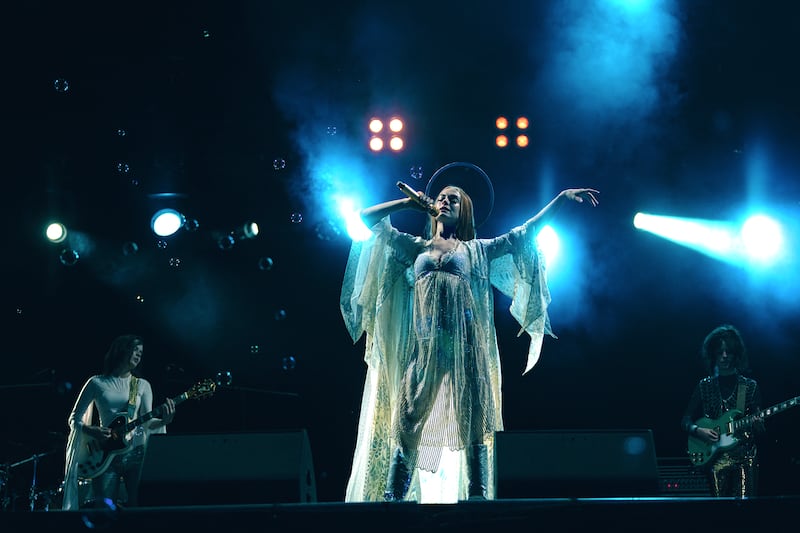
The further Mother Mary goes on, the more Lowery gussies it up with flashy showmanship, be it a sequence that tracks Mary’s recurring entrance and exit from the stage (her exhaustion growing with each passage through a door), or some climactic bloodshed that allows for additional Christian imagery.
It’s less that the director loses his handle on the story so much as he barely has one in the first place and increasingly feels the need to dress it up with stylish tableaus, ornate gowns and get-ups, and shots of people being suddenly drenched in heavenly light. The intensity of its (and its leads’) effort is always palpable, yet less evident is any basis for caring about these individuals and their uninteresting and unrevealing tensions.
Mother Mary presents itself as profound with a rigorousness that’s at odds with its effect, and at a certain point, it does the almost unthinkable: It makes the reliably magnetic Hathaway and Coel come across as strained and insincere.
Save for those brief moments when Mary commands a crowd, there isn’t a second when it resounds as believable or engaging, the result being a film that’s only success is in eliciting a headache-inducing number of eye rolls.