‘Night Swim’ Is Scary—and Silly—Enough to Be the New ‘M3GAN’
A guide to the week’s best and worst TV shows and movies from The Daily Beast’s Obsessed critics.

Photo Illustration by Thomas Levinson/The Daily Beast/Universal
Not sure what to watch next? Subscribe to The Daily Beast’s Obsessed See Skip newsletter here and get the latest show and movie recommendations every Tuesday.
There are roughly 47,000—oh, wait, a new Netflix Original just dropped; make that 47,001—TV shows and movies coming out each week. At Obsessed, we consider it our social duty to help you see the best and skip the rest.
We’ve already got a variety of in-depth, exclusive coverage on all of your streaming favorites and new releases, but sometimes what you’re looking for is a simple Do or Don’t. That’s why we created See/Skip, to tell you exactly what our writers think you should See and what you can Skip from the past week’s crowded entertainment landscape.
See: Night Swim
Night Swim, like M3GAN before it, is a Blumhouse studio horror that’s so clever and kitschy it might be good enough to officially silence the death knell for January horror movies. Come on, you read the words “haunted swimming pool” and don’t run to buy a ticket?
Get the best of Obsessed delivered right to your inbox
By clicking “SUBSCRIBE” you agree to our Terms of Use and Privacy Policy.
Here’s Jesse Hassenger’s take:
“From the Stephen King school of what-object-can-we-haunt comes Night Swim, this year’s annual first-weekend-in-January horror movie. Yes, it really is about a family that moves into a new house and encounters a haunted swimming pool. That’s the kind of concept inevitably preceded by “proof of” in someone’s enthusiastic pitch meeting, and sure enough, this 98-minute movie began its life as a short film that, sans credits, runs about as long as a typical trailer.
Still, it’s not as if the short leaves the feature-length Night Swim with no place to go; the original version’s glimpsed specter doesn’t even get in the water! To expand upon this glorified teaser, director and co-writer Bryce McGuire (along with Rod Blackhurst, co-director of the short, who has a story credit here) have concocted a pair of backstories—one for their pool-vexed family, the other for the pool itself.”
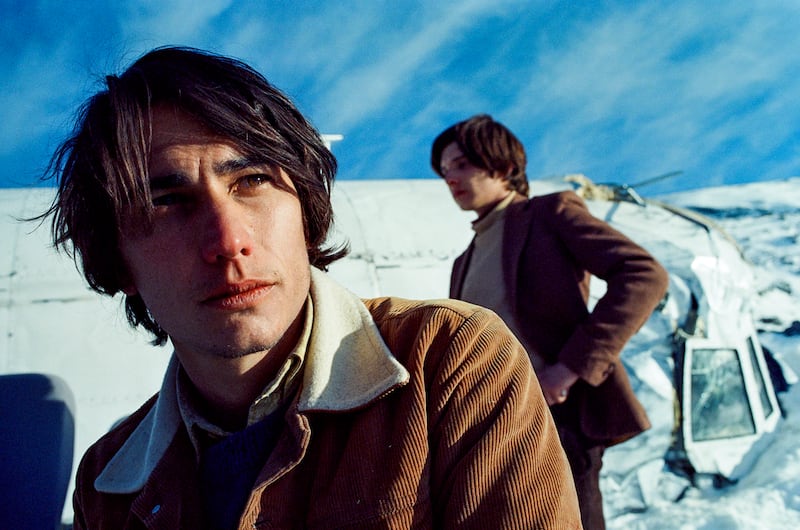
Society of the Snow.
Netflix
See: Society of the Snow
Society of the Snow is an engrossing look at the dire conditions that survivors of the 1972 Miracle of the Andes flight disaster faced in order to survive. The film is an agonizing watch that hits you with all of the enormity its subjects weathered, making it a thrilling account of this baffling true story.
Here’s Nick Schager’s take:
“Director J.A. Bayona is drawn to calamities and the unimaginable fortitude—and providence—required to survive them, and 11 years after he tackled those subjects with 2012’s The Impossible (and then, in far more fantastical terms, with 2018’s Jurassic World: Fallen Kingdom), he revisits them with Society of the Snow, a dramatized account of the 1972 Andes flight disaster. Though now an oft-told tale (including by 1993’s Alive), Bayona’s latest feature finds new measures of beauty and horror amidst its wreckage, casting a haunting spell—at once horrific and hopeful, despairing and inspiring—that marks it as his finest film to date, and a fitting tribute to those who both perished and managed to escape their fateful mountain tomb.
‘This is a place where life is impossible,’ says Numa (Enzo Vogrincic Roldán), thereby underlining Society of the Snow’s (on Netflix Jan. 4) relationship to Bayona’s past work as well as bluntly summing up its environs: a cold, barren, snow-covered valley in the Andes Mountains where a plane heading from Uruguay to Chile carrying 40 passengers and five crew members, many of them male teenage members of the Old Christians Club rugby union team, went down in a crash on Oct. 13, 1972.
As close to the middle of nowhere as any spot on the planet, it was a location almost preternaturally designed to never be found, and for 71 days, it wasn’t, forcing those who didn’t die during the initial accident to valiantly try to stay alive. As became immediately clear to all, that was an arduous task, given that they only had half the craft’s fuselage for shelter, minimal clothes to keep themselves warm (especially at night, when temperatures dropped upwards of 80 degrees), and scant rations to stave off starvation.”

(L to R) Jamael Westman, Himesh Patel, Ruth Negga, Luke Evans and Daniel Levy in Good Grief.
Chris Baker/Netflix
Skip: Good Grief
Good Grief is missing all of the natural charm that we know its writer, director, and star Dan Levy has in droves. Instead, the film skates along the surface of empty platitudes about loss, never digging deep enough to dredge up a single tear.
Here’s Coleman Spilde’s take:
“Not 20 minutes into Good Grief, the feature-length directorial debut from Schitt’s Creek star Dan Levy (streaming on Netflix Jan. 5), the actor—who also wrote and stars in the film—tees up the first of several soft-spoken meditations on loss. ‘I’ve been reading that the brain is like a muscle,’ Levy’s character, Marc, says about the recent death of his husband. ‘That’s why getting over a death is so hard: because your brain has been trained to feel things for a person. And when they go away, your head is still operating under the impression that it should feel those things for that person. Like…muscle memory.’
While that is a completely surface-level and obvious examination of the feeling of grief, Levy delivers the dialogue he wrote for himself with a navel-gazing sense of pride, thinly masked by his character’s monotonous tone. There’s a false profundity to this and the countless other itinerant soliloquies that make up Good Grief. These shallow vignettes—which are practically lab-designed for Netflix to screenshot and post on their social media accounts for engagement—are strung together with little flair.
If there were something between the lines, some kernel of novelty in the complicated and endlessly workable depth of grief, this 100-minute vanity project could easily save itself from the dregs of streaming content. But that originality never arrives, despite Levy’s apparent confidence that it’s omnipresent.”
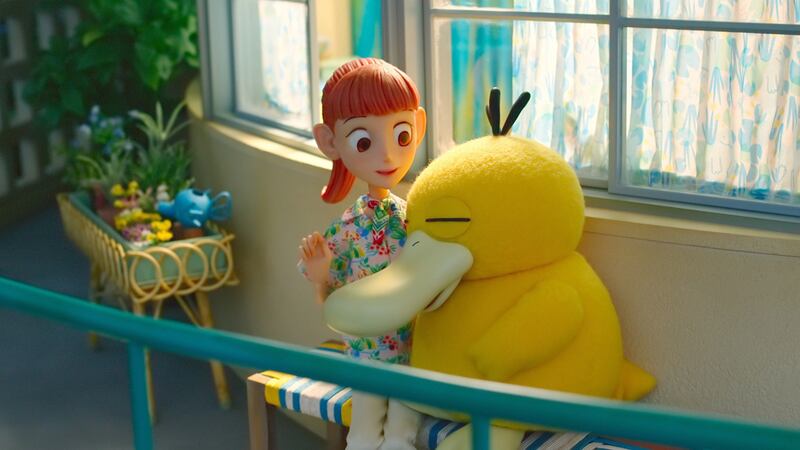
Pokémon Concierge.
Netflix
See: Pokémon Concierge
Pokémon Concierge explores the sweeter side of these little creatures, pausing the battles and instead reveling in the innate adorableness of their designs—a perfect slice of stop-motion for anyone who’s ever wanted to live a day in the Pokémon world.
Here’s Jesse Hassenger’s take:
“I’d hazard a guess that when most people think of Pokémon, they think of collecting and battling with cutesy monsters, in either video game or cartoon form. But as a lifelong, extremely obsessive Poké-nerd, I’ve always had a penchant for the series’ lighter side.
I obviously love classic games like Pokémon Red and Ruby, as well as action-oriented spinoffs like 2021’s Pokémon Legends: Arceus. But it was the release of picture-taking adventure game Pokémon Snap that made me want to get my first console, the Nintendo 64.
I played the (unfairly maligned) TV-watching simulator Pokémon Channel to death. Pokémon Puzzle Challenge and Pokémon Pinball: Ruby and Sapphire rank highly among my most-played games of all time, Pokémon or otherwise. And even when playing the better known, fighting-and-collection-oriented entries, I relish any opportunity to wash, dress, or hang out with my ’mons. That your favorite Pokémon can walk around the map right alongside you is why Pokémon SoulSilver is my favorite game in the series, and possibly of all time.”
Sign up for our See Skip newsletter here to find out which new shows and movies are worth watching, and which aren’t.

Got a tip? Send it to The Daily Beast here.
Register below to read this article for free or subscribe
to unlock unlimited access to The Daily Beast.
Monthly
$1
First month then $5.99/month
Annual
$35
First year then $59.99/year
Premium
$79
First year then $119.99/year
*Substack access provided by the next business day, using your subscription email. Choosing the Premium plan constitutes your permission to share your subscription email with Substack and your agreement to Substack’s Privacy Policy.
Already have an account? Sign In
Looks like you already have a subscription!
You're all set!
Thanks for subscribing.