James Gray is contemporary cinema’s reigning New York auteur, and he once again proves his peerless feel for his urban hometown with Paper Tiger.
A spiritual heir to his first three features (Little Odessa, The Yards, We Own the Night), with which it shares a 1980s time period and a story about yin-yang brothers that intertwines familial and mafia drama, the writer/director’s latest is another of his masterful examinations of the knotty ties that bind. The opening night selection (Sept. 25) of this year’s New York Film Festival (after which it arrives in theaters on Nov. 13), it pulsates with heart, rancor, and terror—thanks, in no small part, to standout performances from its illustrious leads Adam Driver, Scarlett Johansson, and Miles Teller.
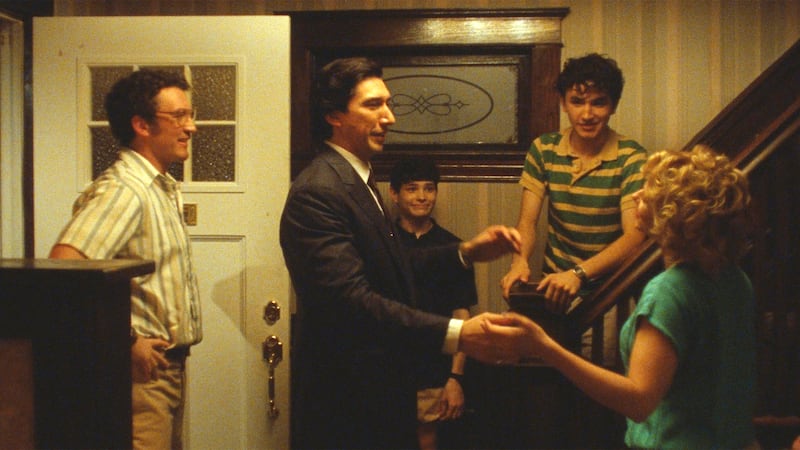
The year is 1986, the neighborhood is Queens, and the center of Paper Tiger’s universe is Irwin Pearl (Teller), a mild-mannered engineer in big glasses whose private business is doing just enough to support his homemaker wife Hester (Johansson)—who somehow wears even bigger spectacles than her spouse—and their sons Ben (Roman Engel) and Scott (Gavin Goudey), the latter of whom is approaching his 18th birthday and a departure to college.
Their close-knit Jewish household is full of the usual joking and bickering, and in just a few short scenes, Gray—his touch as deft as it is unaffected—authentically conveys their unremarkably sweet dynamics.
At a public pool, Irwin scoffs at his mother-in-law’s desire for them to move to Great Neck, but the man of the house isn’t immune to his clan’s desires for something better, be it Hester’s interest in relocating to Long Island or Scott’s complaints about their modest lifestyle. Those pressures are exacerbated by Irwin’s brother Gary (Driver), an ex-cop who drives a Mercedes and visits with a feast from Peter Luger’s steakhouse in tow.
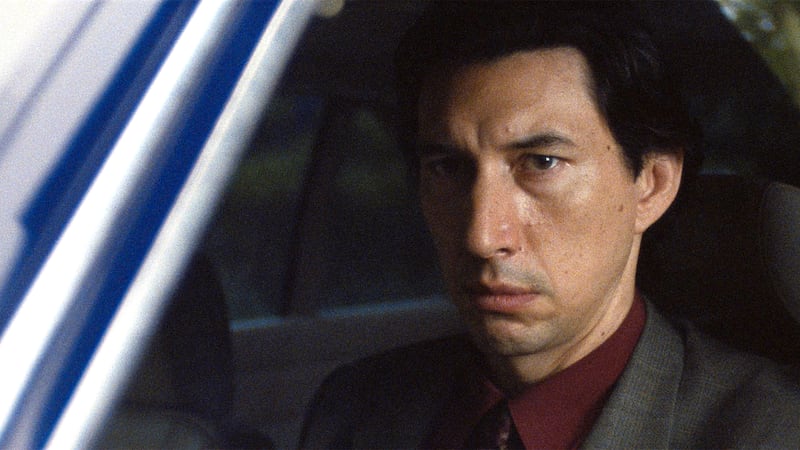
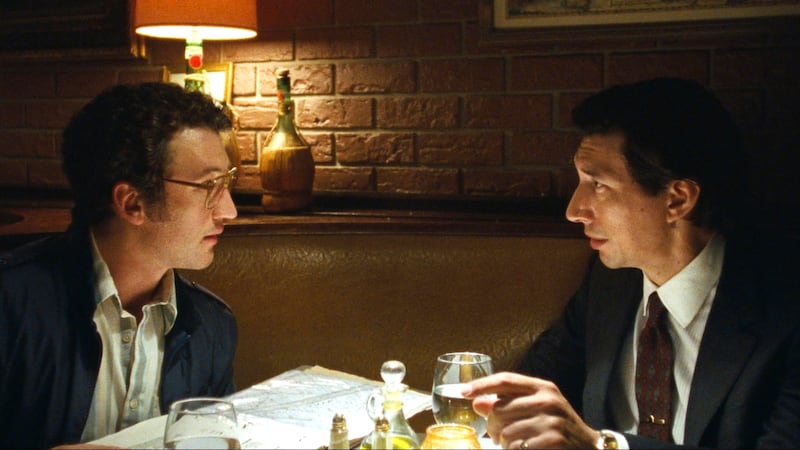
In a dapper suit and a gold watch, Gary is the suave, gregarious, jet-setting opposite of unassuming working-class Irwin, although that disparity hasn’t thwarted their relationship. On the contrary, it’s clear from their initial scenes together that Driver and Teller’s siblings share a deep, loving bond that transcends their divergent stations in life.
Gary’s magnetism and Irwin’s ordinariness make them a typical Gray (and film noir) pair, yet the actors’ turns are anything but mechanical and contrived. With slicked-back hair and a confident answer for every question, Driver is a whirlwind of charm, whereas Teller underplays things while still maintaining a requisite measure of authority and good humor.
It’s Irwin’s principles that are the catalyst for Paper Tiger’s tale, which kicks into gear with Gary offering his brother a can’t-miss opportunity to acquire the money (and, with it, the stature) he craves via a plan to create a company that’ll clean out the polluted Gowanus Canal by partnering with the region’s new Russian immigrants.
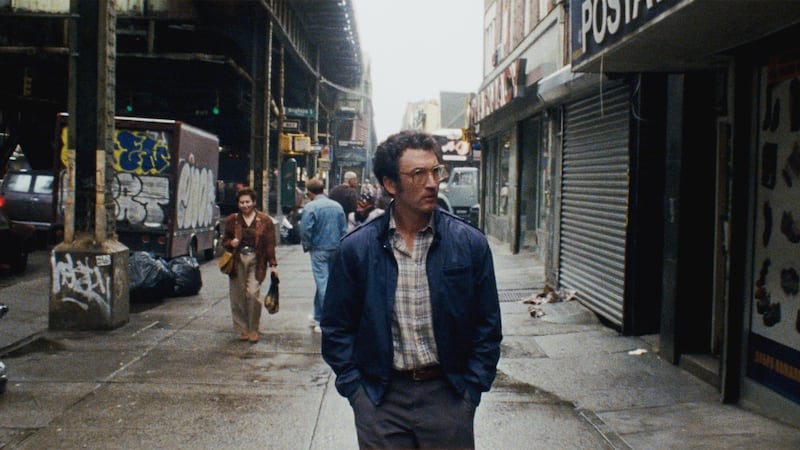
Gary envisions himself as the smooth-operator idea man and Irwin as the nuts-and-bolts coordinator, and his sales pitch is so convincing that Teller’s paterfamilias can’t resist. Alas, Paper Tiger’s rich, shadowy cinematography (by Joaquin Baca-Asay) and lush, portentous score (courtesy of Christopher Spelman) suggest that this is the start of something bad. Though an initial meeting with Gary’s Russian contact is ominous but relatively successful, their venture soon goes horribly south when straight-laced Irwin (whom Gary admits is not “streetwise”) takes his sons to the docks at night and, for his naïve intrusion, earns them all a load of traumatic trouble.
Gray’s script is a model of economy, such that Hester’s offhand remark about not driving a German car speaks volumes about her heritage and disposition. His direction is understated and striking, highlighted by a brilliant cut linking a pan across a crashed car’s hood (to the tree it struck) and an analogous shot that ends at a giant pipe leaking toxic sludge.
Danger is omnipresent in Paper Tiger, and in the aftermath of Irwin’s misstep, his situation grows perilous, forcing the brothers to meet with their Russian cohorts’ boss, Simeon Bogoyavich (Victor Ptak), a mafia kingpin whose no-nonsense negotiations are as intimidating as a later break-in sequence—constructed with a breathtaking focus on silhouettes and half-seen faces—is nerve-wracking.
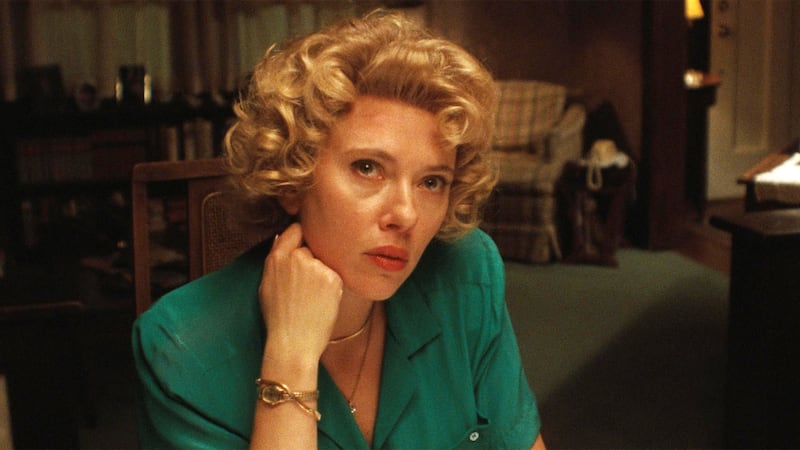
Paper Tiger is a fable about ambition, greed, trust, obligation, shame, and fear that revolves around brotherly love, which both sustains and destroys. Driver and Teller are in top form, matched by a fiery, distraught Johansson as Hester, a wife and mother whose puzzling medical symptoms clearly warn of forthcoming misfortune.
With a Jewish accent that’s right on the money, the actress transforms what might have been a contrived plot-device role into a poignant three-dimensional portrait of grief, resilience, and sacrifice, and it ultimately serves as a complementary piece of Gray’s larger depiction of the push-pull between selfishness and selflessness, honesty and corruption, honor and ignominy.
Irwin and Gary are destined to come to blows over the fallout from the former’s mistake, and Paper Tiger—its title a reference to Gary’s cocky belief that the Russians are all talk, no bite—builds to it with a sense of looming tragedy. Along the way, it offers a gripping window into domestic, criminal, and law enforcement worlds, where cops, crooks, and everyday citizens are entangled in a web they can’t easily escape.
From a wheelchair-bound police officer receiving an award with a blank look in his eyes, to the Russian thugs who lurk around Bogoyavich like vipers ready to strike, Gray populates his film with one memorable personality after another, and his evocation of mid-‘80s NYC is similarly convincing and compelling, adding to the proceedings’ realism.
As with his finest work, Gray strikes a beautiful balance between fraught interpersonal drama and nail-biting thrills, and his old-school craftsmanship culminates with a showdown which harkens back to a key moment in The Godfather (a kindred tale of brothers mired in criminal machinations) and stands as one of the most outstanding sequences in his canon.
Gray may till familiar soil with Paper Tiger, yet like all true auteurs, he does so with an imagination and attention to detail (of thought, emotion, and deed, not to mention setting) that renders the film anything but a retread. There aren’t many making genre features with this much suspense and poignancy, and even fewer capable of orchestrating them with this level of artistry.