Paul Thomas Anderson won his first three Oscars for One Battle After Another at Sunday’s Oscars, but the way the director has addressed—or not addressed—the politically charged themes of his film during awards season is rubbing fans the wrong way.
Anderson took home Best Adapted Screenplay and Best Director, and shared the Best Picture award as a producer of the film. But what could have been a celebratory moment for the director turned into a pile-on after he deliberately dodged opportunities to speak about the film’s political themes.
During a backstage interview Sunday night, a reporter asked him, “They say that winning Best Picture, it tells the temper of our times. So how does this one reflect where we are or where we’re going in society?” Anderson let out a deep sigh and then replied, “I thought we were supposed to be partying.”
The backlash was swift.
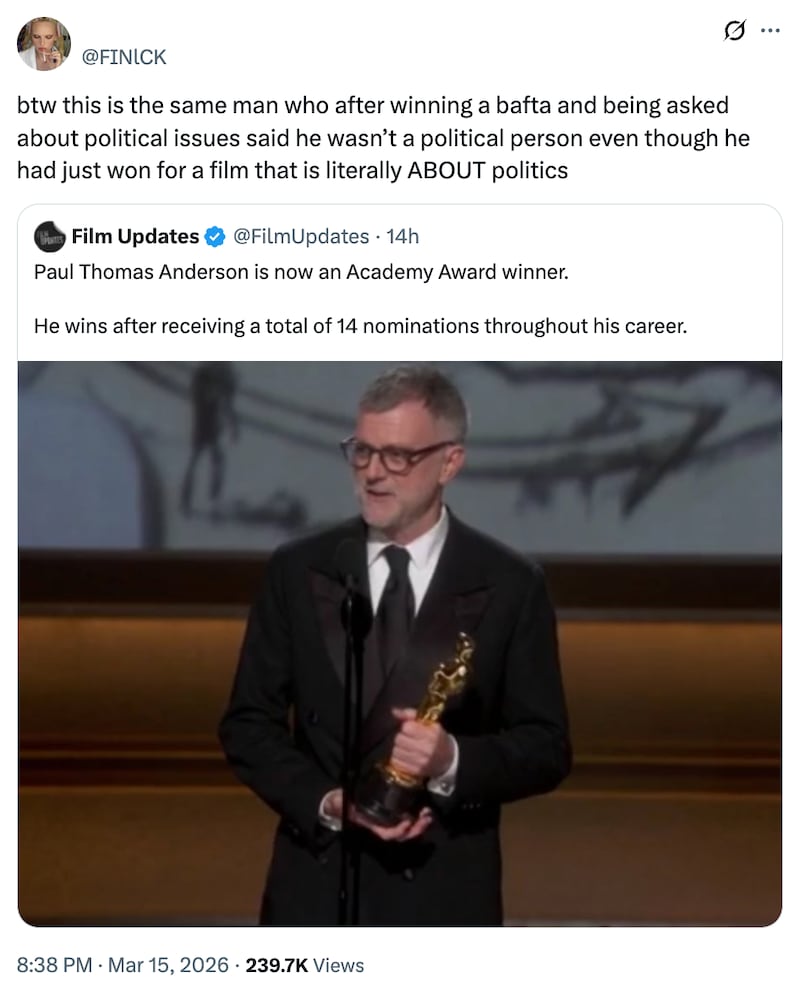
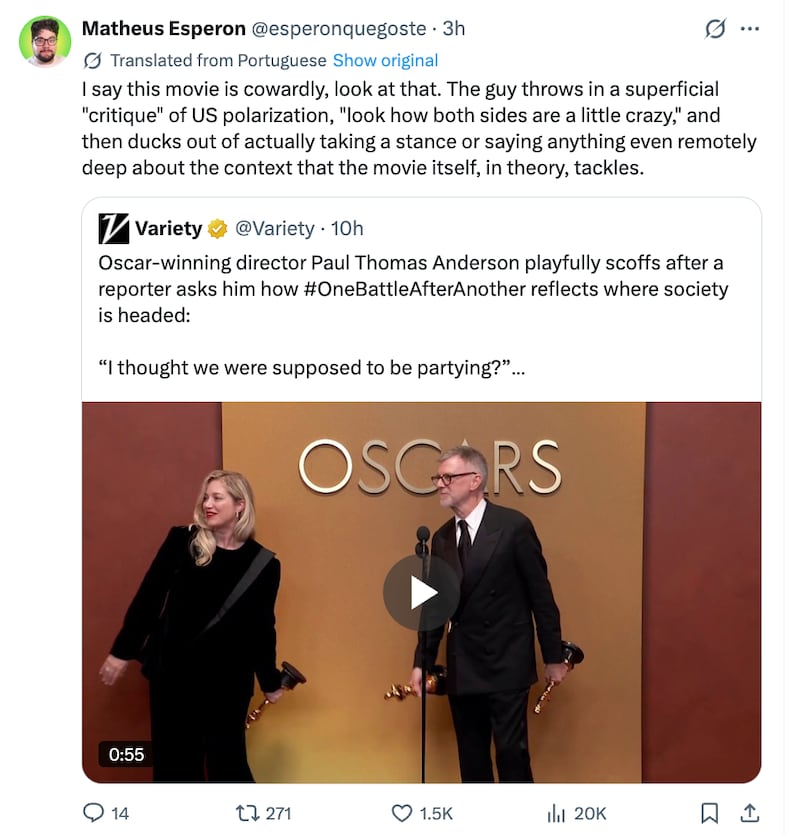
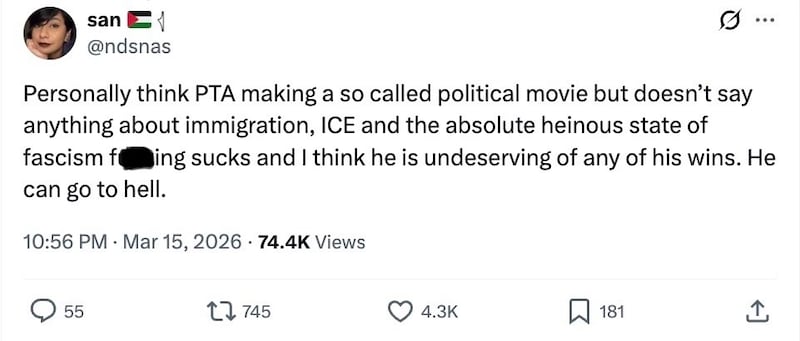
Wrote one user on X, “You can’t make a film about revolution and use Black bodies in such a way and then have NOTHING TO SAY WHEN ASKED ABOUT POLITICS THIS AWARD SEASON.”
Another added, “PTA is one of those guys who cosplays intellectual because he has some talent (i loved Phantom Thread), but is actually astonishingly vacuous and superficial.”
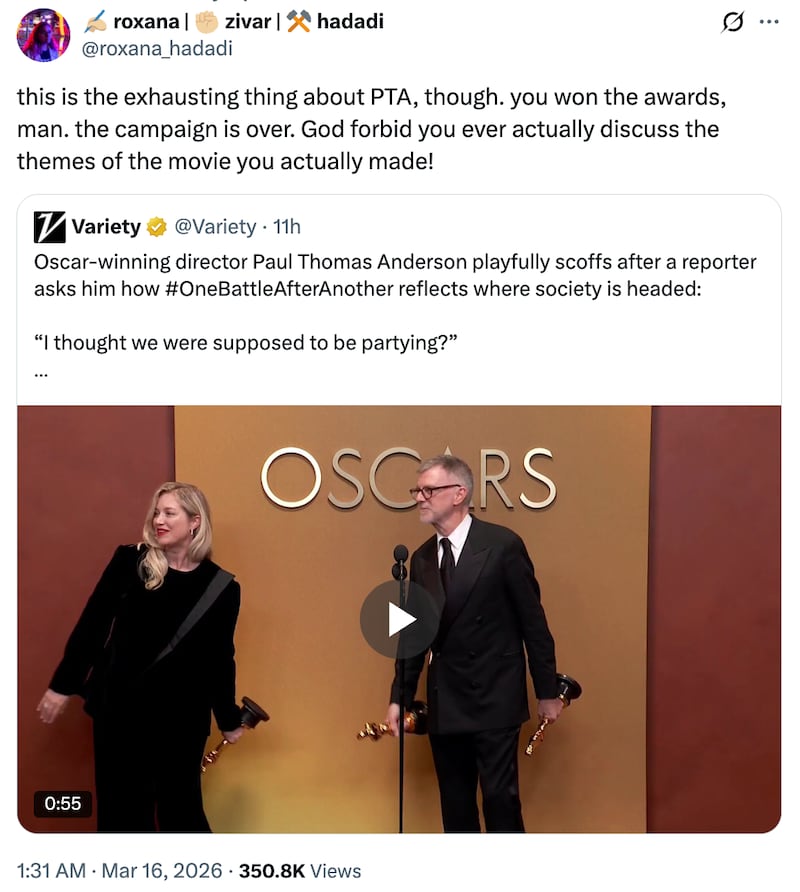
Another wrote that he “meant well,” but that his responses “also reveal the limitations in his thinking.”
The film follows a former radical (Leonardo DiCaprio) pulled back into a chaotic political conflict while trying to rescue his kidnapped daughter (Chase Infiniti). The story explores extremism and race, including through DiCaprio’s own relationship with partner Perfidia (Teyana Taylor) and his mixed-race daughter, but critics argue its attempt to satirize racist attitudes—like the villain’s (Sean Penn) fixation on a Black woman—blurs the line between critiquing those stereotypes and reproducing them.
Wrote Peter Bradshaw for The Guardian, “Intentions can result in the opposite of what’s intended, and that’s why our intentions with other people’s lived experiences need to be handled so carefully... in going so far into being the thing in order to mock it, sometimes the line gets awfully blurry, and it starts to feel like the film isn’t so much pointing at racist/sexist stereotypes and male gaze as becoming those things."
But Anderson has largely avoided a deep dive into that conversation. So has Taylor, who in November told The Hollywood Reporter when asked about her character’s portrayal in film, “Is that not what Black women go through? We are fetishized, especially by creepy motherf---ers... This movie should spark debate.”
Notably, DiCaprio said in December that though he tries to avoid politically polarizing films, he signed on to One Battle because Anderson wrote it “15 years ago,” pre-Donald Trump.
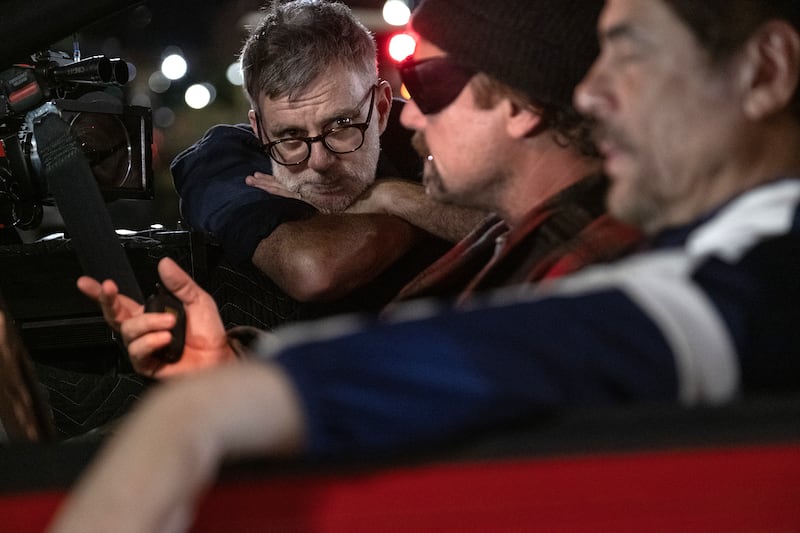
Anderson ultimately addressed critiques about the film’s portrayal of its Black women characters during press questions on Sunday.
“I know a little bit about that critique,” Anderson said. “It’s complicated. We always knew we were trying to make something complicated.”
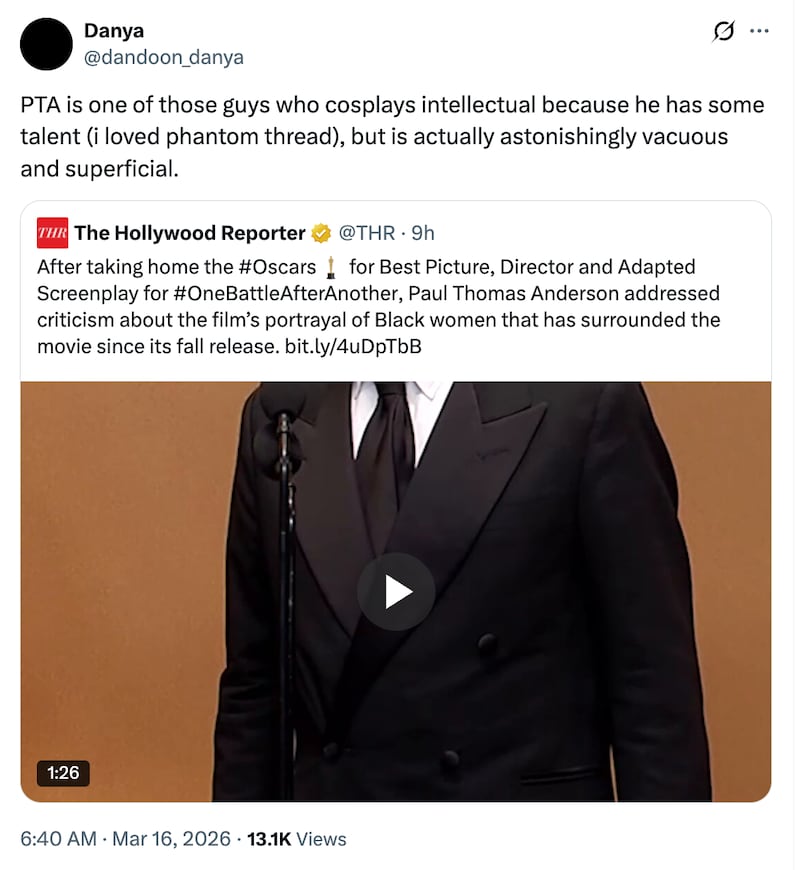
Wrote one X user who insisted he’d still “dodged” the question, “PTA dodged that question about the portrayal of black women because he knows he has no viable explanation.”
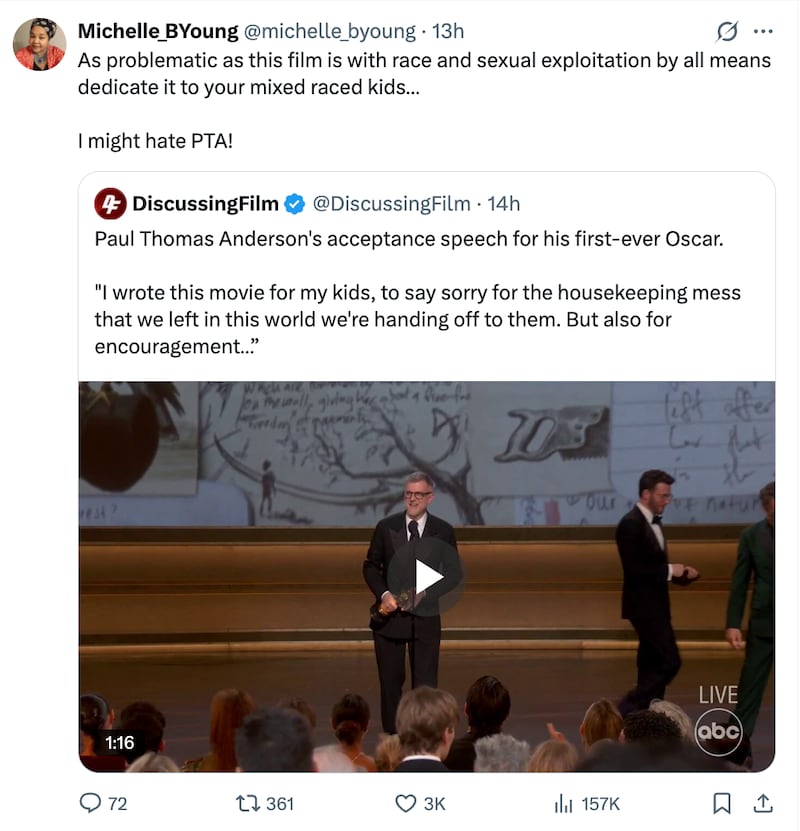
Anderson made similarly vague comments from the Oscars stage when he accepted his award, stating that he’d wrote the film to “say sorry” to his children “for the housekeeping mess that we left in this world we’re handing off to them.”
Anderson shares four children—Pearl, Lucille, Jack, and Minnie—with his longtime partner, Saturday Night Live alum Maya Rudolph.
“As problematic as this film is with race and sexual exploitation by all means dedicate it to your mixed-race kids,” wrote one peeved X user.
Variety’s Owen Gleiberman was also unimpressed with the way Anderson spoke about his film, writing, “One Battle After Another is a movie that has the politics of America today at the very core of its cinematic DNA… In an evening where it took home six Oscars, that reality should have been at the forefront of the celebration of its triumph.”
Gleiberman continued, “Instead, if you tuned into the Oscars but hadn’t seen the movie they saluted most ardently, you might never have had the slightest idea of what the movie was about.”
Anderson ended his Best Director acceptance remarks, “You make a guy work hard for one of these, I really appreciate it.”