
With 2020’s Oscar-winning My Octopus Teacher, Netflix revealed to the world that octopuses are highly intelligent and empathetic. Now, with Remarkably Bright Creatures, it exploits that fact for historic levels of mawkishness.
So saccharine it’s liable to give viewers diabetes, Olivia Newman’s adaptation of Shelby Van Pelt’s 2022 best-seller is a treacly tale of an aquarium cleaning lady, a young stranger, and the octopus whom they befriend—and, vice versa, since this eight-limbed mollusk has his sights set on healing his two-legged pals’ decades-old wounds. Eliciting exasperated laughs at its every manipulation, it may be the most ridiculously corny movie of all time.

Boasting more syrup than the state of Vermont, Remarkably Bright Creatures (May 8) is set in the coastal village of Sowell Bay, where Tova (Sally Field) works as the aquarium’s dutiful janitor. A widow whose grief over her teenage son Erik’s death is so great that she can barely bring herself to enter his bedroom, Tova is a morose loner whose sole companion is Marcellus, a giant Pacific octopus (crafted entirely with CGI) whose inner thoughts are voiced by Alfred Molina.
Marcellus laments that his captivity means he can no longer be alone, and in case the ensuing action wasn’t going to be obvious enough, he states from the start that he and Tova—the sole human he tolerates—share a host of similarities, including that “we both dream of the bottom of the sea. Of what we lost there.”
The octopus is a wise anthropomorphic soul whose every utterance is groan-worthy and whose arrogance is infinite, whether he’s talking about “my boundless wisdom” or stating that “my superior intelligence makes me uniquely attuned to the behavior of all creatures.” His egotism extends to his condescending view of humans and their “incessant jabber,” which Remarkably Bright Creatures intends to be oh-so-adorable.

It’s not. And neither is the film’s habit of spelling everything out in the bluntest, sappiest terms, be it Tova remarking that “Sowell Bay is a fish tank” or Marcellus opining, “The cleaning lady’s heart. I must find a way to heal it. It’s the least I can do to repay her for saving mine.”
Remarkably Bright Creatures treats its audience as if it’s dim-witted, including with regard to Cameron (Lewis Pullman), a twentysomething who lives in a messy van that breaks down just as he arrives in Sowell Bay.
A rocker in a band called “Moth Sausage,” Cameron has just lost his mother and is searching for his rich developer dad, whom he never knew. To earn money for vehicle repairs, he temporarily takes Tova’s job while she recovers from an ankle injury suffered when wily Marcellus escaped his tank. No sooner has Cameron shown up than the octopus deduces that Cameron, like Tova, has a big figurative hole in his heart, and he decides that “helping one might help the other.”
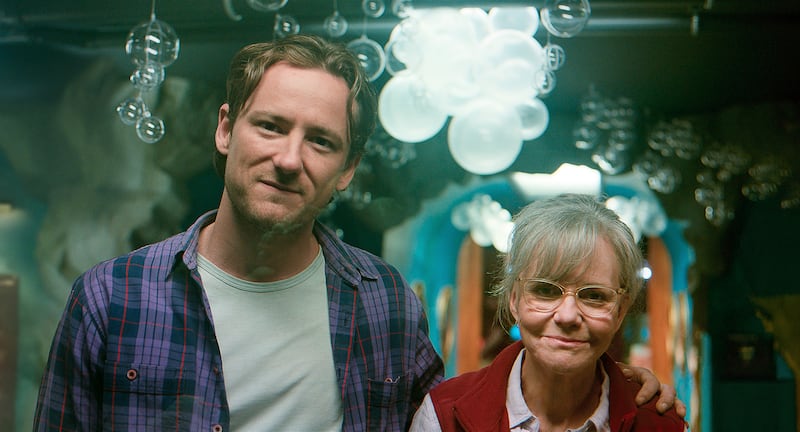
Newman casts her film as a simplistic storybook for adults about recovery, home, and family, and its every hokey gesture makes one want to pull out their hair and scream—or, at least, turn off the TV. Marcellus is basically a magic being whose suckers (capable of touch, smell, and taste) allow him to perceive signals that are “beyond humans’ limited comprehension,” and he spends most of Remarkably Bright Creatures monologuing about how he, Tova, and Cameron are the same, and how he must save them before his time runs out—because, of course, he’s dying.
To do this, he primarily breaks out of his tank (what a rascal!) and holds their hands (what a sweetie!), as well as endlessly blathers to himself in mushy and self-satisfied voiceover.
Two-time Academy Award-winner Field alternates between grumpily shunning others and looking anguished and weepy. Her interactions with her three BFFs (Joan Chen, Kathy Baker, and Beth Grant) are almost as cutesy as their knitting group calling itself The Knitwits.
Tova has reluctantly decided to sell her log-cabin house (which her dad built) and move to a retirement community, and she’s keeping this news from her friends. Despite some early hiccups, she quickly warms to Cameron, a slacker-doofus whose love of Radiohead compels him to perform “I Can’t” (his favorite Pablo Honey deep cut) at an open mic night.
In these and other instances, the slushiness is suffocating, with Cameron striking up a tacked-on romance with local paddleboard expert Avery (Sofia Black-D’Elia) and Tova giving in to the flirtations of country store owner Ethan (Colm Meaney), who shows her that being with others is, you know, not that bad!

Tova takes Cameron to visit his father, Cameron develops a rapport with Marcellus, and the two form a surrogate mother-son bond that’s only outdone in the melodrama department by the film’s foreseeable—and yet still laugh-out-loud schmaltzy—climactic revelations.
All the while, various characters play matchmaker (tee hee!), and Marcellus brags about his cleverness, leading Tova and Cameron “toward symbiosis.” Egregious is barely a strong enough word to describe the depths to which this endeavor tries to preciously amuse and calculatingly pull at the heartstrings, with the material proving moist to the point of moldiness.
There isn’t a single thing in Remarkably Bright Creatures that isn’t either telegraphed from an ocean away or stated outright, but somehow even that is less insufferable than Marcellus’ snobby blather about mankind’s “abysmal communication skills” and comment that he sneaks out of his tank because “my gastronomical satisfaction depends on it.”

Molina’s sage-and-snooty vocal performance is in keeping with the proceedings’ oppressive sentimentality, as is Fields’ turn as an inconsolable woman whose every emotion is written across her face and who’s destined, ultimately, to cry tears of sorrowful joy in the rain. Together, they’re an excruciating pair, and Pullman’s sad-sack Coleman is no better—the type of contrived clown who only exists in Hallmark Channel-grade slop.
Remarkably Bright Creatures is like taking a 113-minute bath in Velveeta cheese, and its goofy gloppiness is relentless right to the end, courtesy of a last-second cherry-on-top bombshell that would be overkill if not for the fact that everything preceding it was beyond excessive.
“There is no quiet like the bottom of the sea,” muses Marcellus—except, that is, the glorious silence that accompanies this film’s conclusion.