
Not since John Carpenter has a horror director burst onto the scene like Zach Cregger, whose first two films, Barbarian and the Oscar-winning Weapons, established him as a generational scary-movie talent, and whose third—and best—feature, Resident Evil, solidifies his status as a maestro of monstrous madness.
A PlayStation adaptation that’s at once spiritually faithful to its source material and yet unburdened by demands for across-the-board fidelity—a tack that was also taken by Paul W. Anderson and Milla Jovovich’s wholly separate six-entry series—Cregger’s latest (Sept. 18, in theaters) is less formally adventurous than his prior behind-the-camera efforts, opting for a pedal-to-the-metal dash into a heart of malevolent darkness. As hilarious as it is unnerving, it’s the rare video game-based film to rock from breakneck start to insane finish.

Cregger’s Resident Evil pivots around an original franchise protagonist, medical courier Bryan (Austin Abrams), who’s introduced dropping off a package at a local hospital. Trailing behind him to echo the Resident Evil titles’ trademark third-person perspective, Cregger instantly elicits close engagement with Bryan, who’s understandably flustered by the less-than-helpful treatment he receives from doctors and attendants. Making things more stressful, he’s just ended a testy call with a girlfriend who’s clearly unhappy with him for his lack of enthusiasm about her pregnancy.
On his way out, Bryan is given an out-of-the-blue assignment to deliver very important (mysterious) cargo to a hospital in Raccoon City. Though that destination is far and it’s snowing outside, the lure of money is enough to entice him to accept. While navigating an icy road, a moment of distraction leads to calamity when he hits a woman (materializing out of nowhere) with his car. Exiting the vehicle, Bryan finds that she’s gone, and he’s none too keen on following the bloody tracks leading into the woods.
Muttering to himself about the awfulness of every facet of his ordeal, Abrams is a riot in Resident Evil, serving as an intensely relatable proxy for an audience that, like him, is conversant with horror-movie and video-game conventions. Over its fleet and ferocious 90 minutes, the film is wink-wink in the finest way possible, nodding to the franchise’s lore (such as the sight of a typewriter on an office desk) and building tension through scenarios that lean into their outrageous danger.

In ways both obvious and subtle, Cregger cops to his audience’s knowledge of such material, and thus it’s all the more entertaining when he still manages to shock and frighten.
That he does—and on multiple occasions—as highlighted by three jolt scares that are as good as any in modern horror cinema. Cregger’s script is a forward-momentum affair that alternates between instances of unsettling quiet and extreme chaos, and it’s not long before things go haywire. Bryan manages to wrestle his victim into his car—her frozen arms outstretched in front of her and her face decorated with a bloody mustache that extends across her cheeks—after which he’s discovered by a police officer. Neither of these developments, however, prepare him for what comes next, and in the wake of a mad confrontation, he flees to a nearby farm in search of safety and help.
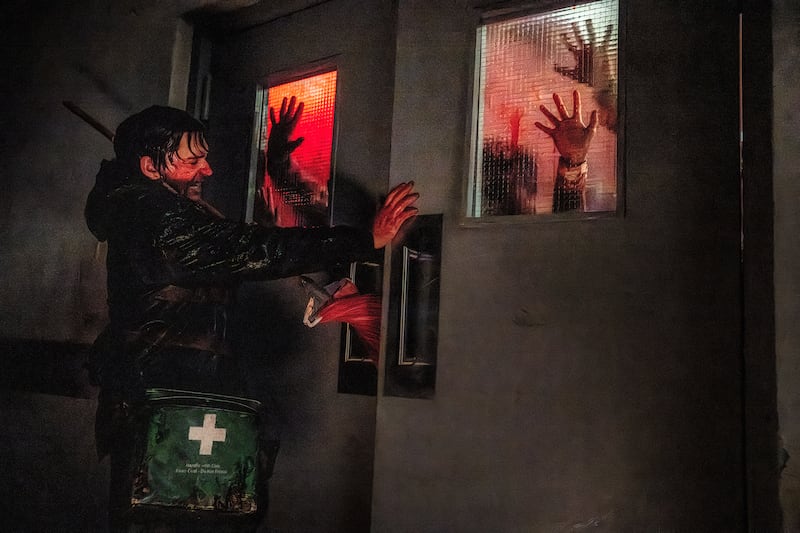
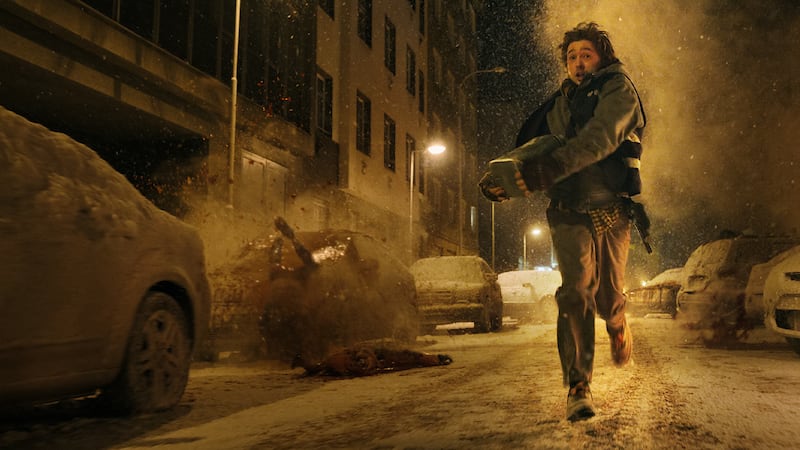
Cregger fashions his film as a theme park attraction designed to make one scream and, immediately afterwards, laugh, and Abrams’ performance boasts the precise amounts of legitimate terror and slapstick goofiness. Slipping, flailing, shrieking, and sprinting for his life, Bryan exudes amusing astonishment and outrage at the nature of his predicament, and those emotions grow exponentially more intense once he neutralizes his pursuers (and a rabid dog) with firearms, only to learn that his adversaries are outright monsters.
Given that Capcom’s beloved games are about quasi-zombie mutants created by a malevolent virus, this is par for the Resident Evil course, but the director puts his own spin on the creatures—literally, as it turns out, courtesy of a hybrid fiend that moves via cartwheel.

Bryan’s turbulent evening takes him from remote streets and creepy barns to darkly lit tunnels, through abandoned RVs, and into a city that’s been overrun by the infected. Each stage of his journey is crafted with video game-ish mechanics, be it shuffling along a narrow ledge or using a ladder to evade a fearsome enemy. Cregger’s regular use of first-person perspective (complete with pans that mimic Bryan’s swiveling head) is another nod to his source material (in particular, its most recent PlayStation installments).
Even so, the proceedings never feel homage-y; the auteur simply knows his stuff and naturally channels the atmospheric and formal spirit of his interactive predecessors.
Bryan’s parcel is, of course, connected to the crisis at hand, although that’s ultimately beside the point, since it functions as merely a MacGuffin-y excuse to have Bryan soldier onward toward his Raccoon City destination—which, courtesy of a run-in with Paul Walter Hauser’s Umbrella Corporation employee, winds up being a hospital’s top-floor laboratory.
Cregger pits his everyman against a handful of inventive beasts and, better yet, concocts nerve-rattling situations that demand, and receive, creative solutions. Bryan’s irritation with his plight is punctuated by a strong recurring gag about padlocks and is heightened by his dwindling supply of ammunition (another canny allusion), and Abrams—following breakout turns in Euphoria and Weapons—makes him a recognizable and likable sort of hero.
In terms of imaginative structure and thematic depth, Resident Evil plays it safer than Cregger’s previous ventures. Nonetheless, his ability to distill the games’ fundamental elements and employ them for an original story is no small feat, and it’s a far more successful approach than the previous attempt at bringing the series to the screen, 2021’s dismal Resident Evil: Welcome to Raccoon City.
The director translates rather than just duplicates, and the result is a go-for-broke nightmare that takes no prisoners through to a finale that’s too preoccupied with being adrenalized and nasty to bother with pat happily-ever-afters.
A skillfully constructed thriller that doesn’t waste a second on superfluous backstory or unnecessary world-building, Resident Evil isn’t just a AAA cinematic rollercoaster—it’s a prototype for how to do justice to gaming’s most popular hits.