
One thing you learn from talking to the dead is that the dead don’t talk back. This is reassuring; my years watching horror cinema have taught me that when the dead start speaking, the world tends to go haywire. There’s something to be said, too, for recycling the same groaners and anecdotes you shared with your captive audience in life, without them reminding you that they’ve heard this one before. But the trade off for conversations like these is that the dead don’t listen, either.
Watching Hans Block and Moritz Riesewieck’s new documentary, Eternal You, weeks after my mother died in December gave me a grim clarity on its subject matter. The film, which first premiered at the 2024 Sundance Film Festival, studies the growing industry of “death capitalism”—effectively, the tech sector’s macabre attempt to commodify the afterlife and further colonize digital life by preying on the bereaved.
Ever wish you could ring your dead grandma for sage wisdom and gushing adoration? You can, for the low price of $10 to Jason Rohrer’s Project December!
Except Rohrer himself admits that you can’t. Christi Angel, one of Block and Riesewieck’s interviewees, recounts an exchange she had with the chatbot posing as Cameroun, her late partner, where the AI claims he is “in Hell.” That isn’t what anyone wants to hear from the program they’re paying for to interact with their deceased loved ones, especially a practicing Christian like Angel. If Project December is intended for solace, her encounter seems to be a bug, not a feature.
When Eternal You cuts to Rohrer for his insightful response to Angel’s ordeal, he chuckles. “If she wants my opinion on it, I’ve got some bad news for her,” Rohrer says. “Like, [Cameroun] doesn’t exist anymore.”
Rohrer peevishly justifies Project December’s function with a classic tech bro defense: rejecting any shred of responsibility to his users, because responsibility means relinquishing the freedom to innovate without considering consequences or taking precautions. That users might need occasional reminders that Project December is an illusory experience chafes Rohrer as much as empathy for Angel eludes him.
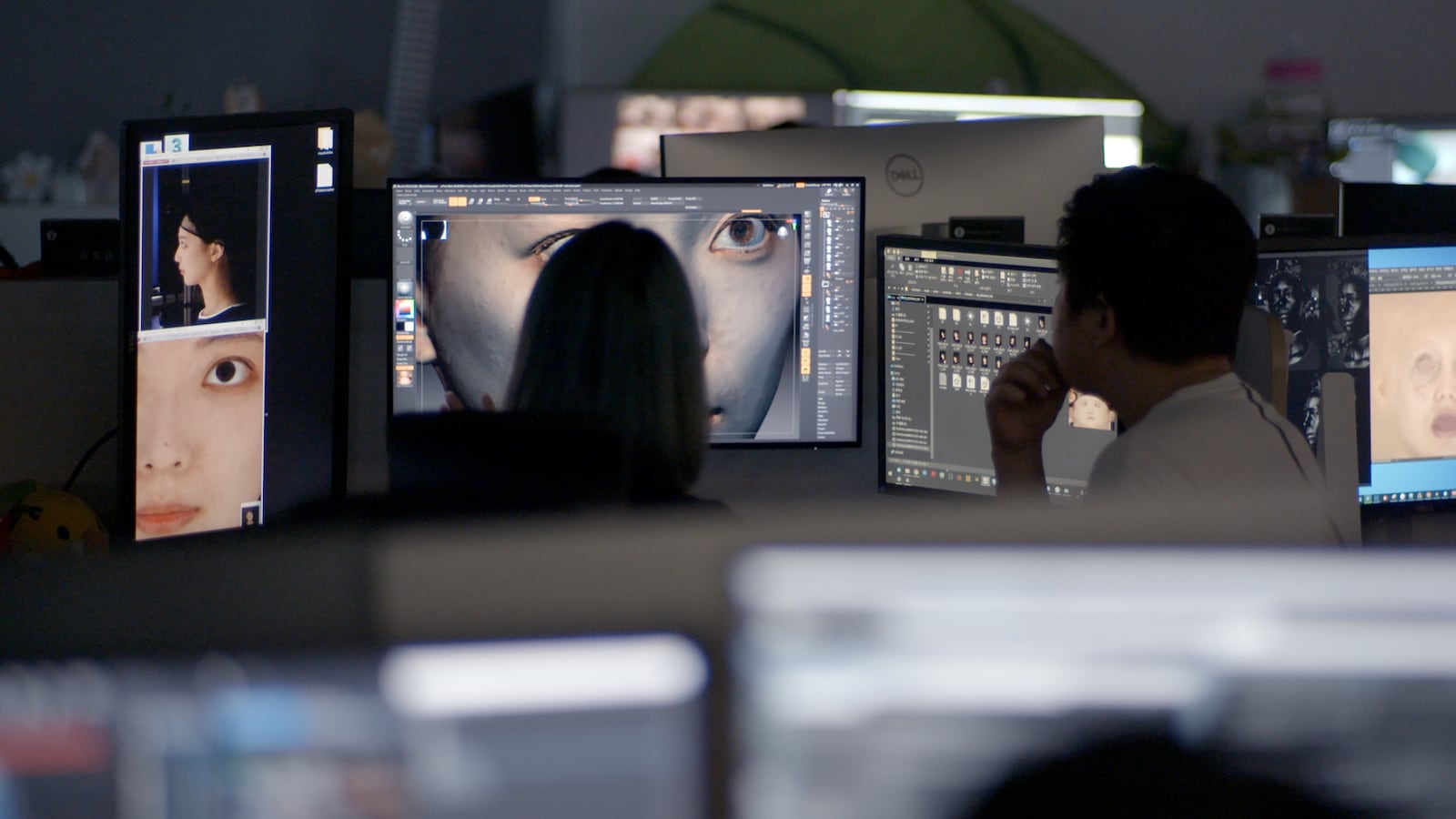
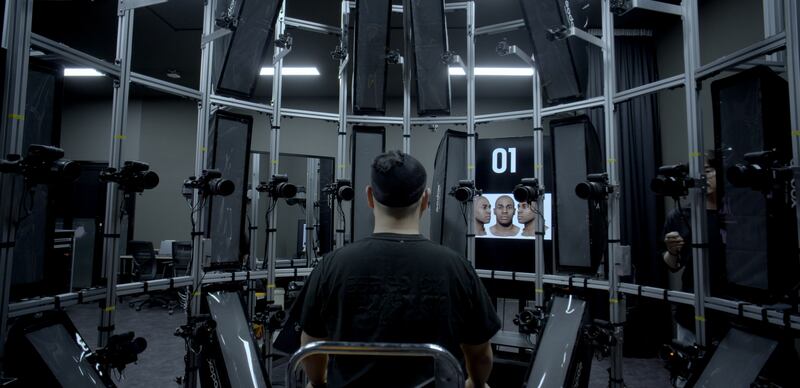
As Eternal You introduces its audience to other pioneers in death capitalism, this thinking metastasizes into one of tech culture’s key mores. Mark Sagar, co-founder of “ethical” AI Assistants company Soul Machine, appears unconcerned by the ethics of using his own newborn baby as a model for designing a virtual newborn baby in his pursuit of perfecting a “virtual interactive person.”

On the other hand, Justin Harrison, the founder of the digital afterlife startup YOV (You, Only Virtual), makes a bristling and wildly discordant comparison between death capitalist ventures and the invention of CPR. “F--- death,” he nearly spits, “and the hyperbole about, ‘Oh, it’s nature and you have to deal with it.’”
To Harrison, death is “clearly not a natural thing that everybody wants to happen.” He’s half wrong and half misguided; nobody wants to die, but it is a natural part of life. My mother didn’t want to die, especially not while lying in a hospital bed, and certainly not without seeing her family—my dad, my brother, and the families we’ve made as men—one more time. I thought we had time. Then, the morning came when Dad called me to tell me that Mom had died just minutes before I woke up. Time ran out before I could check the clock. That’s life; that’s death.
If I surrendered the digital pieces of Mom that Rohrer and Harrison’s glorified séances require to invoke her spirit, would I be swayed to buy the parlor trick? Not at all. I’ve seen Eternal You; if there’s a faster way to dispel the fantasy they’re eager to sell by exploiting people’s grief, it hasn’t come out yet. For another, I’ve sat with my mother, hours after she died and moved on to whatever follows life on this earth, assuming anything does. (Unlike Angel, I’m not a Christian and I am open to the idea that Heaven is an art deco repertory theater that plays my favorite films, stocks my favorite snacks, and pours my favorite beers.)

No AI can fool me into accepting the words they produce as hers, because no AI can amount to a shadow of who she was: the woman who made me, yes, but an accomplished, veteran nurse practitioner and midwife, a mentor beloved by those she trained, a professional respected by those she worked with and whose lives she changed in performing her job, and the dictionary definition of a grandmother, to boot. My kids can’t hug an avatar; a chatbot can’t read to them while cradling them in its arms.
Eternal You confirms, with authority, that the promise companies like Project December and YOV make to users is a demented and frankly self-aggrandizing joke; they’re focused on cheating death rather than helping people process it, hocking intangible facsimiles of the dead at a psychological cost. If there’s more to the end of life than dying, we’ll probably never find out. But there’s more to my mom than a ruse, even one as sophisticated as Rohrer’s, could ever hope to capture.