
Socialism is so dire and destructive that even when For All Mankind’s creators reimagine the Soviet Union as triumphant in the 20th-century space race, they can’t stop portraying the country as a hellhole of paranoia, deceit, betrayal, cruelty, and misery.
That depiction is the backbone of Star City (May 29), a spin-off of Ben Nedivi, Matt Wolpert, and Ronald D. Moore’s Apple TV sci-fi series that views its events from the USSR’s perspective—a vantage point that underscores that even in victory, there’s no progress in a socialist system, only more of the same tyrannical repression and suffering.
It’s a shockingly grim complement to the streamer’s inherently hopeful hit, although that doesn’t mean it’s lesser. Rather, with a bleakness that’s as compelling as its predecessor’s optimism, it wrings taut drama (all in English, despite its setting) from the story of Eastern Bloc men and women trying, at great personal and moral risk, to foster innovation under the thumb of authoritarianism.
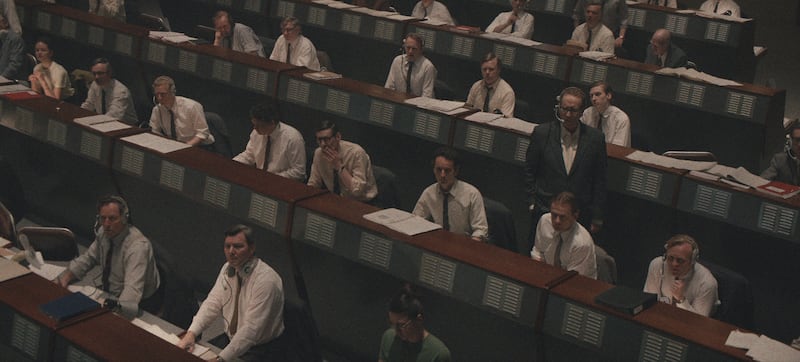
Star City doesn’t begin with a recap of alterna-history events à la For All Mankind, largely because very little is different in the Soviet Union following the country’s trailblazing 1969 moon mission. The massive achievement is the handiwork of the Chief Designer (Rhys Ifans), who’s awarded a medal for his feat but told that his identity must remain secret and that he has to stay in the country indefinitely lest the dastardly Americans try to get their hands on him.
Such is the atmosphere of the USSR, including in the office where new recruit Irina Morozova (Agnes O’Casey) is assigned to listen to wiretap recordings. Her primary focus is the home of Valya (Adam Nagaitis) and Tanya Markelova (Ruby Ashbourne Serkis), the former a cosmonaut who’s preparing for a mission with buddy Sasha Polivanov (Solly McLeod) that will make their third comrade, Yana Akhmatova (Niamh Algar), the first woman to set foot on the moon.
That is not to be, since Irina’s surveillance-apparatus colleague determines that Yana has withheld personal information which suggests she’s a spy—thus netting less qualified cosmonaut Anastasia Belikova (Alice Englert) the prized gig. All of this takes place under a cloud of secrecy and suspicion that’s so thick you could cut it with a saber, and much of it is fostered by KGB baddie Lyudmilla Raskova (Anna Maxwell Martin), who rules this roost with an iron fist.
Lyudmilla is as cold and austere as her surroundings, and Star City drenches its action in dull grays and blacks to emphasize the harshness of this culture and its day-to-day operations, in which everyone must toe the line, no one is safe from accusations, and each citizen is incentivized—for career advancement and their safety—to keep an eye on their neighbor and report any dubious activity.
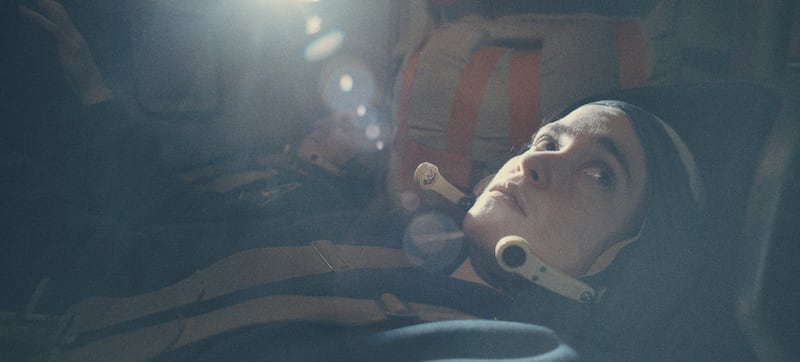
In every way the opposite of For All Mankind, whose narrative (and characters) are driven by an uplifting belief in man’s capacity for advancing the species through hard work, risk-taking, collaboration, and dreaming big, Star City is a nightmare of fighting for progress in a place that values stasis, control, and conformity. For Irina, navigating her new environs grows thorny once she deduces that Yana might not have been as guilty as Lyudmilla and others believed. Her gradual involvement in Valya and Tanya’s situation helps her climb the socialist ladder—no surprise given that, as fans of Nedivi, Wolpert, and Moore’s original series know, she eventually ascends to a position of considerable space-program power.
To disobey orders is to court intense trouble in Star City, and those who do so are generally punished in an unpleasant manner. Then again, there’s so little freedom in this Soviet Union that opportunities to break the rules or challenge superiors are basically nonexistent, which is why Anastasia and Sasha agree to an arranged marriage to bolster her squeaky-clean paragon-of-the-USSR image.
Even so, minor rebellions abound, as does subterfuge, perpetrated by covert American operatives, turncoat espionage agents, and even the Chief Designer, whose desire to reach Venus is rebuffed by his commanders, thereby prompting him to devise clandestine plans to beat the USA to another interstellar destination.
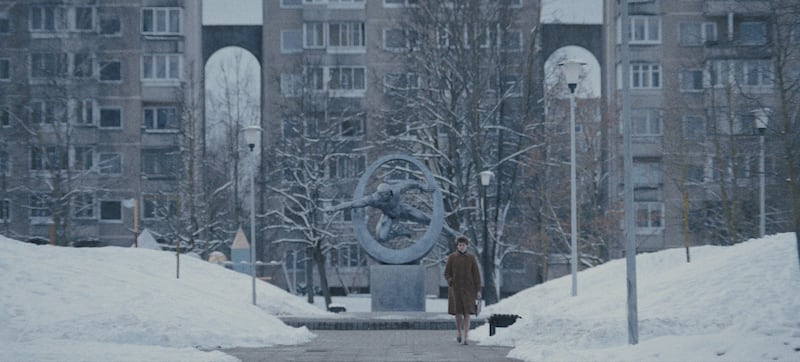
As it reveals the numerous entanglements ensnaring its characters, all of them the byproduct of socialist despotism, Star City comes to resemble The Americans. Like that celebrated thriller, an air of doom hangs over the series, and not simply because—thanks to knowledge about how For All Mankind plays out—certain plot threads are destined to end in disaster. Shot in muted hues and in tight, claustrophobic interior spaces, the show is defined by constriction, right down to a credit sequence whose final aerial image paints Star City as a remote, hermetically sealed base with no exits.
Considering Star City’s overarching dourness—as well as the fact that most of its characters are enemies of For All Mankind’s beloved American characters—it’s initially difficult to emotionally latch on to any of its protagonists. Nonetheless, by the first season’s midway point, that hurdle is easily cleared, courtesy of sharp scripts that underline how everyone is twisted, mangled, and corrupted by a Soviet state that encourages, if not demands, conniving and heartless behavior.
Self-preservation comes at a high cost in this world, and a perpetually ominous score and equally haunting direction (from Nick Murphy, Stefan Schwartz, and Kasia Adamik) capture the pain, fear, and longing wrought by the USSR’s totalitarianism.
At least in its first five episodes (which were all that were provided to critics), Star City is at once wedded to its America-centric counterpart and distinctly independent of it, its tale so self-contained in Star City and its surrounding area that it might as well be taking place on a lunar base.
Consequently, whereas its ancestor stirred the heart, this series merely troubles it, italicizing the many major and minor horrors perpetrated by the Soviet machine and the innocent (and not-so-innocent) men and women caught in its gears. Still, that portrait does get under one’s skin, presenting a vision of communism so awful and terrifying that it can’t help but serve as a reminder of why this alternate version of history never actually came to pass.