Welcome to UNMISSABLE, the Daily Beast’s Obsessed’s guide to the one thing you need to watch today. Whether it’s the most gripping streaming show, the most hilarious comedy, the movie which you’ll never forget, or the deliciously catty reality TV meltdown, we bring you the real must-see of the day—every day. Sign up for our daily UNMISSABLE newsletter now.
Ryan Murphy is one of modern television’s most successful impresarios. And his fondness for gory, tawdry, titillating, campy horror stories continues unabated with The Beauty, an FX series (January 21, also on Hulu) that co-stars Ashton Kutcher in a remixed variation on his ex-wife Demi Moore’s acclaimed 2024 feature The Substance.
A sturdy bounce-back after last year’s All’s Fair, Murphy’s latest borrows bits and pieces of Moore’s recent big-screen hit and synthesizes it with elements of The Fly, Seven, Aliens, The Silence of the Lambs, and The Matrix to concoct a satire that’s obvious, unoriginal, and yet not without its lurid and flamboyant pleasures.
Especially in its later going, it takes its fantastical “what if” premise to uniquely off-kilter places, in the process transforming its maiden season into a tantalizing jumping-off point for even loopier potential follow-ups.
Blending sex, violence, romance, mystery, and sci-fi gruesomeness without a care for moderation—or, in many cases, narrative rhythm—The Beauty is a tale about insecurity, identity, self-improvement, and the dangers of striking Faustian bargains for unparalleled attractiveness, youth, and vigor—the last of which is made clear by its opening scene.

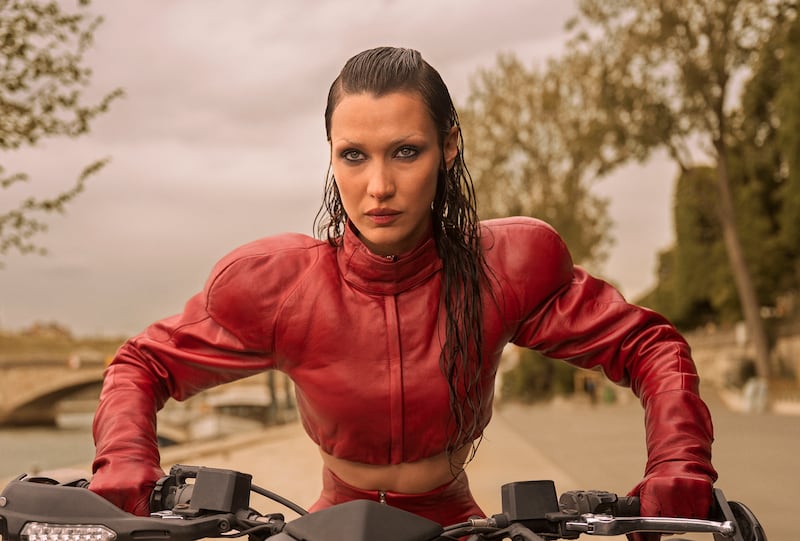
At a Paris fashion show, a model (Bella Hadid) goes sweatily, savagely off the rails, attacking everyone in sight while seeking out, and chugging, any water bottle in her vicinity. Her rampage is hectically staged and not nearly as exciting as Murphy and co-creator/co-writer Matt Hodgson intend it to be, but it does conclude with a nasty surprise: Hadid’s runway strutter literally explodes from her bizarre condition.
Getting to the bottom of this mess is the job of FBI agents Cooper Madsen (Evan Peters) and Jordan Bennett (Rebecca Hall), who are in a steamy relationship despite both claiming they don’t want anything serious and are thus free to see others. The looks Cooper and Jordan share indicate they’re more interested in each other than they’re willing to admit. Yet figuring out their commitment issues takes a backseat to wrestling with the Paris massacre, whose victim, it turns out, was infected with a designer virus that’s like a cross between HIV and rabies.
Worse, this incident isn’t a one-off; similar detonations have been reported in London and Berlin. Before long, Cooper and Jordan are sent to Italy to investigate the demise of another model-influencer who’s been ritually murdered in a bedroom whose wall features a bloody Egyptian hieroglyph for “beauty.”
Between this initial action (including Jordan talking about getting breast implants to feel better about herself) and an embargoed subplot involving an incel named Jeremy who visits a clinic called “A NU U,” The Beauty immediately sets its sights on societal body-image mania, complete with references to plastic surgery, Ozempic, and the universal desire to feel desirable.
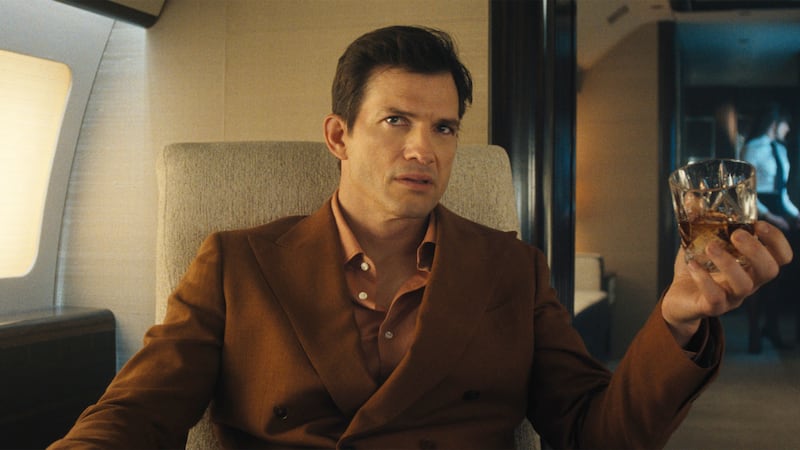
At the start, it keeps its audience at least one step ahead of its characters, even with regards to the Corporation (Kutcher), a biotech billionaire who’s introduced stating “beautiful people don’t think the rules apply to them” while having his Assassin (Anthony Ramos)—who wears a metal eye patch and swanky suits—fell a target with a nerve toxin.
The Corporation is clearly the villain behind this madness, and if the show can be laughably ham-fisted—the models have been made literally and figuratively hot to the point of spontaneous combustion—it’s nonetheless in line with Murphy and Hodgson’s prioritization of sultry outrageousness over subtlety.
The source of this crisis, it’s eventually revealed, is the Beauty, a revolutionary single-injection treatment that instigates a radical physical makeover, turning people into jaw-droppingly gorgeous men and women who are free of all defects, weaknesses, and illnesses. The Corporation views it as a paradigm-shifting breakthrough poised to earn him trillions, although The Beauty spends its first episodes demonstrating the downsides to the groundbreaking therapy, such as a calamity at the Condé Nast cafeteria where a Vogue assistant editor goes splat in front of Manny (Ben Platt) and Brittany (Meghan Trainor, making her acting debut alongside Hadid and Amelia Gray).
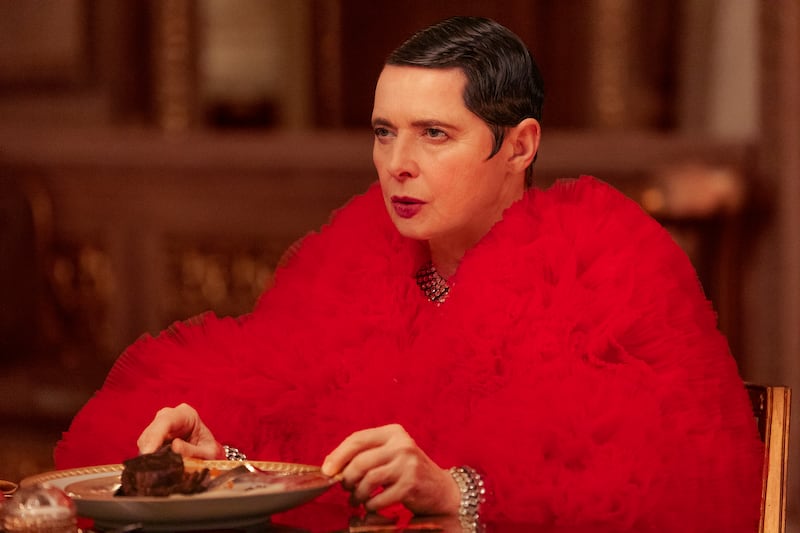
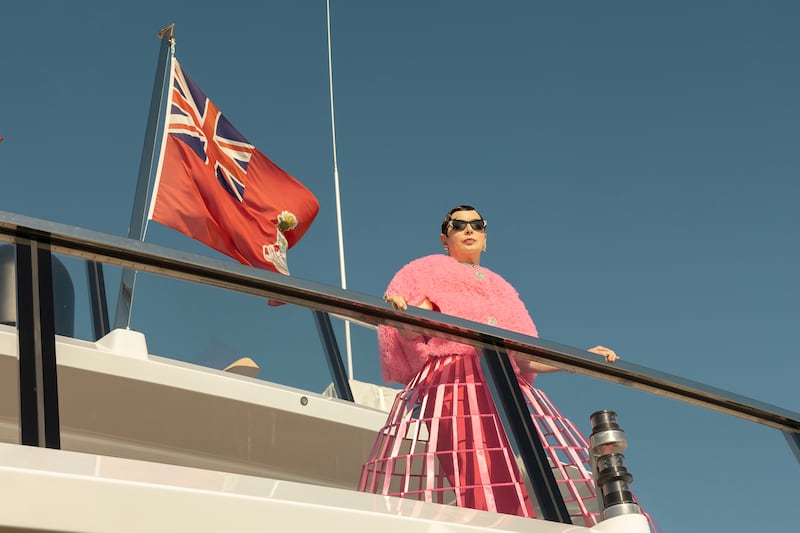
It additionally puts Cooper and Jordan in mortal danger, thereby cluing them into the fact that someone wants to cover up this affair, all of which leads back to the Corporation, whose wife (Isabella Rossellini, dressing like she’s trying out for the Broadway production of Moulin Rouge!) spits at him, “You are the biggest monster on this planet. Every day, I pray for your death.”
The Beauty picks up steam in its middle passages, thanks to a prolonged flashback that details the origins of the Corporation’s involvement with the Beauty and the increasingly wonky rapport between Cooper and Jordan, whose dynamic is radically reconfigured by their case.
The back-breaking, limb-cracking, torso-thrusting process initiated by the Beauty grows less interesting with each successive depiction. And Murphy and Hodgson underline, italicize, and highlight every topical parallel between their out-there tale and contemporary life. Couple that with incessant eroticism and luridness, random pop culture references (see: Christopher Cross), and glossy, showy widescreen visuals, and the series sticks closely to the formula that’s made its creator’s American Horror Story and Monster such compulsively watchable pulp.
Murphy and Hodgson’s conceit doesn’t always make sense—in particular, a trans subplot pushes the Beauty into an even grander fairy tale realm—but throughout, rationality takes a backseat to glitz, glamor, and gnarly goofiness. Just as Peters and Hall’s chemistry bolsters its introductory chapters, Kutcher’s haughty malevolence invigorates its back half, during which a host of bombshells—involving cyborgs and mutations—ups the bonkers ante.
Thinking about any of this craziness for more than a few seconds is apt to expose its inherent illogicality (even within the clearly established confines of its fiction). Still, it intriguingly imagines the many reasons people might be seduced by a drug promising physical perfection and, also, the lengths to which they’d go to acquire it.
The Beauty is a small-screen B-movie that, at 11 episodes, would feel distended were it not for Murphy and Hodgson finding multiple angles from which to approach their premise, and a finale that sets the stage for expanding the series’ purview and reshaping it into a Succession-style nightmare.
It’s a show about change that, if it’s smart, won’t stop evolving.