John Wilson is one of the funniest people in America: a filmmaker who turns the mundane into something hysterical, insightful, and moving by using New York City, its inhabitants, and his own life as fodder for ruminations on topics both big and small. Now, in the wake of his brilliant three-season HBO series How To with John Wilson, he takes his unique and uproarious non-fiction voice to theaters with The History of Concrete.
As its title implies, Wilson’s latest—which debuted at January’s Sundance Film Festival and premieres nationwide on Sept. 18—does not boast the most thrilling of subjects. But that un-sexiness is part and parcel of the documentary’s eccentric hilarity.
Assuming his TV series’ basic form, The History of Concrete is, as promised, about the material that helps make the modern world. It’s also about Wilson’s own post-television path, Hallmark holiday movies, tattoos, ATMs, local musicians, and the fundamental impermanence of everything—including the metropolis he loves.
A winding collage of on-the-street vignettes, character profiles, and B-roll jokes which he drolly narrates, it’s part autobiography, part urban portrait, and part philosophical treatise, all of it punctuated with shrewd juxtapositions, clever revelations, and juvenile non-sequiturs.
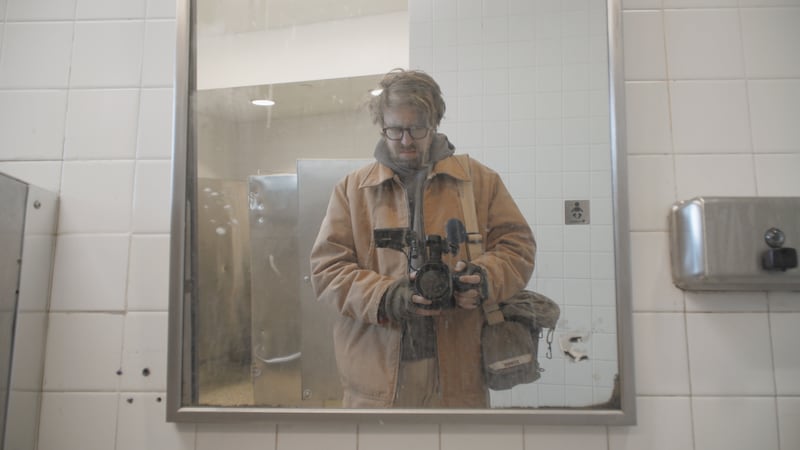
The History of Concrete solidifies Wilson’s status as a great chronicler of contemporary New York, not to mention himself and the human condition. Unlike anything else in cinema, his maiden feature is that rare thing—a true original—and is even more electrifying for being so unpredictable, finding rewarding avenues of inquiry around every street corner.
Consequently, it was an honor to sit down with the idiosyncratic artist to discuss all things concrete, NYC, and the inimitable non-fiction comedy he continues to pioneer.
Walking to this interview in Manhattan, I passed a driveway where a random elderly New Yorker in a backpack was playing a discarded stand-up piano, and I thought—this is the perfect prologue for a John Wilson interview.
You could have your own TV show [laughs].
When you’re without your camera, do you ever fear missing unexpected sights like that?
I do have a bit of anxiety around when I have my nice camera versus when I don’t. But I always have my iPhone with me, and that fills in every other gap. There’s a lot of iPhone footage in The History of Concrete, just because that’s the right tool in a lot of ways. Like the Kim Kardashian dinner thing—that was all on my iPhone, just because you need to be inconspicuous in certain ways. The tool should match whatever the requirements of the room are.
I thought that would be discreet enough, but Kim still seemed to clock that I was filming the entire time.
Did that lead to any discomfort?
Yeah. I mean, how often are you filming a four-minute uninterrupted shot of a person you’re eating dinner with? But I had never seen an uncut shot of Kim Kardashian before. There’s something about that. Whatever that is, I wanted to have it, because every piece of media you see of that family is just carved up like crazy. You very rarely see something like that.
Did you ever consider making The History of Concrete differently than How To with John Wilson? Or was continuing its format always the plan?
I landed on this format a while ago, and I think some of the struggle with pitching the film—which is in the film itself— is that people did want something different, but it felt arbitrary to me. Their value system is kind of strange. They value change and pivoting to different things, and I understand that and appreciate that in a lot of ways. But I didn’t land at this format accidentally. I just think it’s the right way to do a lot of things.
Like make a movie about concrete.
I wanted to make the definitive movie about concrete, and it’s like a prequel to the show in a way. It really gets to the literal foundational material for a lot of the stuff that you saw in the show, and it’s what everything else that I’ve been working on, up until that point, was built on.
I was overthinking it a little too much when I was pitching the movie, because everyone seemed to have this idea of what they wanted next for me, and I started to really resent that. I needed to trust the fluidity of the process that I was already familiar with. I’m tired of hearing what everyone thinks I should be doing. I just need to do it the way that comes naturally and feels honest to me. Then, I can fit in what they think it should be—but, you know, maybe it’s slightly tongue-in-cheek. I both embrace and betray their instructions in equal measure in a lot of the movie. I wanted to make them also feel like they were right in certain ways—which was another way of chopping my ego down a tiny bit.
Was getting funding for The History of Concrete also complicated by the fact that you were discovering the film as you made it?
Yeah, you’re right. I think pitching an open-ended non-fiction project is intimidating for any director. You’re asking them to come on a journey with you with no resolution, no scripts, no nothing. And I think an added layer of difficulty, especially with the stuff that I like to do, is that I often get tired of the assignment I’ve given myself and need to revolt against my own initial intuitions in certain ways.
Any investor would have fully checked out by this point, hearing something like that.
How do you manage that situation?
You have to do enough of it to get to a point where you can show people what’s going on. Then, you might be able to get some money in the last couple of miles. At least, that’s what happened with this project.
What’s your process for making a film like The History of Concrete? Does it begin with compiling B-roll material on the street and then crafting a narrative, or does it start with the primary idea and grow from there?
My resting state is harvesting random imagery that doesn’t have any context or purpose. Where part of the narrative started to form with this movie was going to this Hallmark [movies writer’s] workshop. I had no idea what that was going to be part of, but then I also wanted to make this concrete movie around the same time. I was struggling with structure and form, and I just needed to have some type of structure to work from, even if I throw 100% of it out. I have all this material that doesn’t have a home, and I really adore it, and I need to basically create a container to fit all of it into so it doesn’t get corrupted or lost on a hard drive somewhere.
Once I have this project that I fit all the material into, and the farther away that you get from the subject matter with the imagery, the funnier and, I think, more profound it can sometimes get. Then when the movie’s done, I feel this wave of relief. The archiving of this material is crowdsourced, and I don’t need to worry about losing it.

Were there any particular discoveries during filming that helped shape its direction—such as, say, the GumBusters business that cleans gum off NYC’s sidewalks?
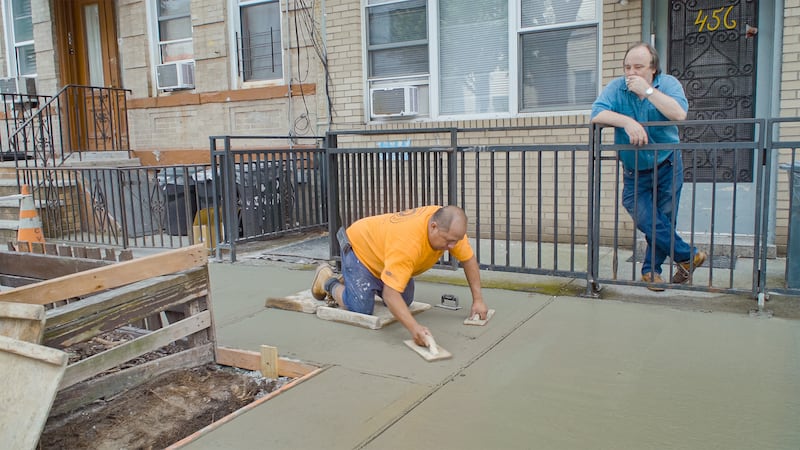
Well, GumBusters was day one, because I had to think about who actually cared, aesthetically, for the concrete in the city. That was the one guy.
As for discoveries, the tattoo preserving thing [Save My Ink Forever, a business that frames deceased individuals’ tattooed skin] was a real non-sequitur at the time. I happened to be nearby, and there was a very tenuous connection from another subject in the film, and I knew that I had to film it just because I found it interesting and hadn’t seen any coverage of anything like this.
I do a lot of stuff like that and then try to think about how it might fit or strike certain themes in the movie. With the tattoo preservation stuff, it became about historical preservation in the way that neighborhoods or cities are preserved. And I was trying to critique my own way of thinking, because I feel like I’m very pro-historical preservation— at least, superficially—but then you think about something like that, and where do you draw the line with what’s preserved? What’s grotesque?
In the film, you note that NYC ATMs aren’t allowed to be fully on the sidewalk. Why is that?
I’m not really sure. I went through the sidewalk guidelines and rules when I was doing research, and it’s a lot of really weird stuff. But yeah, I don’t know. Money just can’t touch the sidewalk. I think it could be that simple. Or it might just be a larger thing about how you cannot have basically anything fixed to the sidewalk except for, like, a mailbox.
What drew you to the Hallmark workshop? Were you interested in the movies themselves, or the process of making them?
It was just sheer boredom that brought me there. [laughs] There was the writers’ strike, and I get these emails that I usually ignore from the WGA about different functions that they host. This one felt really special for some reason, and I went with my little handicam and filmed it. In fact, I almost didn’t film it. I was going to go and genuinely absorb whatever she was saying, because I don’t think you’re supposed to be filming in rooms like that. But I started recording, and no one told me to stop, so I kept doing it.
It’s become one of the most memorable parts of The History of Concrete for a lot of people I’ve talked to, because the writing process can be such a black box. Nobody really knows how anyone does it in a lot of ways, and everyone has a unique approach to it, so it’s cool to hear about how things are written.
It is eye-opening.
It’s so bizarre. I feel like I may not have necessarily taught you how to write a Hallmark movie by the end of it all, but the larger mission of making art feel accessible and possible—that’s the stuff that spoke to me the most growing up. The stuff that gave you all the information you needed to do something. Sometimes it’s better not to know, but I’m too curious.

Your work, including The History of Concrete, is really fascinated with the way New York operates on a macro and micro basis. Was there a point at which you consciously decided that the city would be your creative focus?
This is the best place I could think of to do it. I grew up on Long Island for the most part, and the city was such a rich environment. I think New York is such a great stand-in for other cities too, because there are waves of progress that follow in different cities based on what happens here.
I initially started shooting stuff in this style when I was broke, because it almost made it seem like, just by being on the street, it had more production value. And you can fool people into thinking, at least subconsciously, that there’s some kind of valuable message here, potentially. I also feel that everyone has a relationship with New York City in a weird way. Even if you’ve never been here, you know of it conceptually as this metropolis.
Have you ever considered shooting in another city?
I lived in Boston for a little while, and I didn’t really feel the same kind of drive to investigate what works and what doesn’t there. [laughs] The city is really clean in a lot of ways. There were bike lanes. There was infrastructure. Cambridge was really nice. But I needed a place that has a few more warts. I don’t want a city to be perfect.
I think there’s a lot of beauty in the constant tension between people that try to perfect it and how our species behaves in it.
Permanence—and impermanence—is a major theme in The History of Concrete. Do you envision your role as a preservationist of a city that has a rich history and yet is also constantly evolving?
Yes, I think the work is preservation. I think the moving image does that best in a lot of ways. Even if you fully mute my movie and just watch the imagery, it’s something we didn’t have before. I like to capture the stuff that’s in between the bigger moments. Everyone’s cameras are fixed on this political figure or that catastrophe, and I feel like we’re missing out on a lot of minutiae in terms of what we capture and preserve.
I think so much about the movie The Social Life of Small Urban Spaces, which is essentially a study of how people use benches and parks. There’s so much subtlety in there that is so cool to watch with historical distance. Everything is such a performance these days with what people capture, and I think we need to maybe redirect our attention and try to capture stuff that is more transient than you realize.
As someone who grew up in and around the city, I can say that New York’s real character is as much about the guy I saw playing the piano as the Empire State Building and Times Square.
Yeah, the piano. That man’s not going to be playing that piano forever.